
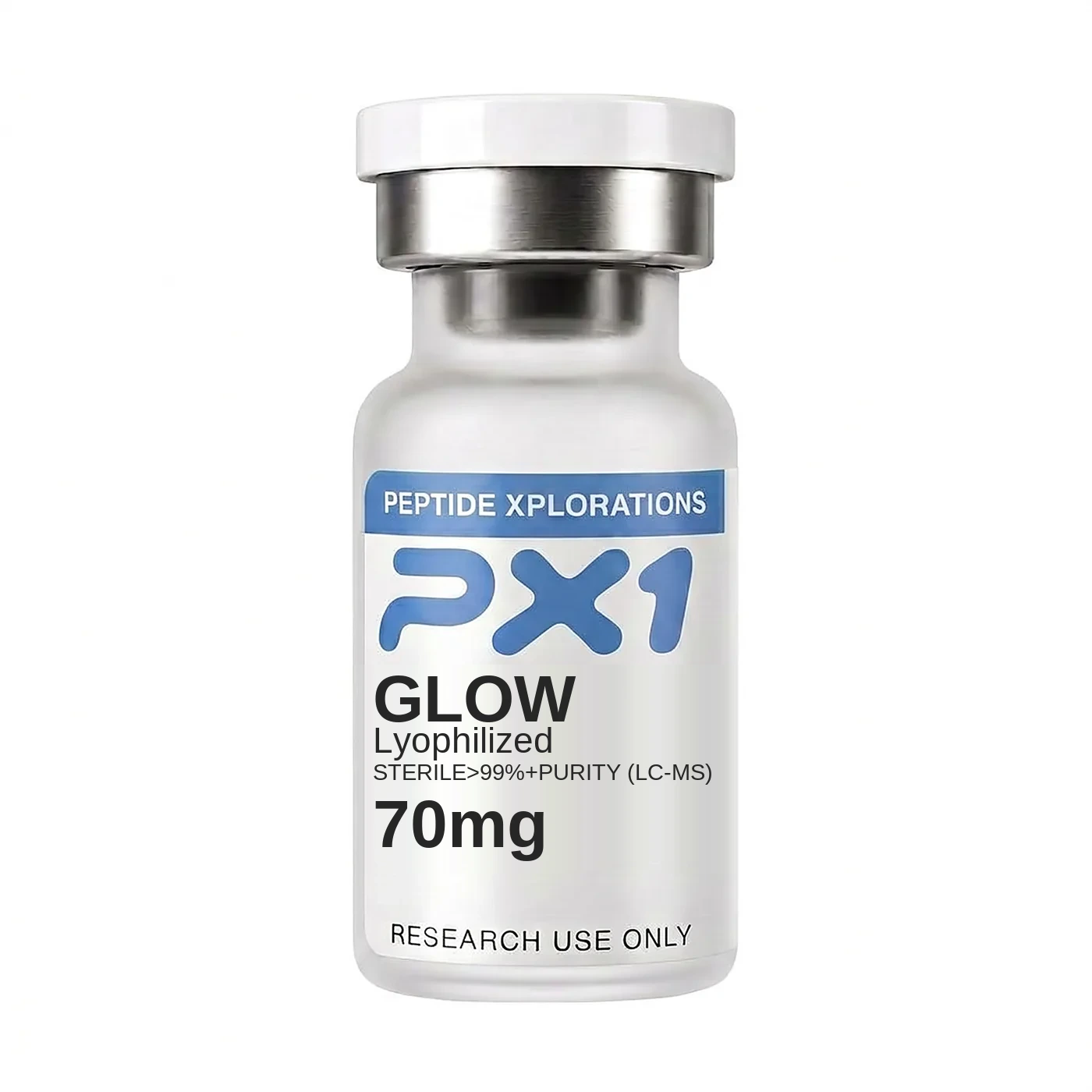
What is BPC-157?
BPC-157 (Body Protection Compound-157) is a synthetic 15-amino-acid pentadecapeptide with the sequence GEPPPGKPADDAGLV, derived from a partial sequence of body protection compound identified in mammalian gastric juice. It is one of the most extensively studied cytoprotective research peptides in the preclinical literature, appearing in more than a hundred peer-reviewed animal and cell-culture reports.
PX1 Research supplies lyophilized BPC-157 as a reference compound for laboratory investigation of tissue-protective signaling, wound-healing models and gastrointestinal research. Every vial ships with a batch-specific Certificate of Analysis and is offered strictly for research use only — not for human or veterinary use.
Mechanism of action
The precise receptor target of BPC-157 has not been fully resolved in the published literature, but multiple independent groups have characterized its downstream effects. In preclinical models, BPC-157 upregulates growth-hormone receptor expression on fibroblasts, modulates the nitric oxide (NO) system, and interacts with the vascular endothelial growth factor (VEGF) pathway to influence angiogenesis in wound-healing assays.
Additional reports describe BPC-157's effects on dopaminergic, serotonergic and GABAergic signaling in central-nervous-system animal models, and on tendon-to-bone healing in orthopedic preclinical studies. The peptide is notably stable in gastric juice — a property attributed to its evolutionary origin — which distinguishes it from many other short peptides in the same size class.
Research history
BPC-157 was first characterized by the group of Predrag Sikirić at the University of Zagreb in the 1990s, drawing on earlier work on gastric-juice-derived cytoprotective factors. The initial reports established its protective effect in models of gastric ulceration.
Over the following two decades the same group and independent laboratories extended the model system to include tendon and ligament injury, inflammatory bowel research, brain-gut-axis models, cardiac ischemia-reperfusion, and post-traumatic peripheral nerve injury. The 2018 Sikirić review remains one of the most-cited entry points to the BPC-157 literature.
Laboratory handling and storage
BPC-157 ships as a lyophilized white powder. Before opening, store between −20°C and −80°C protected from light. Bring the sealed vial to room temperature before reconstitution to avoid moisture condensation on the cake.
Reconstitute aseptically with bacteriostatic or sterile water for research reconstitution added down the vial wall; swirl gently to dissolve rather than vortexing aggressively. Once reconstituted, store at 2–8°C and use within your laboratory's validated stability window. Aliquot to minimize freeze-thaw cycling.
Purity and Certificate of Analysis (COA)
Every PX1 BPC-157 batch is USA-manufactured to ≥99% purity by reversed-phase HPLC with identity confirmed by mass spectrometry against the theoretical monoisotopic mass of the pentadecapeptide. The batch-specific COA — including HPLC chromatogram, LC-MS confirmation, endotoxin result and lot number — is published on this product page and traces directly to the vial in your hand.
Testing methods
PX1 releases each BPC-157 lot against six independent tests: reversed-phase HPLC for purity, LC-MS for identity, kinetic chromogenic LAL for endotoxin, gas chromatography for residual solvents, Karl Fischer titration for water content, and visual inspection for appearance and reconstitution. The HPLC method is validated to resolve BPC-157 from process-related impurities including deletion and truncation variants.
BPC-157 vs TB-500 in the research literature
BPC-157 and TB-500 are the two most frequently paired compounds in tissue-repair research, and they are often discussed as if interchangeable. They are not. BPC-157 is a 15-amino-acid partial sequence of body protection compound, a protein identified in gastric juice; TB-500 is a synthetic fragment corresponding to the actin-binding region of thymosin beta-4. Their mechanisms in preclinical systems are distinct — BPC-157 work centers on angiogenic signaling and the nitric oxide system, while thymosin beta-4 literature centers on actin sequestration and cell migration.
That mechanistic separation is why the two appear together in blended research preparations such as the Wolverine blend: the pathways studied are complementary rather than redundant. In analytical terms a blend is a harder release problem than either single peptide, because the HPLC method must resolve both molecules and their respective impurity profiles in one run, and the mass spectrometry must confirm two distinct intact masses.
BPC-157 is also notable for its comparative stability. Published stability work has examined the peptide's behavior in aqueous and low-pH environments, and the molecule is generally regarded as robust relative to peptides of similar length, which is one reason it appears so widely in oral-delivery and formulation research alongside conventional parenteral study designs.
Analytical characterization
Laboratories that work with BPC-157 typically characterize incoming material on three axes before it enters a study: identity, purity and content. Identity is established by high-resolution mass spectrometry against the theoretical monoisotopic mass (1,419.5 Da for the 15-residue sequence), usually supported by MS/MS fragmentation that walks the backbone and confirms the sequence rather than just the total mass. A matching intact mass alone can be satisfied by a scrambled or partially epimerized sequence, which is why fragmentation data is the stronger identity evidence.
Purity is quantified by reversed-phase HPLC with UV detection, integrating every resolved peak in the chromatogram and expressing the main peak as a percentage of total area. The gradient matters more than the headline number: a shallow, well-optimized gradient resolves closely eluting process impurities such as deamidation products, oxidation variants, truncated sequences and acetate adducts, while an aggressive gradient can co-elute them under the main peak and inflate the reported purity. PX1 publishes the chromatogram itself, not only the integrated figure, so the resolution behind the number is auditable.
Content — how much peptide is actually in the vial once counter-ions and residual water are subtracted — is the axis most often skipped by low-cost suppliers. Net peptide content is a function of the labeled mass, the water content measured by Karl Fischer titration, and the counter-ion (typically trifluoroacetate or acetate) load. A vial that is 99% pure by HPLC can still under-deliver on content if it carries a high salt and moisture fraction, which is why the COA reports both.
Solubility, reconstitution and stability behavior
BPC-157 is supplied as a lyophilized white powder, typically as the acetate salt. The lyophilized cake is the most stable form of the molecule and should be kept sealed at −20°C or below, protected from light, until the study begins. The single most common handling error in a research setting is opening a cold vial: atmospheric moisture condenses onto the cake the moment the stopper is broken, and that water starts hydrolytic degradation before reconstitution has even happened. Always equilibrate the sealed vial to room temperature first.
Reconstitution should be performed aseptically with bacteriostatic or sterile water for research reconstitution, introduced slowly down the inner wall of the vial rather than streamed directly onto the cake. Swirl — never shake. Peptides are surface-active, and vigorous agitation drives them to the air-liquid interface where they unfold and aggregate; visible foaming is a sign that material has already been lost to interfacial denaturation. Full dissolution to a clear, particle-free solution normally takes under a minute of gentle swirling.
Once in solution the molecule is far more labile than it was as a powder. Reconstituted BPC-157 should be held at 2–8°C, protected from light, and aliquoted immediately into single-use volumes so that the working stock is never subjected to repeated freeze-thaw cycling. Each freeze-thaw cycle contributes measurable loss through aggregation and adsorption to container surfaces. Low-binding polypropylene tubes reduce adsorptive loss at dilute concentrations, and a carrier protein is commonly added to very dilute working solutions for the same reason.
Documented research applications
The BPC-157 literature is dominated by preclinical models of tissue injury and repair across multiple organ systems — gastrointestinal mucosa, tendon and ligament, muscle, and vascular tissue. A recurring theme is angiogenesis: several reports associate BPC-157 exposure with upregulation of vascular endothelial growth factor receptor 2 signaling and with the nitric oxide pathway, which the authors propose as a unifying mechanism across the otherwise disparate injury models.
A second body of work examines gut-barrier and inflammatory models, which is why BPC-157 is commonly studied alongside KPV and larazotide in gut-focused research preparations. A third examines central nervous system models, where the peptide's effect on neurotransmitter systems has been reported in rodent behavioral studies.
Methodologically, the field has matured toward requiring analytical confirmation of the test article, because a substantial fraction of early independent replication failures were traced to material of unverified identity rather than to the biology. Publishing the lot's chromatogram and mass spectrum alongside results has become normal practice in higher-quality reports.
Sourcing, provenance and what separates lab-grade material
The research-peptide market is unusually wide in quality. The same nominal BPC-157 listing can represent USA-manufactured material released against a documented specification, or repackaged bulk of unknown origin with a generic certificate that was never generated from the lot in the vial. The distinction is invisible from the product photo and only becomes visible in the paperwork.
The practical test is traceability: the lot number printed on the vial label should appear on the certificate of analysis, and that certificate should show the actual chromatogram and mass spectrum for that lot rather than a representative example. A COA without a lot number, without instrument traces, or dated years before the vial was filled is a document, not evidence. PX1 publishes the batch-specific report directly on the product page so the chain from manufacturing to vial is checkable before purchase.
Beyond the certificate, consistent lab-grade supply depends on synthesis and release happening under one controlled process: domestic solid-phase manufacturing, preparative HPLC purification, lyophilization under validated cycle parameters, and third-party confirmation of purity and endotoxin. BPC-157 sold by PX1 Research is produced and released on that pathway and is supplied strictly for laboratory research use — not for human or veterinary use.
Study design considerations
BPC-157 work divides sharply between cell-culture and whole-animal models, and the two make different demands on the material. Culture work at low micromolar or nanomolar concentration is dominated by adsorptive loss and by the peptide's behavior in serum-containing media, so low-binding labware and a verified working-stock concentration matter more than absolute lot purity. Animal-model work is comparatively forgiving on adsorption but far more sensitive to endotoxin, which is why the LAL result on the certificate is the number to check first.
Angiogenesis endpoints are the most-replicated readouts in the literature — tube formation, VEGFR2 expression and nitric-oxide-pathway markers — and the standard design pairs them with a functional repair measure in the same model so that mechanism and outcome are linked rather than inferred. Adding a nitric oxide synthase inhibitor arm is the conventional way to test whether the observed effect is NO-dependent, and it appears throughout the published record.
Blend studies need a decomposition plan. When BPC-157 is run as part of a Wolverine or GLOW preparation, the design should include the single-agent arms at matched concentrations, otherwise any effect is attributable only to the mixture and not to any component. This is the most common structural weakness in blend research and it is entirely avoidable at the design stage.
Route and formulation are a recurring variable. A substantial portion of the literature examines oral and mucosal delivery alongside parenteral administration in animal models, and stability in the relevant medium is part of the experimental question rather than a background assumption. Studies in that area typically include a stability arm measuring intact peptide recovery from the delivery medium over the exposure window.
Because early independent replication attempts in this field frequently failed for test-article reasons rather than biological ones, methods sections in higher-quality reports now state the supplier, the lot, the measured purity and the analytical method used to confirm identity. Recording those four facts at the start of a study costs nothing and preserves the ability to interpret a negative result.
Common research questions about BPC-157
Is BPC-157 a naturally occurring peptide? It is a synthetic 15-amino-acid sequence corresponding to a partial region of body protection compound, a protein described in human gastric juice. The full parent protein is not what is supplied or studied; the 15-mer fragment is, and essentially the entire published record concerns that fragment. Descriptions that treat the fragment and the parent protein as the same molecule are conflating two different test articles.
What is the difference between BPC-157 acetate and BPC-157 arginate? The peptide backbone is identical; the counter-ion differs. Acetate is the standard salt form produced by conventional preparative HPLC purification and is what the large majority of the published literature used. Arginate salt forms are marketed on stability grounds. Because counter-ion affects net peptide content per milligram of powder, the two are not interchangeable on a mass basis without correcting for content, which the COA reports.
Why is BPC-157 so often studied alongside TB-500? Their described mechanisms address different parts of the same repair process — angiogenic and nitric-oxide-pathway signaling for BPC-157, actin sequestration and cell migration for TB-500 — so a model requiring both new vasculature and cell movement engages both descriptions. The pairing is a mechanistic hypothesis, not a marketing construct, and the two are also frequently run as separate arms to isolate each contribution.
Does BPC-157 survive in solution? Relative to peptides of similar length it is regarded as comparatively robust, and published stability work has examined its behavior in aqueous and acidic conditions. Comparatively robust is not indefinitely stable: reconstituted material should still be refrigerated, protected from light, aliquoted for single use and consumed on a defined schedule rather than held for months.
What analytical evidence should accompany a BPC-157 lot? A reversed-phase HPLC chromatogram with a shallow enough gradient to resolve deamidation and truncation impurities, an LC-MS spectrum matching 1,419.5 Da, endotoxin by kinetic chromogenic LAL, residual solvents by GC, and Karl Fischer water content. Independent replication failures in the early literature were frequently traced to unverified test article rather than to the biology, which is why this documentation is now expected in methods sections.
Where BPC-157 sits in the PX1 catalog
BPC-157 anchors the tissue-repair group. It is stocked as a single peptide, as the BPC-157 + TB-500 Wolverine blend, and as a component of the GLOW and KLOW preparations that add GHK-Cu and KPV. Study designs that intend to attribute an effect to BPC-157 specifically should hold the single peptide alongside whichever blend is under test.
In gut-focused research the relevant neighbors are KPV and the BPC-157 / KPV / larazotide capsule preparation, where the shared endpoints are barrier integrity and inflammatory mediator expression rather than angiogenesis. In musculoskeletal models the usual companions are TB-500 and, for the extracellular-matrix axis, GHK-Cu.
PX1 lists BPC-157 across several vial strengths and in capsule form for oral-delivery research. All formats are released against the same specification and the batch certificate is published on the product page, so a laboratory can confirm the exact lot before purchase rather than after delivery.
References
- Sikirić 2018. Sikirić P, et al. Brain-gut axis and pentadecapeptide BPC 157: theoretical and practical implications. Current Neuropharmacology. 2018;14(8):857-865.
- Chang 2011. Chang CH, et al. The promoting effect of pentadecapeptide BPC 157 on tendon healing involves tendon outgrowth, cell survival, and cell migration. Journal of Applied Physiology. 2011;110(3):774-780.
- Seiwerth 2018. Seiwerth S, et al. BPC 157 and standard angiogenic growth factors — gastrointestinal tract healing, lessons from tendon, ligament, muscle and bone healing. Current Pharmaceutical Design. 2018;24(18):1972-1989.
All products are sold strictly for laboratory and research use only. Not for human or veterinary use, diagnosis, treatment or consumption. Statements have not been evaluated by the FDA.