Peptide In testing8 assays
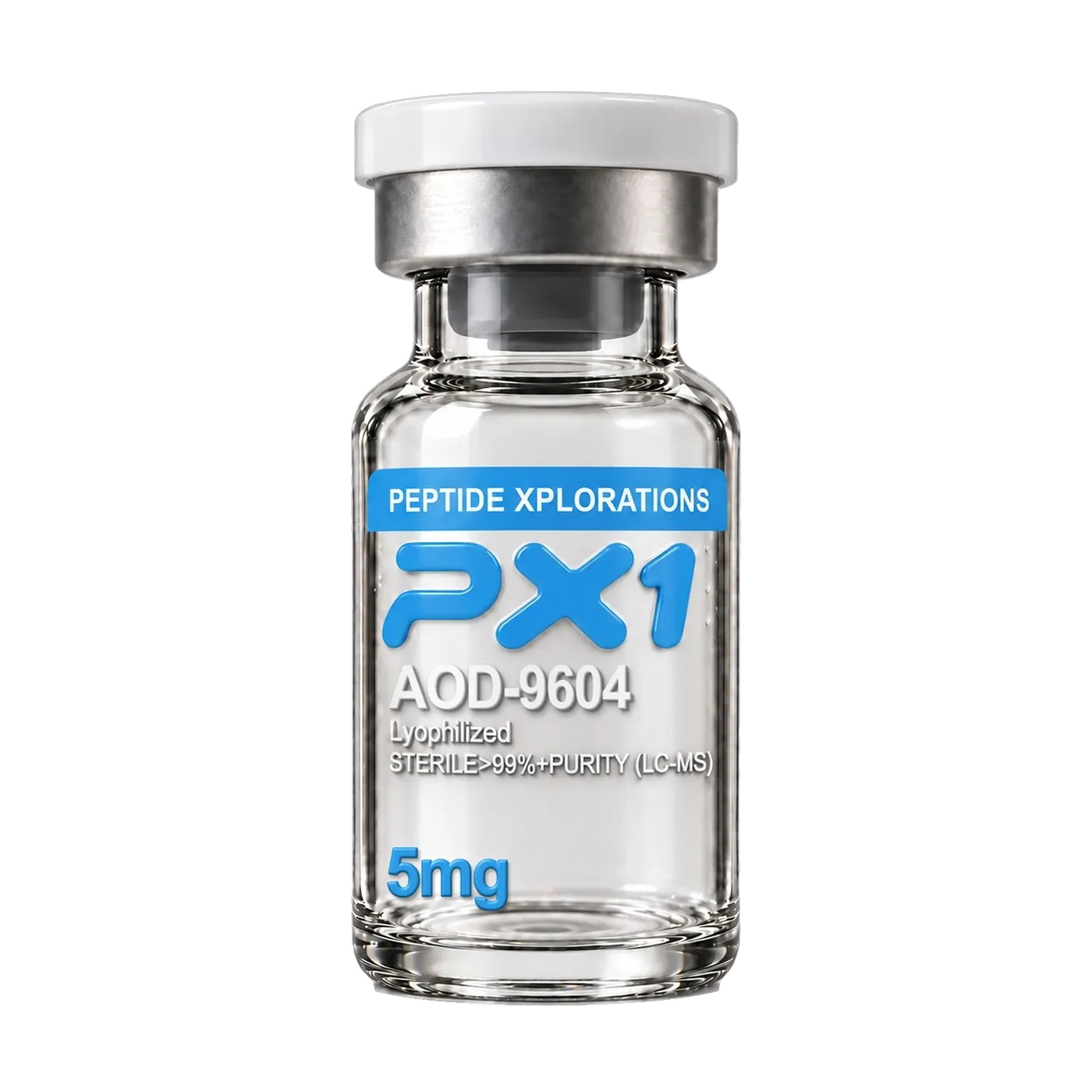
AOD-9604 5mg
Lot Pending
Independent laboratory
Independent laboratory
HPLC purity
Pending
Result pending
Peak graph available when testing is complete
Labeled amount5mg
Measured amountPending
IdentityPending
TestedPending
Made in the USA
Ships from the USA
Peptides
Research monograph on AOD-9604 — the C-terminal hGH fragment 176-191 studied for lipolytic signaling without the growth-promoting activity of full-length growth hormone.
Strength
Quantity
Bundle & Save
Subscribe & Save 10%
Ships every 30 days · Cancel anytime
Per shipment
$49.00 $44.10
Subscription length
Login required. Manage anytime from Account → Subscriptions.
For research use only. Not for human or animal consumption.
Molecular weight
1815.08 g/mol
Molecular formula
C₇₈H₁₂₃N₂₃O₂₃S₂
CAS number
221231-10-3
Chain length
16 amino acids
Amino-acid sequence
Tyr-Leu-Arg-Ile-Val-Gln-Cys-Arg-Ser-Val-Glu-Gly-Ser-Cys-Gly-Phe
Classification: Research peptide
Batch verification
Independent testing with lot-specific analytical documentation.
Lot Pending
Independent laboratory
Independent laboratory
HPLC purity
Pending
Result pending
Full GHS 16-section Safety Data Sheet for AOD-9604, prepared per OSHA HazCom 2012 (29 CFR 1910.1200). Includes substance identity, handling & storage, PPE, stability, transport and regulatory information.
CAS No.
221231-10-3
Formula
C₇₈H₁₂₃N₂₃O₂₃S₂
Mol. Weight
1815.08 g/mol
Classification
Not hazardous (GHS)
Research monograph on AOD-9604 — the C-terminal hGH fragment 176-191 studied for lipolytic signaling without the growth-promoting activity of full-length growth hormone.
AOD-9604 is classified on this page as a research peptide and is supplied in a lyophilized research preparation. The presentation is intended to support controlled laboratory workflows, analytical method development, and documented preclinical or in-vitro investigation appropriate to the compound.
PX1 Research manufactures and finishes this product in American GMP laboratories rather than purchasing finished vials from overseas. Each released lot is evaluated through the PX1 quality program, with identity, purity, appearance, and applicable contaminant or endotoxin results documented on the lot-linked Certificate of Analysis. Researchers should review the current COA and Safety Data Sheet shown on this page before beginning work.
Store the sealed preparation at −20°C for long-term stability and protect it from light. Bring the closed vial to room temperature before opening, follow the laboratory's validated preparation protocol, and minimize repeated freeze–thaw cycles. Use calibrated equipment, document concentration and storage conditions, and follow institutional safety procedures throughout the study.
For research use only. Not for human or veterinary use, consumption, diagnosis, treatment, or medical application. This material should be handled only by qualified professionals in an appropriate laboratory setting.
Purity (HPLC)
≥99%
Application
For Research Use only
Form
Lyophilized Powder
Storage
-20°C Long Term
Testing
Third Party Tested
Manufacture
USA
99%+ HPLC Purity
Independently verified by accredited US laboratory
Endotoxin-Screened
LAL tested, LPS-free, endotoxin report available
GMP-Certified Manufacturing
USA facility, ISO 9001:2015
Lyophilized for Stability
Shipped cold-packed and sealed for stability
Supplied as a research-grade compound for in-vitro and laboratory investigation.
For research use only — not for human or animal consumption.
AOD-9604 is a synthetic 16-amino-acid analog of the C-terminal fragment 176-191 of human growth hormone, stabilized with a disulfide-bridged tyrosine extension. Preclinical research studies its effects on lipolytic signaling and adipocyte metabolism without the receptor-mediated growth effects of full-length hGH.
| Compound name | AOD-9604 |
|---|---|
| Research code | hGH fragment 176-191 |
| CAS registry number | 221231-10-3 |
| Molecular formula | C78H123N23O23S2 |
| Molar mass | ≈1815.1 g/mol |
| Chain length | 16 amino acids |
| Physical form | Lyophilized white powder |
| Purity specification | ≥99% by reversed-phase HPLC; identity confirmed by LC-MS |
| Intended use | Research use only — not for human or veterinary use |
Research monograph
AOD-9604 is a synthetic analog of the C-terminal fragment (residues 176-191) of human growth hormone, modified with an N-terminal tyrosine. The fragment retains the lipolytic domain of the parent hormone while lacking the regions responsible for receptor-mediated growth signaling.
It is supplied by PX1 Research as a lyophilized reference compound for adipocyte and metabolic research where separating lipolytic activity from somatogenic activity is the experimental objective.
In adipocyte models AOD-9604 has been reported to stimulate lipolysis and inhibit lipogenesis without measurable effect on IGF-1 output or insulin sensitivity readouts, distinguishing it from intact growth hormone. The mechanism appears to be independent of the growth hormone receptor, with beta-3 adrenergic pathway involvement proposed in rodent studies.
Because it does not activate the somatogenic arm, AOD-9604 is frequently used as a negative control for growth-hormone-receptor-mediated effects in comparative experiments.
AOD-9604 ships as a lyophilized powder in a sealed, tamper-evident vial. Store the unopened vial between −20°C and −80°C, protected from light, until the day of use. In this state the peptide is stable through the labeled expiration date printed on the lot documentation.
Every PX1 Research lot of AOD-9604 is manufactured in the United States and released against a documented specification of ≥99% purity by reversed-phase HPLC, with identity confirmed on the same lot by high-resolution LC-MS against the theoretical mass of the sequence.
AOD-9604 supplied by PX1 Research is intended strictly for in-vitro laboratory and research applications. It is not a drug, food, cosmetic, or medical device, and it is not for human or veterinary use, diagnosis, treatment, or consumption.
Researchers are responsible for handling the compound in accordance with their institution's safety procedures and all applicable local regulations. Safety data sheets and current lot documentation are available on this site.
AOD-9604 is a modified fragment corresponding to residues 177-191 of human growth hormone with an added tyrosine at the N-terminus. Because it is a short sequence derived from a much larger protein, the impurity profile of a lot is dominated by truncation and deamidation products that differ from the target by a small mass increment — which is exactly the class of impurity a fast generic HPLC gradient fails to resolve.
PX1 reports lot-specific purity at ≥99% by reversed-phase HPLC on a shallow gradient, with identity confirmed by liquid chromatography-mass spectrometry against the theoretical monoisotopic mass of the modified 15-mer plus the N-terminal tyrosine. The added tyrosine is the feature that distinguishes AOD-9604 from the unmodified hGH fragment, and high-resolution mass data on the actual lot is what confirms it is present.
Endotoxin by kinetic chromogenic LAL, residual solvents by gas chromatography and water content by Karl Fischer titration are reported per lot, along with net peptide content. Net peptide content matters here because short fragments are frequently supplied as acetate salts, and salt and water together can account for a substantial fraction of the labelled mass.
AOD-9604 is a fragment of growth hormone, not a secretagogue. Secretagogues such as Ipamorelin, CJC-1295 and Tesamorelin act on receptors upstream of the pituitary and are studied in terms of the endogenous release axis. AOD-9604 is a structural fragment studied in its own right, so comparisons between the two classes concern completely different points of intervention.
It is also distinct from full-length recombinant growth hormone, which is a 191-residue protein. The fragment retains only a short region of that sequence, and the published literature on the fragment therefore does not transfer from work on the intact protein. Methods sections should state which test article was used, because the two are routinely conflated in secondary sources.
In comparative in-vitro designs AOD-9604 frequently appears alongside secretagogue analogs specifically so that fragment-based and axis-mediated approaches can be separated experimentally rather than assumed equivalent.
Is AOD-9604 the same as the hGH fragment 176-191? Closely related but not identical. AOD-9604 is the 177-191 region with an added N-terminal tyrosine, and that modification is part of the compound's definition. Material sold simply as "fragment 176-191" is a different test article and should not be substituted without saying so.
Does AOD-9604 stimulate growth hormone release? No — it is a fragment of the hormone, not a secretagogue, and the distinction is the reason it appears in comparative designs alongside GHRH analogs rather than as an alternative to them.
What purity is appropriate? ≥98% by reversed-phase HPLC on a resolving gradient is the working floor and ≥99% is the practical standard. Because the characteristic impurities are truncated versions of the same sequence, the impurity profile is as informative as the headline figure.
How is a lot verified on receipt? Confirm the vial lot matches the certificate, confirm the certificate carries the actual chromatogram and mass spectrum rather than a summary table, and confirm the reported mass corresponds to the tyrosine-modified 15-mer rather than the unmodified fragment.
AOD-9604 is a 16-residue analog of the C-terminal 176-191 region of human growth hormone, carrying an added tyrosine at the N-terminus and a disulfide bridge that reproduces the loop geometry of the parent fragment. That disulfide is the analytical pressure point: a reduced or scrambled lot has the same amino-acid composition and nearly the same mass as correctly folded material, so a mass number alone does not establish identity. PX1 reports reversed-phase HPLC purity for the specific lot in the vial against a ≥99% specification, with the chromatogram published rather than summarized.
Identity is confirmed by liquid chromatography-mass spectrometry against the theoretical monoisotopic mass of the intact, oxidized 16-mer. Because the reduced form differs from the oxidized form by only two mass units, the release panel reads the isotope envelope rather than a nominal mass, and retention time relative to a characterized reference lot is treated as a second identity criterion.
Each AOD-9604 lot additionally carries endotoxin by kinetic chromogenic LAL, residual solvent screening by gas chromatography, and water content by Karl Fischer titration. Water content and net peptide content together determine how much peptide is actually present per labelled milligram — the figure a laboratory needs when preparing a quantitative reference standard, which purity alone never answers.
AOD-9604 was designed to isolate the lipid-metabolism-associated region of human growth hormone from the receptor-binding regions that drive the somatotropic signaling of the full-length hormone. In comparative in-vitro designs it is therefore used as the fragment arm against recombinant hGH as the full-length arm, allowing an effect to be attributed to the 176-191 region rather than to growth hormone receptor engagement generally.
Researchers studying growth hormone secretagogues frequently run AOD-9604 alongside a GHRH analog such as Tesamorelin and a ghrelin-receptor agonist such as Ipamorelin. Those two act upstream, on secretion; AOD-9604 acts as a structural fragment downstream of secretion, so the three occupy genuinely different positions in an experimental matrix rather than being interchangeable.
Because the fragment is short and unlipidated, its handling profile is closer to that of BPC-157 or KPV than to acylated incretin analogs such as PX1-S or PX13-R, which need shallow chromatographic gradients and surfactant-aware labware.
How does AOD-9604 differ from the 176-191 fragment itself? AOD-9604 adds an N-terminal tyrosine to the natural 176-191 sequence, which improves synthetic tractability and analytical detectability while preserving the disulfide-constrained loop.
Why does the certificate report water content? Because a lyophilized cake retains residual moisture. A vial can be 99% pure by HPLC and still contain measurably less peptide per labelled milligram than assumed, which changes every calculated concentration downstream.
Which storage state is stable longest? The lyophilized state, at -20 °C and protected from light, through the labelled expiration. Aqueous solution is the least stable state for any disulfide-containing peptide and is treated as a short-lived working preparation.
Is AOD-9604 supplied for human use? No. PX1 supplies AOD-9604 strictly as a research reference compound. It is not for human or veterinary use, and no dosing guidance is provided.
All products are sold strictly for laboratory and research use only. Not for human or veterinary use, diagnosis, treatment or consumption. Statements have not been evaluated by the FDA.
High Quality — 99% Purity Guaranteed
We are continuously conducting HPLC testing on all of our raw powders as well as our finished products to ensure the quality of what we ship. You can have the product you bought from us independently tested at any HPLC-licensed testing facility — and if the results come back negative, we will refund the following:
HPLC Test Fee
$100
Plus a full refund
Total order amount + shipping
AOD-9604
$49.00