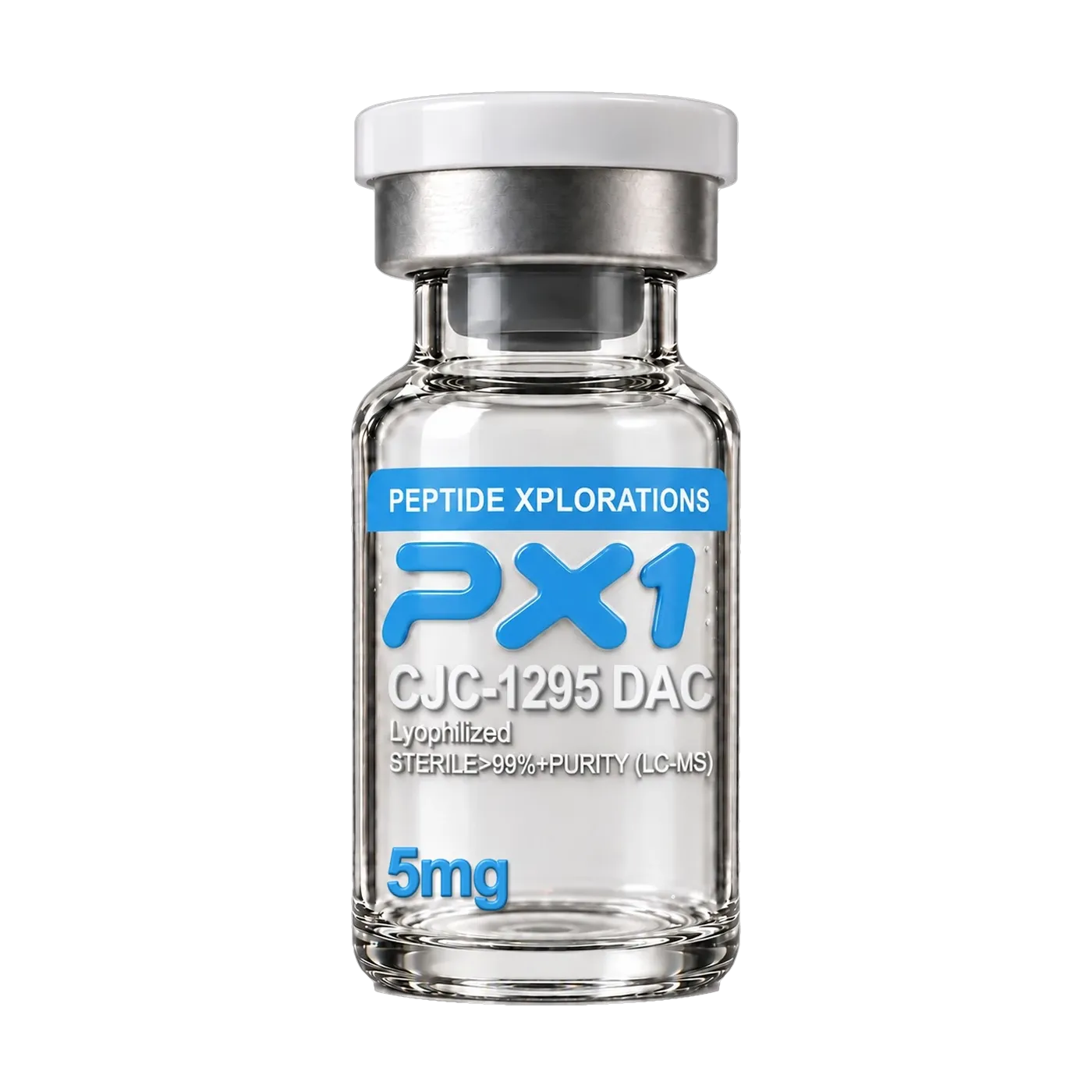
Research monograph on Ipamorelin and CJC-1295 — a selective ghrelin-receptor pentapeptide and a long-acting GHRH analog, the most-studied secretagogue pairing in somatotropic-axis research.
Strength
Quantity
1
Bundle & Save
Subscribe & Save 10%
Ships every 30 days · Cancel anytime
Per shipment
$772.72$695.45
Subscription length
Login required. Manage anytime from Account → Subscriptions.
Same-day dispatch before 2PM EST · Free shipping over $300
In stock · Ships cold chain
HPLC & LC-MS verified purity 99%+ · Lot-linked COA
We accept:AMEXDISC●VERACH$ZV
For research use only. Not for human or animal consumption.
Molecular weight
Not assigned for this material
Molecular formula
Not assigned for this material
CAS number
Not assigned for this material
Chain length
29 amino acids; 5 amino acids
Amino-acid sequence
Ipamorelin: Aib-His-D-2-Nal-D-Phe-Lys-NH2
Classification: Research peptide
Batch verification
Certificate of Analysis
Independent testing with lot-specific analytical documentation.
Peptide In testing8 assays
CJC-1295 DAC 5mg 5mg
Lot Pending
Independent laboratory
Independent laboratory
HPLC purity
Pending
Result pending
Peak graph available when testing is complete
Labeled amount5mg
Measured amountPending
IdentityPending
TestedPending
Full GHS 16-section Safety Data Sheet for CJC-1295 + Ipamorelin, prepared per OSHA HazCom 2012 (29 CFR 1910.1200). Includes substance identity, handling & storage, PPE, stability, transport and regulatory information.
CAS No.
Not assigned
Formula
Not assigned
Mol. Weight
Per COA
Classification
Not hazardous (GHS)
CJC-1295 DAC – Explore the Potential of CJC-1295 DAC for Sophisticated Investigations
CJC-1295 DAC stands as a state-of-the-art peptide developed to replicate the endogenous Growth Hormone Releasing Hormone (GHRH) found in the body. This advanced molecular compound is optimized to latch onto precise pituitary gland receptors, potentially initiating a sequence of physiological events that boost the production and systemic circulation of growth hormones (GH). Trials in preclinical settings have shown that applying CJC-1295 DAC results in a marked rise in growth hormone concentrations, establishing it as an essential instrument for academic exploration at PX1 Research.
CJC-1295 DAC – Mechanism of Action for CJC-1295 DAC
CJC1295 DAC functions by meticulously mirroring the configuration and biological role of native GHRH. This structural resemblance permits efficient binding to GHRH receptors situated on the anterior pituitary gland's cellular surfaces. Through the stimulation of these specific sites, CJC-1295 DAC encourages the synthesis and discharge of growth hormones into systemic circulation. Findings suggest that increased human growth hormone (HGH) levels can remain present for multiple days post-administration, emphasizing the lasting impact of this peptide.
CJC-1295 DAC – Prolonged Half-Life for Consistent Research Results
A primary distinguishing characteristic of CJC1295 DAC is its lengthened half-life, which differentiates it from alternative research peptides. This longevity is facilitated by the specialized Drug Affinity Complex (DAC) architecture, allowing the molecule to establish firm attachments with albumin found in blood plasma. This bioconjugation mechanism notably extends its metabolic endurance, facilitating a continuous rise in growth hormone levels across a long duration. While many peptides undergo rapid degradation, CJC-1295 DAC provides investigators at PX1 Research a dependable solution for longitudinal analysis.
Secondary Contribution to IGF-1 Generation
Beyond its primary influence on the secretion of growth hormone, CJC1295 DAC is instrumental in the manufacture of Insulin-like Growth Factor-1 (IGF-1). Following the release of growth hormone into the blood, it migrates to the liver to trigger the synthesis of IGF-1. Data indicates that CJC-1295 DAC effectively raises both GH and IGF-1 levels. This hormonal pair operates in tandem to facilitate diverse physiological processes, such as the repair of tissues and the proliferation of cells.
The Technical Foundation of DAC Innovation
The "DAC" suffix in CJC1295 DAC refers to the Drug Affinity Complex, a pioneer advancement pioneered by the esteemed scientist John J. Kopchick at Ohio University. This specific technology improves the structural integrity and metabolic duration of the peptide by facilitating its attachment to serum albumin, resulting in a gradual and consistent release. This prolonged bioavailability makes CJC-1295 DAC a premier selection for experimental designs that necessitate constant growth hormone provocation.
Form: Lyophilized powder contained in sterile glass containers
Dosage: 5mg per vial
Important Disclaimer
CJC-1295 DAC is provided exclusively for in vitro laboratory research and must be utilized only by qualified experts. This substance has not received FDA authorization for use in humans or animals and should never be improperly labeled, misused, or redirected for use as a pharmaceutical, dietary supplement, food, or cosmetic product.
References
Activation of the GH/IGF-1 axis by CJC-1295: ScienceDirect
Netnography of CJC-1295 use: Taylor & Francis
CJC-1295 in GHRH knockout mice: American Journal of Physiology
LC-HRMS/MS identification of GHRH: Springer
Drug-receptor interactions: NCBI
Purity (HPLC)
≥99%
Application
For Research Use only
Form
Lyophilized Powder
Storage
-20°C Long Term
Testing
Third Party Tested
Manufacture
USA
99%+ HPLC Purity
Independently verified by accredited US laboratory
Endotoxin-Screened
LAL tested, LPS-free, endotoxin report available
GMP-Certified Manufacturing
USA facility, ISO 9001:2015
Lyophilized for Stability
Shipped cold-packed and sealed for stability
Studied as a long-acting growth-hormone-releasing hormone that sustains GH and downstream IGF-1 levels for tissue repair research.
For research use only — not for human or animal consumption.
What is CJC-1295 (no DAC) + Ipamorelin?
CJC-1295 without DAC (Mod GRF 1-29) is a 29-amino-acid GHRH analog; ipamorelin is a selective 5-amino-acid ghrelin-receptor pentapeptide. Combined, they are the most referenced research blend for studying complementary GHRH and secretagogue pathways of pulsatile growth-hormone release.
CJC-1295 (no DAC) + Ipamorelin chemical & technical data
Compound name
CJC-1295 (no DAC) + Ipamorelin
CAS registry number
863288-34-0 (CJC-1295 no DAC); 170851-70-4 (ipamorelin)
Molecular formula
C152H252N44O42 (CJC-1295 no DAC); C38H49N9O5 (ipamorelin)
Molar mass
≈3367.9 g/mol; ≈711.9 g/mol
Amino acid sequence
Ipamorelin: Aib-His-D-2-Nal-D-Phe-Lys-NH2
Chain length
29 amino acids; 5 amino acids
Physical form
Co-lyophilized white powder
Purity specification
≥99% by reversed-phase HPLC per component; identity confirmed by LC-MS
Intended use
Research use only — not for human or veterinary use
Research monograph
Ipamorelin & CJC-1295 — Complete Research Overview
What are Ipamorelin and CJC-1295?
Ipamorelin is a synthetic pentapeptide (Aib-His-D-2-Nal-D-Phe-Lys-NH2) that acts as a selective agonist at the growth hormone secretagogue receptor GHS-R1a, the receptor for endogenous ghrelin. Its defining characteristic in the literature is selectivity: unlike earlier growth hormone-releasing peptides such as GHRP-2 and GHRP-6, ipamorelin showed minimal effect on cortisol and prolactin in the original characterization studies, which is why it became the reference ghrelin-mimetic for clean axis experiments.
CJC-1295 is a modified analog of GHRH(1-29). It exists in two distinct research forms that are routinely confused: CJC-1295 with DAC, which carries a drug-affinity complex enabling covalent binding to serum albumin and a substantially extended duration; and CJC-1295 without DAC (also called modified GRF 1-29), which retains four stabilizing amino-acid substitutions but has no albumin anchor and therefore a short duration. These are different test articles and should never be treated as interchangeable in a study design.
PX1 Research supplies both compounds individually and as the blended preparation, each released against a batch-specific certificate of analysis. Research use only — not for human or veterinary use.
Why the two are studied together
The somatotropic axis has two independent stimulatory inputs at the pituitary somatotroph: the GHRH receptor and GHS-R1a. Because the receptors are distinct and their signaling converges downstream, co-stimulation in preclinical models produces a response larger than either input alone — a synergy that is one of the better-replicated findings in the field.
That is the mechanistic rationale behind the CJC-1295 + ipamorelin blend, which is among the most commonly requested research preparations in the class. The GHRH analog raises the amplitude of the release pulse while the ghrelin-mimetic increases pulse frequency and suppresses somatostatin tone, and study designs frequently isolate each contribution by running the two singles alongside the blend.
Comparative designs also bring in tesamorelin (a hexenoyl-stabilized GHRH(1-44) analog) and sermorelin (unmodified GHRH(1-29)) to separate duration effects from receptor effects, since the three GHRH-side molecules differ mainly in how they resist DPP-4 cleavage and clearance.
Analytical characterization
Laboratories that work with Ipamorelin and CJC-1295 typically characterize incoming material on three axes before it enters a study: identity, purity and content. Identity is established by high-resolution mass spectrometry against the theoretical monoisotopic mass (711.9 Da for ipamorelin; ≈3,647.2 Da for CJC-1295 with DAC and ≈3,367.9 Da for the non-DAC form), usually supported by MS/MS fragmentation that walks the backbone and confirms the sequence rather than just the total mass. A matching intact mass alone can be satisfied by a scrambled or partially epimerized sequence, which is why fragmentation data is the stronger identity evidence.
Purity is quantified by reversed-phase HPLC with UV detection, integrating every resolved peak in the chromatogram and expressing the main peak as a percentage of total area. The gradient matters more than the headline number: a shallow, well-optimized gradient resolves closely eluting process impurities such as deamidation products, oxidation variants, truncated sequences and acetate adducts, while an aggressive gradient can co-elute them under the main peak and inflate the reported purity. PX1 publishes the chromatogram itself, not only the integrated figure, so the resolution behind the number is auditable.
Content — how much peptide is actually in the vial once counter-ions and residual water are subtracted — is the axis most often skipped by low-cost suppliers. Net peptide content is a function of the labeled mass, the water content measured by Karl Fischer titration, and the counter-ion (typically trifluoroacetate or acetate) load. A vial that is 99% pure by HPLC can still under-deliver on content if it carries a high salt and moisture fraction, which is why the COA reports both.
Purity and Certificate of Analysis (COA)
Each lot is USA-manufactured and released at ≥99% purity by reversed-phase HPLC with LC-MS identity confirmation, kinetic chromogenic LAL endotoxin, GC residual solvents and Karl Fischer water content. For the blend, the release method resolves both peptides in a single chromatographic run and mass spectrometry confirms both intact masses — a blend released against a single-analyte method has only been half-characterized.
The DAC and non-DAC forms of CJC-1295 differ by roughly 279 Da, which makes mass spectrometry an unambiguous check that the vial contains the form on the label. Confirming this is worth doing, because mislabeling between the two forms is one of the more common quality failures in the research-peptide market.
Sourcing, provenance and what separates lab-grade material
The research-peptide market is unusually wide in quality. The same nominal Ipamorelin and CJC-1295 listing can represent USA-manufactured material released against a documented specification, or repackaged bulk of unknown origin with a generic certificate that was never generated from the lot in the vial. The distinction is invisible from the product photo and only becomes visible in the paperwork.
The practical test is traceability: the lot number printed on the vial label should appear on the certificate of analysis, and that certificate should show the actual chromatogram and mass spectrum for that lot rather than a representative example. A COA without a lot number, without instrument traces, or dated years before the vial was filled is a document, not evidence. PX1 publishes the batch-specific report directly on the product page so the chain from manufacturing to vial is checkable before purchase.
Beyond the certificate, consistent lab-grade supply depends on synthesis and release happening under one controlled process: domestic solid-phase manufacturing, preparative HPLC purification, lyophilization under validated cycle parameters, and third-party confirmation of purity and endotoxin. Ipamorelin and CJC-1295 sold by PX1 Research is produced and released on that pathway and is supplied strictly for laboratory research use — not for human or veterinary use.
Study design considerations
A well-formed secretagogue experiment is factorial: vehicle, GHRH analog alone, ghrelin-mimetic alone, and the combination. Anything less cannot distinguish additivity from synergy, and synergy is the specific claim most often made about this pairing. Because the two receptor inputs differ in their kinetics, the sampling schedule must be dense enough to capture both the amplitude and the frequency components of the response.
Selectivity controls belong in the design when ipamorelin is chosen for its clean profile. Measuring cortisol and prolactin alongside growth hormone confirms in the specific model that the selectivity reported in the original characterization holds, and it provides the contrast that justifies using ipamorelin rather than GHRP-2 or GHRP-6.
The DAC question must be settled before the study starts, not after. CJC-1295 with DAC produces sustained exposure measured in days, while the non-DAC form is short-acting; a sampling schedule appropriate for one is wrong for the other, and a methods section that says only "CJC-1295" leaves the result uninterpretable. State the form, the lot and the confirmed mass.
Downstream, IGF-1 serves as the integrated readout that smooths pulsatile growth hormone data, but it lags the stimulus and saturates, so it complements rather than replaces direct sampling. Designs reporting both give a much clearer picture of whether an intervention changed pulse structure or only total output.
For in vitro work, somatotroph models should be characterized for both GHRH-receptor and GHS-R1a expression before use, since the synergy under investigation requires both receptors to be present at functional density. Verifying expression in the specific line prevents a null combination result that reflects receptor absence rather than pharmacology.
Common research questions about Ipamorelin and CJC-1295
What makes ipamorelin "selective"? Earlier growth hormone-releasing peptides such as GHRP-2 and GHRP-6 stimulate the secretagogue receptor but were also reported to raise cortisol and prolactin, confounding any experiment attempting to isolate the somatotropic axis. The original ipamorelin characterization reported minimal effect on both, which made it the preferred tool compound for clean axis studies and remains the reason it is chosen over the older GHRPs.
What is the difference between CJC-1295 with and without DAC? With DAC, the molecule carries a maleimidopropionic acid drug-affinity complex that binds covalently to serum albumin, creating a long-lived circulating reservoir. Without DAC — commonly labeled modified GRF 1-29 — the sequence keeps four stabilizing substitutions but has no albumin anchor and a much shorter duration. They are different test articles, differ by roughly 279 Da, and mislabeling between them is one of the most common quality failures in this category.
Why combine a GHRH analog with a ghrelin-mimetic? They act at two independent receptors on the same cell, and co-stimulation in preclinical models produces a response greater than either alone. The GHRH side raises pulse amplitude while the ghrelin side affects pulse frequency and somatostatin tone, so the combination is a mechanistic design choice rather than simply a larger stimulus.
Should the blend or the singles be purchased? For a study isolating each receptor's contribution, the singles are required and the blend serves as the combination arm — most rigorous designs use all three. For method development or as a reference standard, the singles are the more useful stock because their impurity profiles can be characterized independently.
What should the certificate show for a co-lyophilized blend? Both intact masses confirmed by mass spectrometry, both peptides resolved on a single HPLC run with their individual impurity profiles integrated, and the ratio between the two analytes reported. Endotoxin, residual solvents and water content apply to the finished blend as filled, not to the components before blending.
Where these compounds sit in the PX1 catalog
Ipamorelin and CJC-1295 are stocked individually and as the co-lyophilized blend, which is the configuration most often requested for co-stimulation designs. A factorial study needs all three listings — the two singles and the blend — plus vehicle, so laboratories working in this area typically order the set together.
On the GHRH side the catalog comparators are Tesamorelin, the hexenoyl-stabilized GHRH(1-44) analog, and Sermorelin, the unmodified 1-29 fragment. On the ghrelin side they are GHRP-2 and GHRP-6, the earlier and less selective secretagogues against which ipamorelin's selectivity is defined.
IGF-1 LR3 completes the group as the direct-acting comparator that bypasses the pituitary. Every listing in the group is released against the same specification with a lot-matched certificate, and for the blend the certificate resolves both peptides in a single chromatographic run.
References
Raun 1998. Raun K, et al. Ipamorelin, the first selective growth hormone secretagogue. European Journal of Endocrinology. 1998;139(5):552-561.
Teichman 2006. Teichman SL, et al. Prolonged stimulation of growth hormone and insulin-like growth factor I secretion by CJC-1295, a long-acting analog of GHRH, in healthy adults. Journal of Clinical Endocrinology & Metabolism. 2006;91(3):799-805.
Jetté 2005. Jetté L, et al. Human growth hormone-releasing factor conjugate stimulates GH secretion in rats and monkeys. Endocrinology. 2005;146(7):3052-3058.
All products are sold strictly for laboratory and research use only. Not for human or veterinary use, diagnosis, treatment or consumption. Statements have not been evaluated by the FDA.
High Quality — 99% Purity Guaranteed
Product Quality Guarantee
We are continuously conducting HPLC testing on all of our raw powders as well as our finished products to ensure the quality of what we ship. You can have the product you bought from us independently tested at any HPLC-licensed testing facility — and if the results come back negative, we will refund the following: