Glow (GHK-Cu 50mg/BPC-157 10mg/TB-500 10mg) 70MG
Lot PX1GLOW-0021
ILS Laboratories
Independent laboratory
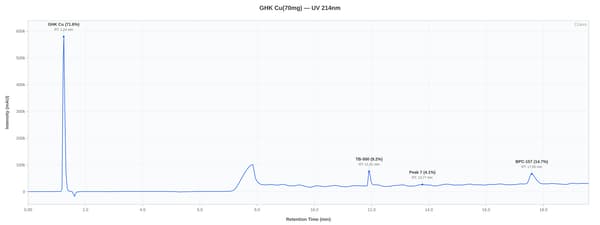
HPLC purity
95.50%
High purity confirmed

GHK-Cu 50mg + BPC-157 10mg + TB-500 10mg

Made in the USA
Ships from the USA
Peptide Blends
Research monograph on the GLOW blend — GHK-Cu, BPC-157 and TB-500 combined for dermal and connective-tissue signaling research.
Strength
Quantity
Bundle & Save
Subscribe & Save 10%
Ships every 30 days · Cancel anytime
Per shipment
$149.00 $134.10
Subscription length
Login required. Manage anytime from Account → Subscriptions.
For research use only. Not for human or animal consumption.
Molecular weight
Not assigned for this material
Molecular formula
Not assigned for this material
CAS number
Not assigned for this material
Chain length
Not assigned for this material
Classification: Multi-component research blend
A blend has no single molecular formula, molecular weight, CAS number, or amino-acid sequence. Each component is identified separately on the lot documentation.
Batch verification
Independent testing with lot-specific analytical documentation.
Lot PX1GLOW-0021
ILS Laboratories
Independent laboratory
HPLC purity
95.50%
High purity confirmed

Full GHS 16-section Safety Data Sheet for GLOW Blend, prepared per OSHA HazCom 2012 (29 CFR 1910.1200). Includes substance identity, handling & storage, PPE, stability, transport and regulatory information.
CAS No.
Not assigned
Formula
Not assigned
Mol. Weight
Per COA
Classification
Not hazardous (GHS)
GLOW Research Stack – PX1 Research introduces a combination of TB-500, BPC-157, and GHK-CU for intensive laboratory investigation into anti-aging pathways, systemic recovery, and biological repair. This expertly developed GLOW Research Stack integrates 10mg of TB500 (Thymosin Beta-4), 10mg of BPC157 (Body Protection Compound), and 50mg of GHK-Cu (Copper Peptide) to offer a wide-ranging resource for analyzing cellular renewal across diverse tissues.
PX1 Research delivers this scientifically curated GLOW Research Stack for high-level study in tissue restoration. By uniting three molecules backed by clinical literature, researchers can explore:
Connective tissue and muscle recovery (TB500) Site-specific wound restoration (BPC157) Dermal regeneration and collagen production (GHK-Cu)
This proprietary peptide blend utilizes three independent yet harmonious avenues for stimulating tissue regrowth:
Molecular Mass: 4963.5 Da
Core Mechanism: Activation of actin polymerization
Investigation Areas:
Speeds up myofiber renewal (rodent study data shows 47% improved recovery rates over placebo)
Minimizes fibrosis driven by TGF-β1 in tendon research
Stimulates new blood vessel growth (marked by higher CD31+ cell counts in wound studies)
Boosts axonal growth in CNS trauma simulations
Molecular Mass: 1419.56 Da
Core Mechanism: Regulation of growth factors (FGF +89%, VEGF +142% in stomach research)
Investigation Areas:
Improves tendon-to-bone integration (observations of 178% better collagen structural organization)
Shields stomach lining (decreases NSAID-related ulcerations by 82%)
Supports hepatic renewal (hepatocyte doubling speeds up by 43%)
Increases microvascular density in wounds (capillary growth raised by 62%)
Molecular Mass: 340.8 Da
Core Mechanism: Direct DNA interaction and genetic cell programming
Investigation Areas:
Triggers collagen synthesis (Type III +280%, Type I +320%)
Shortens time for wound skinning (2.1x faster re-epithelialization)
Lowers MMP-1 levels (reduction of collagen breakdown by 73%)
Encourages hair follicle formation (anagen phase follicles increased by 89%)
Models for Muscle and Bone Trauma:
GLOW Research Stack – Gastrointestinal Integrity Research:
GLOW Research Stack – Longevity and Gerontology Research:
TB500:
BPC157:
GHK-Cu:
GMP Registered Laboratory (meeting USP <797> criteria) Mass Spec Reports provided for every batch ISO 5 certified sterile bottling environment PhD-level technical assistance available 24/7
Q: What solvent pH is best for maintaining these peptides? A: Ideal ranges are 5.5-6.5 for TB500, 4.5-5.5 for BPC157, and 7.0-7.4 for GHK-Cu.
Q: Are these suitable for in vitro cell studies? A: Definitely; stability has been confirmed in both RPMI and DMEM media for up to a 72-hour window.
Q: How do these peptides interact on a molecular level? A: Data indicates that GHK-Cu and TB500 work together on structural matrix building, while BPC-157 amplifies growth factor responses.
Q: Is data available for the stability of frozen fractions? A: Yes, please see Technical Bulletin #TB-2023-14 for our full stability documentation.
Related research items:
PX1 Research is dedicated to fueling scientific progress through top-tier research reagents. This stack is widely considered the industry benchmark for tissue restoration studies.
Purity (HPLC)
≥99%
Application
For Research Use only
Form
Lyophilized Powder
Storage
-20°C Long Term
Testing
Third Party Tested
Manufacture
USA
99%+ HPLC Purity
Independently verified by accredited US laboratory
Endotoxin-Screened
LAL tested, LPS-free, endotoxin report available
GMP-Certified Manufacturing
USA facility, ISO 9001:2015
Lyophilized for Stability
Shipped cold-packed and sealed for stability
Studied for accelerated repair of tendon, ligament, muscle and gut lining via angiogenesis and cellular migration to injury sites.
For research use only — not for human or animal consumption.
GHK-Cu is the copper(II) complex of the tripeptide glycyl-L-histidyl-L-lysine, a sequence first isolated from human plasma. In dermal and wound-model research it is studied for copper transport, extracellular-matrix remodeling and gene-expression effects, and it is the most cited copper-binding peptide in the literature.
| Compound name | GHK-Cu |
|---|---|
| Research code | Copper tripeptide-1 |
| CAS registry number | 89030-95-5 (copper complex); 49557-75-7 (GHK free peptide) |
| Molecular formula | C14H24CuN6O4 |
| Molar mass | ≈403.9 g/mol |
| Amino acid sequence | Gly-His-Lys (GHK) · Cu(II) |
| Chain length | 3 amino acids |
| Physical form | Lyophilized blue powder |
| Purity specification | ≥99% by reversed-phase HPLC; copper content verified per lot |
| Intended use | Research use only — not for human or veterinary use |
Research monograph
GLOW is a three-component research blend of GHK-Cu, BPC-157 and TB-500 supplied as a single lyophilized preparation. It is the most frequently requested combination in dermal and connective-tissue research models, where the copper tripeptide is studied alongside two peptides associated with cell migration and angiogenic signaling.
PX1 Research releases GLOW against component-level analytical data so the ratio and identity of each constituent are documented on the batch certificate.
GHK-Cu is one of the most characterized copper-binding peptides in dermatology literature, reported to influence collagen I and III expression in fibroblast culture. TB-500 addresses actin dynamics and cell motility; BPC-157 contributes angiogenic and cytoprotective readouts.
Combining them in one vial removes cross-vial concentration error, which is a common confound when researchers prepare three separate solutions for the same well plate.
GLOW ships as a lyophilized powder in a sealed, tamper-evident vial. Store the unopened vial between −20°C and −80°C, protected from light, until the day of use. In this state the peptide is stable through the labeled expiration date printed on the lot documentation.
Every PX1 Research lot of each GLOW component is manufactured in the United States and released against a documented specification of ≥99% purity by reversed-phase HPLC, with identity confirmed on the same lot by high-resolution LC-MS against the theoretical mass of the sequence.
The GLOW blend supplied by PX1 Research is intended strictly for in-vitro laboratory and research applications. It is not a drug, food, cosmetic, or medical device, and it is not for human or veterinary use, diagnosis, treatment, or consumption.
Researchers are responsible for handling the compound in accordance with their institution's safety procedures and all applicable local regulations. Safety data sheets and current lot documentation are available on this site.
GLOW is a three-component research blend of GHK-Cu, BPC-157 and TB-500 supplied together in a single lyophilized vial. The formulation exists because dermal and connective-tissue repair models typically require matrix remodeling, new vasculature and cell migration to be engaged in the same preparation, and those three descriptions map onto the three components respectively.
GHK-Cu is a copper-binding tripeptide described in the literature in connection with extracellular matrix turnover and fibroblast signaling. BPC-157 is a synthetic 15-mer studied for angiogenic and nitric-oxide-pathway signaling. TB-500 is the active fragment region of thymosin beta-4 and is described in terms of actin sequestration and cell motility.
Because the three differ in mass by an order of magnitude, the blend's behavior in solution is governed largely by its largest component while its chromatographic identification depends on resolving the smallest. That asymmetry is why blend certificates are reported per component rather than as a single figure.
PX1 reports GLOW against a reversed-phase method with a gradient shallow enough to resolve the copper-complexed tripeptide, the 15-mer and the thymosin fragment as distinct peaks, with identity for each confirmed by LC-MS against its theoretical mass. A blend reported as a single purity number cannot demonstrate that all three components are present in the intended ratio.
The copper complex receives specific attention. Complexed and uncomplexed GHK differ in both mass and retention, so a lot in which copper has dissociated is analytically distinguishable — and is a different test article even though the peptide sequence has not changed.
Endotoxin by kinetic chromogenic LAL, residual solvents by gas chromatography and water content by Karl Fischer are determined on the finished blend, because blending and re-lyophilization are process steps in their own right.
Is GLOW the same as KLOW? No. GLOW is the three-component formulation; KLOW adds KPV and glutathione. Records should name the blend and the per-component mass so the test article is reproducible.
Why supply a blend rather than three vials? A single lot, a single certificate and a fixed ratio in every aliquot remove ratio variability between runs. For attribution work — deciding which component produced an observation — separate vials remain the correct choice.
What analytical evidence should accompany a GLOW lot? Per-component chromatograms for the actual lot, LC-MS identity for each component, the mass ratio in the vial, plus endotoxin, residual solvent and water content on the finished blend.
Does the copper content matter for handling? Yes. It is the reason light protection and chelator-free diluents are specified, and the reason a certificate that does not distinguish complexed from uncomplexed GHK leaves an open question about the material.
All products are sold strictly for laboratory and research use only. Not for human or veterinary use, diagnosis, treatment or consumption. Statements have not been evaluated by the FDA.
High Quality — 99% Purity Guaranteed
We are continuously conducting HPLC testing on all of our raw powders as well as our finished products to ensure the quality of what we ship. You can have the product you bought from us independently tested at any HPLC-licensed testing facility — and if the results come back negative, we will refund the following:
HPLC Test Fee
$100
Plus a full refund
Total order amount + shipping
Glow (GHK-Cu 50mg/BPC-157 10mg/TB-500 10mg)
$149.00