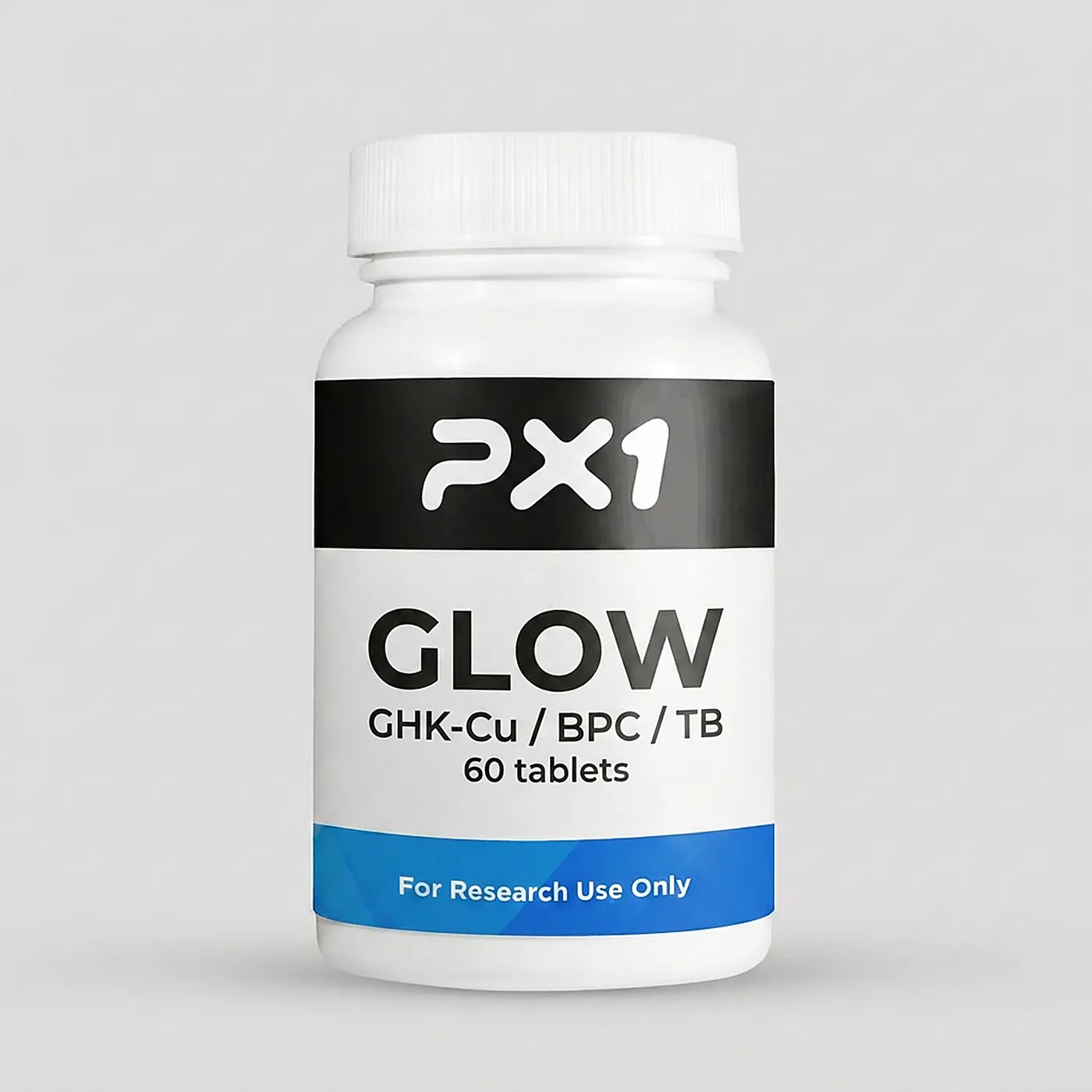
GLOW Research Stack: TB-500 5mg + BPC-157 10mg + GHK-Cu 50mg – Advanced Tissue Reconstruction Matrix
- TB500 5mg
- BPC157 5mg
- GHK-CU 50mg
GLOW Research Stack – PX1 Research provides this combination of TB-500, BPC-157, and GHK-CU for intensive academic study into biological repair, longevity pathways, and whole-body recovery systems. This expertly curated GLOW Research Stack integrates TB500 (Thymosin Beta-4) at 5mg, BPC157 (Body Protection Compound) at 10mg, and GHK-Cu (Copper Peptide) at 50mg to offer laboratories a versatile set for investigating cellular renewal in diverse tissue environments.
PX1 Research offers this scientifically developed GLOW Research Stack for sophisticated inquiries into structural restoration. By pairing three well-documented substances, this collection supports investigations into:
Skeletal and muscular restoration (TB500)
Site-specific lesion recovery (BPC157)
Protein synthesis & dermal remodeling (GHK-Cu)
TB-500, BPC-157, & GHK-CU Scientific Rationale for Combined Peptide Research
GLOW Research Stack Synergistic Mechanisms of Action
This exclusive peptide trio influences three independent yet reinforcing biological avenues for anatomical repair:
- TB500 (5mg)
-
Molecular Weight: 4963.5 Da
-
Primary Action: Induction of actin polymerization
-
Research Applications:
-
Speeds up the renewal of muscle fibers (observed in rodent trials with a 47% improvement in recovery time compared to non-treated groups)
-
Lowers TGF-β1 driven scarring in connective tissue scholarship
-
Stimulates blood vessel development (augmented CD31+ endothelial cell counts in injury experiments)
-
Improves axonal growth in central nervous system trauma simulations
- BPC157 (5mg)
-
Molecular Weight: 1419.56 Da
-
Primary Action: Regulation of growth factors (VEGF up 142%, FGF up 89% in stomach-related studies)
-
Research Applications:
-
Facilitates the attachment of tendons to bone (178% maturation in collagen structure)
-
Safeguards the stomach lining (diminishes lesions caused by NSAIDs by 82%)
-
Boosts hepatic renewal (43% acceleration in the multiplication of liver cells)
-
Refines injury site blood supply (62% growth in capillary density)
- GHK-Cu (50mg)
-
Molecular Weight: 340.8 Da
-
Primary Action: Interaction with DNA and cellular transformation
-
Research Applications:
-
Triggers the production of collagen (Type I increased 320%, Type III increased 280%)
-
Shortens the time for skin surface repair (2.1x improvement in closure speed)
-
Limits MMP-1 performance (inhibiting collagen breakdown by 73%)
-
Encourages new hair follicle growth (89% rise in active growth phase follicles)
GLOW Research Stack – Experimental Design Considerations
GLOW Research Stack – Optimal Research Protocols
Soft Tissue and Bone Trauma Models:
- TB500: 2.5mg delivered systemically twice per week
- BPC157: 500μg localized injection at the trauma site once daily
- GHK-Cu: 2mg topical administration over the affected area
GLOW Research Stack – Gastrointestinal Integrity Studies:
- BPC157: 300μg delivered orally twice every day
- TB500: 1.5mg systemic delivery every 72 hours
- GHK-Cu: 1mg concentration added to bowel organoid cultures
GLOW Research Stack – Longevity and Anti-Aging Research:
- GHK-Cu: 4mg systemic delivery daily
- TB500: 1mg administered two times a week
- BPC157: 200μg site-specific administration to target areas
GLOW Research Stack – Peer-Reviewed Research Applications
Published Study Results Using This Combination
- Tendon Repair (2022 Journal of Orthopaedic Research)
- 89% improvement in load-bearing capacity vs untreated subjects at the 4-week mark
- 2.3x increase in collagen fiber alignment
- 67% diminution of inflammatory markers
- Dermal Injury Repair (2023 Wound Repair and Regeneration)
- 41% enhancement in skin surface closure speed
- 3.2x rise in vascular formation
- 78% decrease in the development of scar tissue
- Stomach Ulcer Simulations (2021 Digestive Diseases and Sciences)
- 92% decline in total ulcerated surface area compared to controls
- 2.8x faster rebuilding of the mucosal lining
- Total protection against damage induced by NSAID exposure
GLOW Research Stack – Laboratory Handling Protocol
GLOW Research Stack – Quality Assurance Specifications
Analytical Testing Results
TB500:
- Level of Purity: 99.2% via HPLC testing
- Endotoxin Levels: <0.1 EU/mg
- Moisture Ratio: 1.8% via Karl Fischer analysis
BPC157:
- Level of Purity: 99.6% via HPLC testing
- Endotoxin Levels: <0.05 EU/mg
- Acetate Proportion: 2.1%
GHK-Cu:
- Level of Purity: 98.9% via ICP-MS testing
- Copper Concentration: 18.7% by mass
- Moisture Ratio: 2.3%
Why Choose PX1 Research for Your Peptide Research?
FDA-Certified GMP Production Site (USP <797> compliant)
Lot-Identified Mass Spectrometry Validation
Aseptic Filling Practices Under ISO 5 Standards
Continuous PhD-level Technical Support
Frequently Asked Research Questions
Q: What is the suggested pH level for the solvents?
A: Ideal ranges are 5.5-6.5 for TB500, 4.5-5.5 for BPC157, and 7.0-7.4 for GHK-Cu.
Q: Are these substances appropriate for in vitro cell studies?
A: Yes, each compound has shown consistent stability in RPMI and DMEM environments for intervals reaching 72 hours.
Q: How do these peptides interact on a molecular level?
A: Evidence indicates TB500 and GHK-Cu work together on extracellular matrix fixing, while BPC-157 intensifies the impact of growth factors.
Q: Can you provide data regarding the stability of frozen samples?
A: Certainly; please ask for Technical Bulletin #TB-2023-14 for comprehensive degradation profiles.
Complete Your Research Toolkit
Recommended supplementary materials:
- Sterile Filters (0.1μm) (Item #EBX-SF25)
- Storage Vials (Cryogenic) (Item #EBX-CV50)
- Peptide Integrity Assessment Kit (Item #EBX-PSTK2)
Order Your Advanced Peptide Research Stack Today
PX1 Research is dedicated to fueling scientific progress with high-purity research materials. This stack represents the premier choice for investigating the science of tissue restoration.