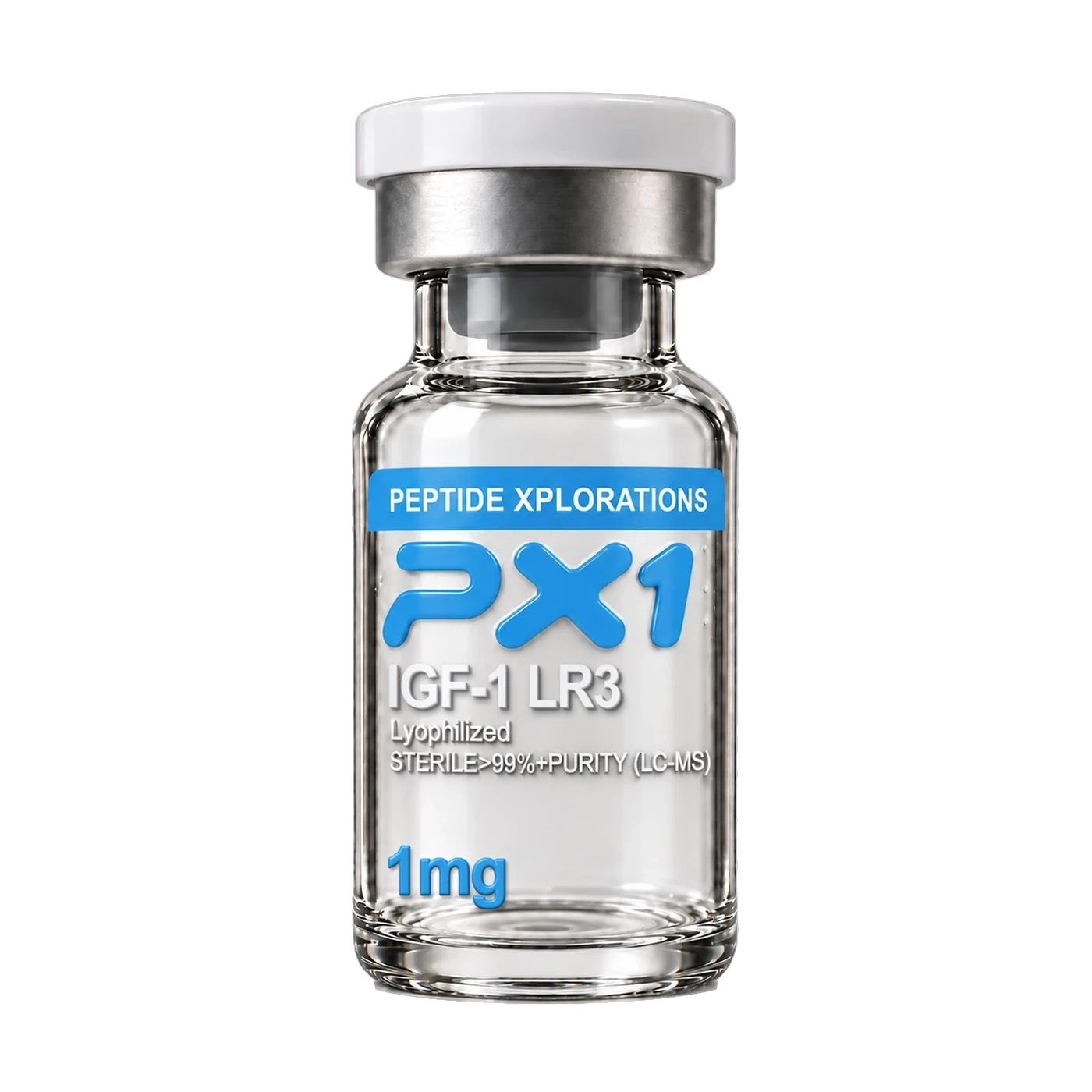
IGF-1 LR3 1mg
Lot Pending
Independent laboratory
HPLC purity
Pending
Result pending

Made in the USA
Ships from the USA
Peptides
Research monograph on IGF-1 LR3 (Long R3 insulin-like growth factor-1) — an 83-residue IGF-1 analog used as a reference compound in receptor-signalling and cell-culture research. Covers structure, mechanism, purity verification, handling and comparisons.
Strength
Quantity
Bundle & Save
PX1 Autoship 10%
Ships every 30 days · Cancel anytime
Per shipment
$124.99 $112.49
Subscription length
Login required. Manage anytime from Account → Subscriptions.
For research use only. Not for human or animal consumption.
Molecular weight
9117.9 g/mol
Molecular formula
C₉₉₀H₁₅₂₈N₂₆₂O₃₀₀S₇
CAS number
946870-92-4
Chain length
83 amino acids
Classification: Research peptide
The complete primary structure is reported only when it can be verified for the exact compound and modification supplied.
Batch verification
Independent testing with lot-specific analytical documentation.
Lot Pending
Independent laboratory
HPLC purity
Pending
Result pending
Full GHS 16-section Safety Data Sheet for IGF-1 LR3, prepared per OSHA HazCom 2012 (29 CFR 1910.1200). Includes substance identity, handling & storage, PPE, stability, transport and regulatory information.
CAS No.
946870-92-4
Formula
C₉₉₀H₁₅₂₈N₂₆₂O₃₀₀S₇
Mol. Weight
9117.9 g/mol
Classification
Not hazardous (GHS)
Research monograph on IGF-1 LR3 (Long R3 insulin-like growth factor-1) — an 83-residue IGF-1 analog used as a reference compound in receptor-signalling and cell-culture research. Covers structure, mechanism, purity verification, handling and comparisons.
IGF-1 LR3 is classified on this page as a research peptide and is supplied in a lyophilized research preparation. The presentation is intended to support controlled laboratory workflows, analytical method development, and documented preclinical or in-vitro investigation appropriate to the compound.
PX1 Research manufactures and finishes this product in American GMP laboratories rather than purchasing finished vials from overseas. Each released lot is evaluated through the PX1 quality program, with identity, purity, appearance, and applicable contaminant or endotoxin results documented on the lot-linked Certificate of Analysis. Researchers should review the current COA and Safety Data Sheet shown on this page before beginning work.
Store the sealed preparation at −20°C for long-term stability and protect it from light. Bring the closed vial to room temperature before opening, follow the laboratory's validated preparation protocol, and minimize repeated freeze–thaw cycles. Use calibrated equipment, document concentration and storage conditions, and follow institutional safety procedures throughout the study.
For research use only. Not for human or veterinary use, consumption, diagnosis, treatment, or medical application. This material should be handled only by qualified professionals in an appropriate laboratory setting.
Purity (HPLC)
≥99%
Application
For Research Use only
Form
Lyophilized Powder
Storage
-20°C Long Term
Testing
Third Party Tested
Manufacture
USA
99%+ HPLC Purity
Independently verified by accredited US laboratory
Endotoxin-Screened
LAL tested, LPS-free, endotoxin report available
GMP-Certified Manufacturing
USA facility, ISO 9001:2015
Lyophilized for Stability
Shipped cold-packed and sealed for stability
Supplied as a research-grade compound for in-vitro and laboratory investigation.
For research use only — not for human or animal consumption.
IGF-1 LR3 is an 83-amino-acid recombinant analog of insulin-like growth factor 1 carrying a 13-residue N-terminal extension and an arginine substitution at position 3. The modifications lower binding-protein affinity, giving a longer research half-life than native IGF-1 in cell-culture models.
| Compound name | IGF-1 LR3 |
|---|---|
| Research code | Long R3 IGF-1 |
| CAS registry number | 946870-92-4 |
| Molecular formula | C400H625N111O116S9 |
| Molar mass | ≈9117.6 g/mol |
| Chain length | 83 amino acids |
| Physical form | Lyophilized white powder |
| Purity specification | ≥99% by reversed-phase HPLC; identity confirmed by LC-MS |
| Intended use | Research use only — not for human or veterinary use |
Research monograph
IGF-1 LR3, commonly written Long R3 IGF-1, is a recombinant analog of human insulin-like growth factor-1. It differs from native IGF-1 in two defined ways: a 13-residue extension is added at the N-terminus, and the arginine at position 3 replaces the native glutamic acid. The result is an 83-amino-acid protein of roughly 9.1 kDa, compared with the 70-residue native molecule.
The arginine substitution at position 3 markedly reduces affinity for insulin-like growth factor binding proteins (IGFBPs), which in serum-containing culture sequester the majority of native IGF-1. Because far less of the analog is bound, a larger free fraction remains available to interact with the IGF-1 receptor in the same experimental system — which is precisely why the analog, rather than native IGF-1, became the standard reference tool in serum-supplemented cell-culture work.
PX1 Research supplies lyophilized IGF-1 LR3 as a reference compound for receptor characterization, cell-culture supplementation studies and analytical method development. Every vial ships with a batch-specific certificate of analysis. IGF-1 LR3 is offered strictly for research use only and is not for human or veterinary use.
IGF-1 LR3 binds the IGF-1 receptor, a receptor tyrosine kinase, triggering autophosphorylation and recruitment of IRS-1 and Shc. Downstream, the PI3K/Akt and MAPK/ERK cascades are the two arms most frequently measured in published work — the former in studies of protein synthesis and cell survival signalling, the latter in proliferation readouts.
The analog also retains measurable affinity for the insulin receptor, as native IGF-1 does, so receptor-selectivity controls matter in any design intended to isolate IGF-1 receptor signalling. Standard practice is to include a receptor-blocking antibody or a selective inhibitor arm rather than to assume selectivity from the ligand alone.
The functional consequence of reduced IGFBP binding is a longer effective residence time in serum-containing media. In practical terms this means a lower nominal concentration of the analog produces the signalling amplitude that a substantially higher concentration of native IGF-1 would require in the same medium — a difference driven by availability, not by intrinsic potency at the receptor.
IGF-1 LR3 is a folded protein with three disulfide bonds, which makes its release panel different in kind from that of a short synthetic peptide. Reversed-phase HPLC establishes chemical purity against a ≥99% specification, but size-exclusion analysis is what detects the failure mode that matters most for this molecule: aggregation and dimer formation. An aggregated lot can present acceptable chemical purity and still behave poorly in receptor work.
Identity is confirmed by liquid chromatography-mass spectrometry against the theoretical mass of the 83-residue chain. Because misfolded and correctly folded material share a mass, retention behaviour relative to a characterized reference lot is used as a second identity criterion, and the published chromatogram lets a receiving laboratory compare its own analysis directly.
Each lot additionally carries endotoxin by kinetic chromogenic LAL — critical for a compound destined for cell culture, where endotoxin alone changes proliferation readouts — plus water content by Karl Fischer titration and net peptide content. All figures are lot-matched to the batch number on the vial and published on the certifications page.
Native IGF-1 is the biological reference: fully IGFBP-bound in serum, short-lived, and the correct arm when the question concerns physiological availability. IGF-1 LR3 is the low-IGFBP-affinity arm, used when the question concerns receptor signalling and binding-protein sequestration would otherwise dominate the result. DES(1-3) IGF-1 is a truncated analog missing the first three residues, which also reduces IGFBP binding but by deletion rather than substitution and extension.
Comparative designs typically run all three because they separate two variables that are otherwise confounded — intrinsic receptor engagement and binding-protein availability. Using only the analog and attributing the difference to potency is the most common interpretive error in this compound family.
Researchers working across growth-axis compounds often pair IGF-1 LR3 with upstream secretagogues such as Tesamorelin, CJC-1295 and Ipamorelin. Those act on secretion of endogenous growth hormone; IGF-1 LR3 is a downstream ligand applied directly. They occupy different positions in a mechanistic chain and are not substitutes for one another.
What does LR3 stand for? Long R3 — the 13-residue N-terminal extension (Long) plus the arginine substitution at position 3 (R3).
Why add BSA to working dilutions? To occupy adsorption sites on tube and plate surfaces. At nanogram-per-millilitre concentrations, surface loss without a carrier protein can consume most of the protein in the tube.
How is aggregation detected? By size-exclusion chromatography on the release panel, not by visual inspection. This is why the lot certificate for a folded protein reports more than reversed-phase purity.
Does IGF-1 LR3 require different storage from short synthetic peptides? The lyophilized storage temperature is the same, but solution stability is shorter and freeze-thaw tolerance is lower. Single-use aliquots are standard practice.
Is IGF-1 LR3 supplied for human use? No. It is supplied strictly as a research reference compound, is not for human or veterinary use, and no dosing guidance is provided.
All products are sold strictly for laboratory and research use only. Not for human or veterinary use, diagnosis, treatment or consumption. Statements have not been evaluated by the FDA.
High Quality — 99% Purity Guaranteed
We are continuously conducting HPLC testing on all of our raw powders as well as our finished products to ensure the quality of what we ship. You can have the product you bought from us independently tested at any HPLC-licensed testing facility — and if the results come back negative, we will refund the following:
HPLC Test Fee
$100
Plus a full refund
Total order amount + shipping
IGF-1 LR3
$124.99