Peptide In testing8 assays
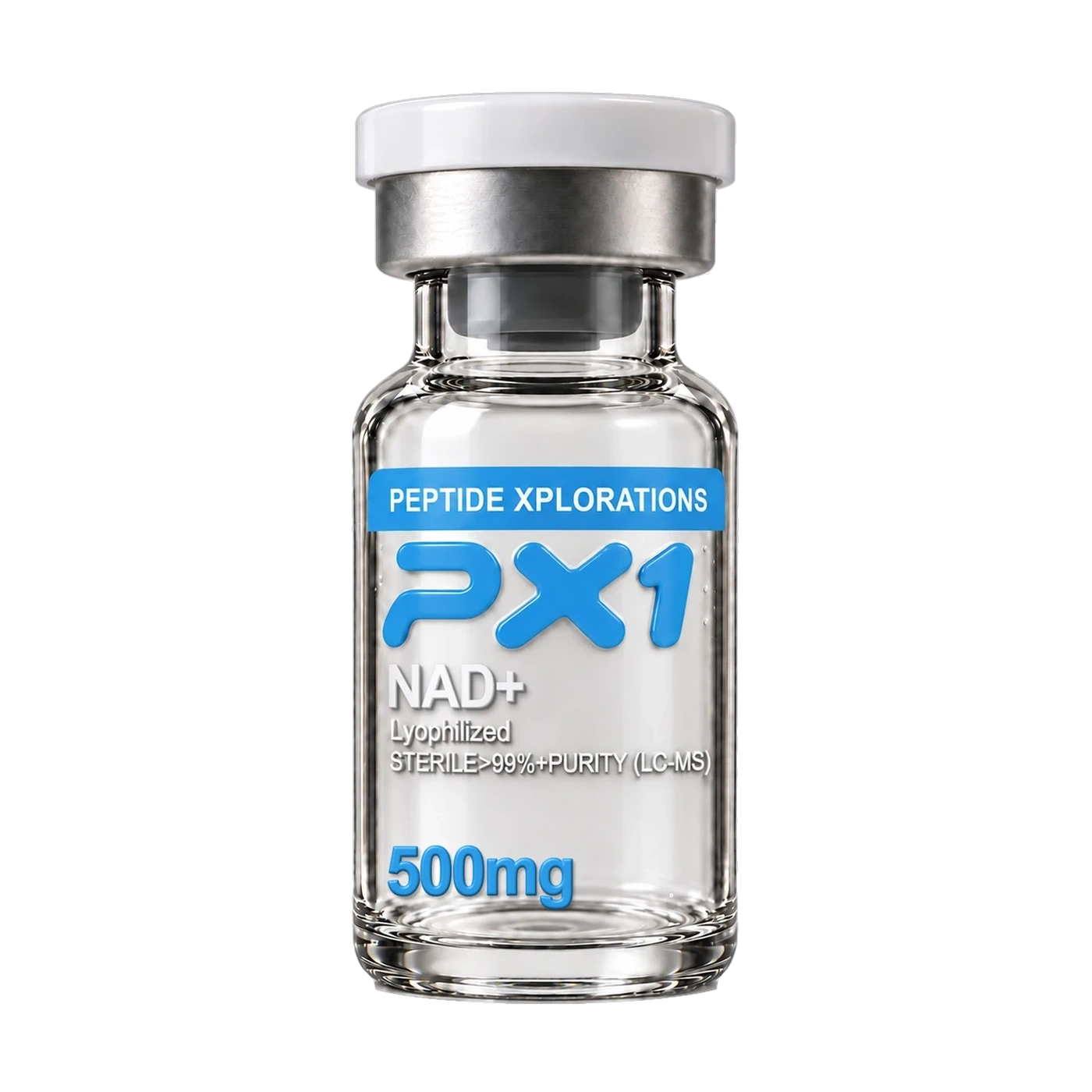
NAD+ 500mg
Lot Pending
Independent laboratory
Independent laboratory
HPLC purity
Pending
Result pending
Peak graph available when testing is complete
Labeled amount500mg
Measured amountPending
IdentityPending
TestedPending
Made in the USA
Ships from the USA
Peptides
Research monograph on NAD+ (nicotinamide adenine dinucleotide) — the central redox cofactor used across mitochondrial, sirtuin and DNA-repair research.
Strength
Quantity
Bundle & Save
Subscribe & Save 10%
Ships every 30 days · Cancel anytime
Per shipment
$95.00 $85.50
Subscription length
Login required. Manage anytime from Account → Subscriptions.
For research use only. Not for human or animal consumption.
Molecular weight
663.43 g/mol
Molecular formula
C₂₁H₂₇N₇O₁₄P₂
CAS number
53-84-9
Chain length
Not assigned for this material
Classification: Non-peptide research compound
This compound is not a peptide, so an amino-acid sequence does not apply.
Batch verification
Independent testing with lot-specific analytical documentation.
Lot Pending
Independent laboratory
Independent laboratory
HPLC purity
Pending
Result pending
Full GHS 16-section Safety Data Sheet for NAD+, prepared per OSHA HazCom 2012 (29 CFR 1910.1200). Includes substance identity, handling & storage, PPE, stability, transport and regulatory information.
CAS No.
53-84-9
Formula
C₂₁H₂₇N₇O₁₄P₂
Mol. Weight
663.43 g/mol
Classification
Not hazardous (GHS)
PX1 Research welcomes the scientific community to this technical review of a cornerstone molecule in cellular biology: Beta-Nicotinamide Adenine Dinucleotide (NAD). Our 250mg vials provide a high-grade, purified chemical essential for the study of metabolic processes, longevity, genomic maintenance, and cellular toughness. Serving as a vital substrate for enzyme signaling and a primary driver of redox homeostasis, NAD offers an expansive field for experimental exploration. This guide acts as a technical reference to assist in the development of your laboratory protocols.
As an indispensable coenzyme present in all living cells, NAD facilitates two primary physiological branches:
A leading premise in contemporary biogerontology suggests that NAD levels diminish as organisms age. This reduction is linked to the primary markers of aging, such as a loss of proteostasis, epigenetic shifts, and mitochondrial decay. Consequently, high-purity research compounds from PX1 Research are indispensable for testing methods to stabilize or elevate NAD levels in laboratory models.
The following domains represent the primary research areas for our 250mg NAD+ vials in in-vitro settings, supported by established scientific literature.
2.1 Investigating Mitochondrial Function and Biogenesis
Mitochondrial performance is a proxy for cellular health. As the immediate precursor to NADH, NAD fuels the respiratory chain. It also triggers SIRT1 and SIRT3, which in turn activate PGC-1α—the primary orchestrator of mitochondrial synthesis.
2.2 Exploring DNA Repair Mechanisms and Genomic Stability
A central theme in aging research is the decline of genomic stability. In the nucleus, PARP enzymes are heavy consumers of NAD, utilizing it to synthesize poly(ADP-ribose) chains that mark damaged DNA and attract repair proteins.
2.3 Studying Sirtuin-Mediated Pathways in Cellular Aging
As NAD-dependent deacetylases, sirtuins connect energy availability to metabolic gene regulation. SIRT1 (nuclear-focused) and SIRT3 (mitochondrial-focused) are vital to regulating metabolism and stress responses.
2.4 Neuroprotection and Cognitive Function Research
The high metabolic demands of the brain make it sensitive to NAD depletion. Scientific inquiry has connected waning NAD+ levels with numerous neurodegenerative states.
Modern scientific inquiry frequently looks at how compounds work together to create collaborative effects.
Product Specification:
Why Choose PX1 Research for Your NAD+ Research?
This 250mg supply of high-purity NAD+ from PX1 Research is a foundational resource for investigating the biology of metabolism and aging. Because NAD decline is a consistent trait across various species, studying it is vital to understanding age-related biological breakdown. By offering a refined source of this coenzyme, we enable scientists to perform nuanced experiments on sirtuin signaling, mitochondrial power, and PARP-driven DNA maintenance.
The referenced studies represent only the beginning. Future NAD research will focus on cell-specific interactions and combination treatments. PX1 Research remains dedicated to providing the high-caliber materials necessary for your discoveries.
Secure your 250mg vial of NAD+ today to further your investigation into cellular longevity and health.
This laboratory-grade NAD+ is a fundamental coenzyme for sophisticated in-vitro studies. It serves as a vital instrument for focusing on DNA maintenance, energy metabolism, sirtuin pathways, and the core biology of living systems.
Purity: ≥98% (HPLC Verified) Storage: Maintain at -20°C or colder.
Remember: PX1 Research products are for laboratory research use only. Not for human or veterinary consumption.
Purity (HPLC)
≥99%
Application
For Research Use only
Form
Lyophilized Powder
Storage
-20°C Long Term
Testing
Third Party Tested
Manufacture
USA
99%+ HPLC Purity
Independently verified by accredited US laboratory
Endotoxin-Screened
LAL tested, LPS-free, endotoxin report available
GMP-Certified Manufacturing
USA facility, ISO 9001:2015
Lyophilized for Stability
Shipped cold-packed and sealed for stability
Studied for cellular energy metabolism, DNA repair pathways and longevity research.
For research use only — not for human or animal consumption.
Research monograph
Nicotinamide adenine dinucleotide (NAD+) is a dinucleotide cofactor present in every living cell, formed from an adenine nucleotide joined to a nicotinamide nucleotide through their phosphate groups. It cycles between oxidized (NAD+) and reduced (NADH) states and is the primary electron carrier in central carbon metabolism.
PX1 Research supplies high-purity lyophilized NAD+ for in-vitro biochemical assay work, enzyme kinetics and mitochondrial research where cofactor purity directly determines assay signal quality.
Beyond redox chemistry, NAD+ is consumed as a substrate by three enzyme families: sirtuins (NAD+-dependent deacylases), poly-ADP-ribose polymerases involved in DNA damage response, and CD38/CD157 ectoenzymes. These consuming reactions link cellular NAD+ availability to transcriptional regulation, genome maintenance and calcium signaling.
Cellular NAD+ concentrations decline with age in many model organisms, which is why NAD+ and its precursors — nicotinamide riboside and nicotinamide mononucleotide — appear so widely in current longevity research.
NAD+ ships as a lyophilized powder in a sealed, tamper-evident vial. Store the unopened vial between −20°C and −80°C, protected from light, until the day of use. In this state the peptide is stable through the labeled expiration date printed on the lot documentation.
Every PX1 Research lot of NAD+ is manufactured in the United States and released against a documented specification of ≥99% purity by reversed-phase HPLC, with identity confirmed on the same lot by high-resolution LC-MS against the theoretical mass of the sequence.
NAD+ supplied by PX1 Research is intended strictly for in-vitro laboratory and research applications. It is not a drug, food, cosmetic, or medical device, and it is not for human or veterinary use, diagnosis, treatment, or consumption.
Researchers are responsible for handling the compound in accordance with their institution's safety procedures and all applicable local regulations. Safety data sheets and current lot documentation are available on this site.
NAD+ (nicotinamide adenine dinucleotide) is not a peptide but a dinucleotide coenzyme, and its analytical requirements differ accordingly. Purity is determined by reversed-phase HPLC with UV detection at 260 nm, where the adenine chromophore absorbs strongly, and the method must resolve NAD+ from nicotinamide mononucleotide, nicotinamide and ADP-ribose — the degradation and precursor species that a coarse gradient reports as a single front peak.
Identity is confirmed by mass spectrometry against the theoretical mass of the oxidized dinucleotide. The oxidized and reduced forms, NAD+ and NADH, differ in both mass and spectral behavior, and a lot in which a fraction has reduced is a different test article for enzymology even though the nominal name is unchanged.
Each lot carries endotoxin by kinetic chromogenic LAL, residual solvents by gas chromatography and water content by Karl Fischer titration. Water content is particularly relevant for this compound because the lyophilized powder is hygroscopic and adsorbed moisture both inflates the apparent mass and accelerates hydrolysis of the pyrophosphate linkage.
NMN (nicotinamide mononucleotide) and NR (nicotinamide riboside) are biosynthetic precursors within the salvage pathway that converges on NAD+. Studies comparing them address pathway entry point and cellular uptake rather than the coenzyme's own chemistry, so a design intending to supply the coenzyme directly and one intending to supply a precursor are answering different questions.
MOTS-c is a mitochondrially encoded peptide described in the literature in connection with metabolic and retrograde signaling, and it appears alongside NAD+ in mitochondrial-function work. The two are mechanistically unrelated at the molecular level — one is a coenzyme consumed by enzymatic reactions, the other a signaling peptide — and pairing them in a study design reflects a shared research area, not a shared mechanism.
Because NAD+ is a substrate for sirtuins, PARPs and CD38 as well as for classical redox enzymes, in-vitro work using it typically has to state which enzyme class is under study. The same vial serves very different assays, and the appropriate purity check — resolving NMN and nicotinamide, or resolving NADH — depends on which one.
Is NAD+ a peptide? No. It is a dinucleotide coenzyme, which is why its certificate reports UV-based purity at 260 nm and mass confirmation of the oxidized dinucleotide rather than peptide-specific parameters such as sequence-related truncation impurities.
How does NAD+ differ from NMN and NR? NMN and NR are precursors that enter the salvage pathway upstream; NAD+ is the coenzyme itself. Substituting one for another changes the research question, not just the material.
Why is NAD+ solution so short-lived? Its pyrophosphate and nicotinamide-ribose linkages are hydrolytically labile at alkaline and acidic pH respectively, and the degradation products are biologically active in their own right. Aged solutions therefore drift in composition rather than simply losing potency.
What should a NAD+ certificate show? A chromatogram on a method that visibly resolves NMN, nicotinamide and ADP-ribose from the parent peak, mass confirmation of the oxidized form, water content by Karl Fischer, endotoxin by LAL and residual solvents by gas chromatography — all for the specific lot in the vial.
All products are sold strictly for laboratory and research use only. Not for human or veterinary use, diagnosis, treatment or consumption. Statements have not been evaluated by the FDA.
High Quality — 99% Purity Guaranteed
We are continuously conducting HPLC testing on all of our raw powders as well as our finished products to ensure the quality of what we ship. You can have the product you bought from us independently tested at any HPLC-licensed testing facility — and if the results come back negative, we will refund the following:
HPLC Test Fee
$100
Plus a full refund
Total order amount + shipping
NAD+
$95.00