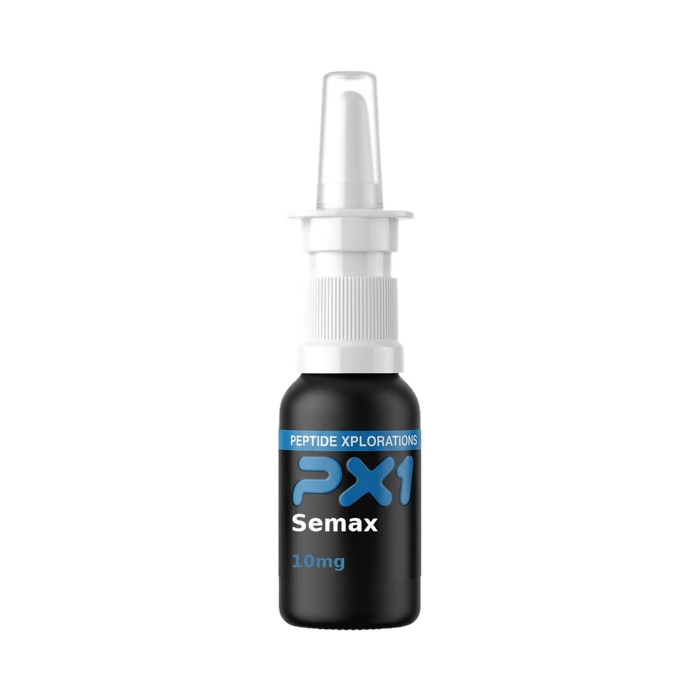
Semax Nasal 10mg
Lot px1smxsp-0022 · Verified
99%+
Purity
HPLC
10.49mg
Net content
label 10mg · +4.9%
Confirmed
Identity
Semax · MS
- HPLC purity
- Mass spec
- Net content
- Lot matched
Peak graph available when testing is complete
Made in the USA
Ships from the USA
Nasal Sprays
Semax is a synthetic ACTH-fragment-related heptapeptide.
Strength
Pack size
Earn up to 324 points · $3.24 back in Research Credit
Earn 2.5 pts / $1 · Redeem 100 pts = $1 · Covers up to 50% of an order · How points work
For research use only. Not for human or animal consumption.
Checking today's dispatch cutoff…
Cutoff is 2:00 PM Pacific on weekdays, 12:00 PM Pacific on Saturday.
Referral program · researchers save 15%, you earn 18% back
Lot shipping px1smxsp-0022 · 10mg
ILS Laboratories · Tested Oct 2, 2026
Lot px1smxsp-0022 · Verified
99%+
Purity
HPLC
10.49mg
Net content
label 10mg · +4.9%
Confirmed
Identity
Semax · MS
Semax Nasal • ACTH(4-10) regulatory peptide analog • 10mg • Third party tested • Research use only
ACTH(4-10) regulatory peptide analog · Research peptide
Semax is a synthetic ACTH-fragment-related heptapeptide.
Investigated in preclinical models for neurotrophic signaling, BDNF-pathway expression and cellular responses to neurological stress.
10mg
Strength
99%+
HPLC purity
Lyophilized
Form
-20°C
Long-term storage
99%+ HPLC Purity
Independently verified by accredited US laboratory
Endotoxin-Screened
LAL tested, LPS-free, endotoxin report available
GMP-Certified Manufacturing
USA facility, ISO 9001:2015
Lyophilized for Stability
Shipped cold-packed and sealed for stability
What's in the vial
813.92 g/mol
C₃₇H₅₁N₉O₁₀S
80714-61-0
7 amino acids
Amino-acid sequence
Met-Glu-His-Phe-Pro-Gly-Pro
Classification: Research peptide
Specifications & quality
Purity (HPLC)
99%+
Application
For Research Use only
Form
Lyophilized Powder
Storage
-20°C Long Term
Testing
Third Party Tested
Manufacture
USA
Welcome to PX1 Research, your premier provider of high-caliber, research-grade biochemical compounds. Our Semax Research Peptide is a meticulously purified synthetic heptapeptide (Met-Glu-His-Phe-Pro-Gly-Pro) featuring a sequence that mirrors a specific fragment of adrenocorticotropic hormone (ACTH). Initially engineered in Russia, Semax has established itself as a fundamental molecule in preclinical neurological research due to its diverse impact on neuroprotection, cognitive performance, and the expression of brain-derived neurotrophic factor (BDNF).
This agent is developed and produced solely for scientific inquiry within regulated laboratory settings. It is intended exclusively for research applications and is not for human or veterinary use, nor for the diagnosis or treatment of any clinical condition.
CRITICAL NOTICE: This substance is provided strictly for research purposes. Its use is limited to qualified scientists in controlled laboratory environments. By completing a purchase, you acknowledge the intended application of this product and commit to following all local, state, and federal laws regarding the handling of research chemicals.
Our Semax is manufactured to rigorous specifications and is subjected to exhaustive third-party High-Performance Liquid Chromatography (HPLC) and Mass Spectrometry testing to confirm a purity level of ≥99%. This ensures high reliability and reproducibility for sensitive experiments focusing on cellular pathways and neurological systems.
Primary Research Applications: Memory and learning assessment protocols Models of ischemic cerebral injury Investigations into neurodegenerative pathology Studies on ocular neuroprotection
Semax belongs to a distinct category of research peptides with verified activity across various neurological circuits. Its utility in the lab covers several essential domains of modern neuroscience:
This 10mg vial of ultra-pure Semax offers investigators a consistent medium for studying intricate neurological events in in vitro and preclinical frameworks.
Mechanism of Action: The nootropic-like properties of Semax are driven by several linked pathways currently under intense scientific scrutiny:
Research Applications & Key Studies:
Proposed Research Protocols for Cognitive Investigation:
Best for: Probing the mechanics of memory, investigating the role of BDNF in mental processing, and creating strategies for cognitive improvement.
Mechanism of Action: The capacity of Semax to protect nervous tissue is a significant focal point of research, particularly concerning acute brain trauma:
Research Applications & Key Studies:
Proposed Research Protocols for Neuroprotection:
Best for: Studying ischemic stroke, neurodegenerative pathology, traumatic brain injury, and the general biology of neuronal cell survival.
Mechanism of Action: Because the retina serves as an extension of the CNS, the neuroprotective benefits of Semax are applicable to eye-related structures:
Research Applications & Key Studies:
Proposed Research Protocols for Ophthalmic Investigation:
Best for: Investigating glaucoma models, optic neuritis, retinal ischemia, and various neurodegenerative conditions of the eye.
Mechanism of Action: Semax differs from standard ACTH by modulating the stress response adaptively rather than provoking corticosteroid release:
Research Applications & Key Studies:
Proposed Research Protocols for Stress Investigation:
Best for: Exploring stress physiology, HPA axis mechanics, emotional stability, and models of depression and anxiety.
Routes of Administration:
Example Study Design (Neuroprotection):
Secure your Semax Research Peptide from PX1 Research today to progress your studies in neuroprotection, cognitive behavior, and BDNF-driven synaptic plasticity.
Disclaimer: This material is for laboratory research use only. Not for use as a drug, food additive, or in human/veterinary clinical applications. Information provided is an educational summary of scientific literature for the research community and does not constitute medical advice. Buyers must be 18+ years of age. Use appropriate protective equipment and sterile techniques during handling.
Full GHS 16-section Safety Data Sheet for Semax, prepared per OSHA HazCom 2012 (29 CFR 1910.1200). Includes substance identity, handling & storage, PPE, stability, transport and regulatory information.
CAS No.
80714-61-0
Formula
C₃₇H₅₁N₉O₁₀S
Mol. Weight
813.92 g/mol
Classification
Not hazardous (GHS)
Questions & answers
Research monograph
Semax is a synthetic heptapeptide analog of the ACTH(4-10) fragment, extended at the C-terminus with Pro-Gly-Pro to resist peptidase cleavage. Unlike the parent hormone fragment, Semax lacks corticotropic activity, which allows researchers to isolate the neurotropic component of melanocortin signaling.
PX1 Research supplies lyophilized Semax as a reference neuropeptide for cognitive, neuroprotection and BDNF-pathway research.
Semax has been reported in rodent models to elevate brain-derived neurotrophic factor and its receptor TrkB in the hippocampus, and to modulate dopaminergic and serotonergic turnover. Transcriptomic studies describe broad changes in genes related to the immune response and vascular tone following administration in ischemia models.
In laboratory comparisons Semax and Selank are studied together as the two best-characterized members of the Russian regulatory-peptide class.
Semax ships as a lyophilized powder in a sealed, tamper-evident vial. Store the unopened vial between −20°C and −80°C, protected from light, until the day of use. In this state the peptide is stable through the labeled expiration date printed on the lot documentation.
Every PX1 Research lot of Semax is manufactured in the United States and released against a documented specification of ≥99% purity by reversed-phase HPLC, with identity confirmed on the same lot by high-resolution LC-MS against the theoretical mass of the sequence.
Semax supplied by PX1 Research is intended strictly for in-vitro laboratory and research applications. It is not a drug, food, cosmetic, or medical device, and it is not for human or veterinary use, diagnosis, treatment, or consumption.
Researchers are responsible for handling the compound in accordance with their institution's safety procedures and all applicable local regulations. Safety data sheets and current lot documentation are available on this site.
All products are sold strictly for laboratory and research use only. Not for human or veterinary use, diagnosis, treatment or consumption. Statements have not been evaluated by the FDA.
High Quality · 99% Purity Guaranteed
We are continuously conducting HPLC testing on all of our raw powders as well as our finished products to ensure the quality of what we ship. You can have the product you bought from us independently tested at any HPLC-licensed testing facility, and if the results come back negative, we will refund the following:
HPLC Test Fee
$100
Plus a full refund
Total order amount + shipping
For laboratory research use only. Not for human or animal consumption.
Semax Nasal10mg / 1 Unit
$129.99