Peptide Verified8 assays
TB-500 (Thymosin Beta-4) 10mg 10mg
Lot PX1TB10-0021
ILS Laboratories
Independent laboratory
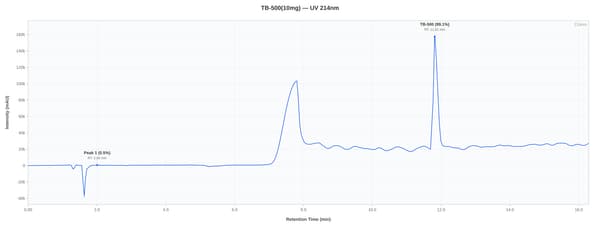
HPLC purity
99.15%
High purity confirmed
Labeled amount10mg
Measured amountSee certificate
IdentityTB-500
TestedJul 31, 2026
Made in the USA
Ships from the USA
Peptides
Research monograph on TB-500 — the synthetic actin-binding fragment of thymosin beta-4. Covers actin sequestration, cell-migration research, comparison against BPC-157, laboratory handling and published literature.
Strength
Quantity
Bundle & Save
Subscribe & Save 10%
Ships every 30 days · Cancel anytime
Per shipment
$279.00 $251.10
Subscription length
Login required. Manage anytime from Account → Subscriptions.
For research use only. Not for human or animal consumption.
Molecular weight
4963.44 g/mol
Molecular formula
C₂₁₂H₃₅₀N₅₆O₇₈S
CAS number
77591-33-4
Chain length
43 amino acids
Classification: Research peptide
The complete primary structure is reported only when it can be verified for the exact compound and modification supplied.
Batch verification
Independent testing with lot-specific analytical documentation.
Lot PX1TB10-0021
ILS Laboratories
Independent laboratory
HPLC purity
99.15%
High purity confirmed
Full GHS 16-section Safety Data Sheet for TB-500, prepared per OSHA HazCom 2012 (29 CFR 1910.1200). Includes substance identity, handling & storage, PPE, stability, transport and regulatory information.
CAS No.
77591-33-4
Formula
C₂₁₂H₃₅₀N₅₆O₇₈S
Mol. Weight
4963.44 g/mol
Classification
Not hazardous (GHS)
Thymosin Beta-4 (TB-500) consists of a 43-amino-acid sequence found naturally in various tissues, serving as a vital factor in actin sequestration, cellular relocation, and structural healing. As a primary subject in anti-inflammatory, wound recovery, and restorative medicine investigations, TB-500 has exhibited notable capability in laboratory models involving the study of:
Restoration of connective tissue (muscles, ligaments, and tendons) Vascularization (angiogenesis) signaling Anti-scarring (fibrosis prevention) in vital organ models Regulation of inflammatory signaling molecules Reconfiguration of the actin cytoskeleton
At PX1 Research, we supply HPLC-tested TB-500 at ≥99% purity levels exclusively for authorized laboratory settings. This substance is not for use in humans or animals and must be managed only by credentialed investigators following standard safety protocols.
Production in USP-standard environments Sterile-processed lyophilization Management under ISO 9001 quality controls
| Peptide | Core Research Utility | Primary Benefit | Stability Profile |
|---|---|---|---|
| TB-500 | Tissue repair, vascularization | Systemic reach | Stable at -20°C |
| BPC-157 | Localized site healing | Digestive health focus | Ambient temp (temporary) |
| PEG-MGF | Muscle fiber synthesis | IGF-1 pathway | Needs -80°C |
Distinctive Features of TB-500: Wider systemic distribution compared to site-specific peptides Greater resilience than traditional growth proteins like IGF-1 Complementary action with BPC-157 during trauma simulations
Mandatory IACUC oversight for all vertebrate research Full PPE usage (safety glasses, lab coats, and gloves)
Regulatory Status:
Support for IRB/IACUC documentation Availability in bulk for multi-phase trials Secure, private transit to US-based institutions Data sheets (MSDS) and stability reports provided
Catalog ID: EBX-TB500-5 Physical State: Lyophilized white powder Assay Purity: ≥99% (HPLC) Molecular Weight: 4963.5 Da CAS Registry Number: 77591-33-4
Warning: This material is intended only for laboratory investigation. By completing this purchase, the buyer agrees that the product will not be used for veterinary or human consumption.
Empower your regenerative discoveries with PX1 Research – precision science for the modern lab!
Purity (HPLC)
≥99%
Application
For Research Use only
Form
Lyophilized Powder
Storage
-20°C Long Term
Testing
Third Party Tested
Manufacture
USA
99%+ HPLC Purity
Independently verified by accredited US laboratory
Endotoxin-Screened
LAL tested, LPS-free, endotoxin report available
GMP-Certified Manufacturing
USA facility, ISO 9001:2015
Lyophilized for Stability
Shipped cold-packed and sealed for stability
Investigated for promoting cell migration, blood-vessel formation and flexibility during soft-tissue and muscle-fiber recovery.
For research use only — not for human or animal consumption.
TB-500 is the synthetic active fragment of thymosin beta-4, a 43-amino-acid actin-sequestering peptide. Research models use it to study actin polymerization, cell migration and angiogenic signaling in tissue-repair experiments, most often alongside BPC-157 as a comparator.
| Compound name | TB-500 |
|---|---|
| Research code | Thymosin beta-4 fragment |
| CAS registry number | 77591-33-4 |
| Molecular formula | C212H350N56O78S |
| Molar mass | ≈4963.4 g/mol |
| Chain length | 43 amino acids |
| Physical form | Lyophilized white powder, acetate salt |
| Purity specification | ≥99% by reversed-phase HPLC; identity confirmed by LC-MS |
| Intended use | Research use only — not for human or veterinary use |
Research monograph
TB-500 is a synthetic peptide corresponding to the actin-binding domain of thymosin beta-4 (Tβ4), a 43-amino-acid protein that is one of the most abundant intracellular proteins in mammalian cells. Rather than reproducing the full protein, TB-500 reproduces the short region responsible for the actin-sequestering activity, which makes it far more tractable to synthesize, purify and characterize.
Thymosin beta-4 itself is not a hormone or a receptor ligand in the conventional sense. Its principal described function is G-actin sequestration: it binds monomeric actin and maintains a cellular pool available for rapid polymerization, which places it upstream of essentially every process requiring cytoskeletal remodeling — cell migration, wound closure and angiogenesis among them.
PX1 Research supplies lyophilized TB-500 as a reference compound for cytoskeletal, cell-migration and tissue-repair research, released against a batch-specific certificate of analysis. Research use only — not for human or veterinary use.
The actin-binding motif is the functional core of the molecule. By binding G-actin, the fragment shifts the equilibrium between monomeric and filamentous actin, and the literature associates this with increased cell motility in scratch-wound and transwell migration assays. Because actin dynamics are universal, the described effects are not tissue-specific, which is why the Tβ4 literature spans dermal, corneal, cardiac and neural models.
Beyond actin sequestration, published work on thymosin beta-4 has reported effects on angiogenic signaling and on inflammatory mediator expression, and has examined interactions with the extracellular matrix. Reports differ on how much of the parent protein's activity is retained by the short synthetic fragment, and that question is itself a recurring experimental design in the field.
TB-500 is one of the more stable research peptides in solution relative to its length, though it remains subject to the same aggregation and adsorption losses as any peptide at dilute working concentration.
TB-500 and BPC-157 are the canonical pairing in tissue-repair research, sold together in blended preparations such as the Wolverine blend and studied together because their described mechanisms are complementary rather than overlapping. BPC-157 work centers on angiogenic and nitric-oxide-pathway signaling; TB-500 work centers on the actin cytoskeleton and cell migration. A repair model that requires both new vasculature and cell movement engages both descriptions.
When the two are supplied as a blend, the analytical burden roughly doubles: the release method must resolve both peptides and their separate impurity profiles in one chromatographic run, and mass spectrometry must confirm two intact masses in the expected ratio. Blends released only against a single-peptide method are under-characterized.
Some study designs add GHK-Cu to the pair, on the reasoning that copper-peptide extracellular-matrix effects address a third axis of the same repair process. Those three-component preparations carry a correspondingly heavier characterization requirement, including copper stoichiometry.
Laboratories that work with TB-500 typically characterize incoming material on three axes before it enters a study: identity, purity and content. Identity is established by high-resolution mass spectrometry against the theoretical monoisotopic mass (≈4,963 Da for the acetylated fragment as supplied), usually supported by MS/MS fragmentation that walks the backbone and confirms the sequence rather than just the total mass. A matching intact mass alone can be satisfied by a scrambled or partially epimerized sequence, which is why fragmentation data is the stronger identity evidence.
Purity is quantified by reversed-phase HPLC with UV detection, integrating every resolved peak in the chromatogram and expressing the main peak as a percentage of total area. The gradient matters more than the headline number: a shallow, well-optimized gradient resolves closely eluting process impurities such as deamidation products, oxidation variants, truncated sequences and acetate adducts, while an aggressive gradient can co-elute them under the main peak and inflate the reported purity. PX1 publishes the chromatogram itself, not only the integrated figure, so the resolution behind the number is auditable.
Content — how much peptide is actually in the vial once counter-ions and residual water are subtracted — is the axis most often skipped by low-cost suppliers. Net peptide content is a function of the labeled mass, the water content measured by Karl Fischer titration, and the counter-ion (typically trifluoroacetate or acetate) load. A vial that is 99% pure by HPLC can still under-deliver on content if it carries a high salt and moisture fraction, which is why the COA reports both.
PX1 TB-500 is USA-manufactured and released at ≥99% purity by reversed-phase HPLC with LC-MS identity confirmation, kinetic chromogenic LAL endotoxin testing, residual-solvent screening by GC, and Karl Fischer water content. The batch-specific report is published on this product page and its lot number matches the vial label.
The research-peptide market is unusually wide in quality. The same nominal TB-500 listing can represent USA-manufactured material released against a documented specification, or repackaged bulk of unknown origin with a generic certificate that was never generated from the lot in the vial. The distinction is invisible from the product photo and only becomes visible in the paperwork.
The practical test is traceability: the lot number printed on the vial label should appear on the certificate of analysis, and that certificate should show the actual chromatogram and mass spectrum for that lot rather than a representative example. A COA without a lot number, without instrument traces, or dated years before the vial was filled is a document, not evidence. PX1 publishes the batch-specific report directly on the product page so the chain from manufacturing to vial is checkable before purchase.
Beyond the certificate, consistent lab-grade supply depends on synthesis and release happening under one controlled process: domestic solid-phase manufacturing, preparative HPLC purification, lyophilization under validated cycle parameters, and third-party confirmation of purity and endotoxin. TB-500 sold by PX1 Research is produced and released on that pathway and is supplied strictly for laboratory research use — not for human or veterinary use.
Migration assays are the core readout, and they are more sensitive to technique than to compound. Scratch width, cell density at the time of wounding, and whether proliferation was inhibited during the assay window all move the result substantially. A mitomycin-C or serum-restriction arm that separates migration from proliferation is standard practice and its absence is the most common weakness in scratch-assay reports.
Because the parent protein and the synthetic fragment are not identical, any study extending a thymosin beta-4 finding to TB-500 should say so explicitly and, where feasible, include the full protein as a comparator arm. That single addition converts an assumption that runs through much of the secondary literature into a measured comparison.
Direct target engagement is measurable. G-actin binding assays and fluorescent phalloidin imaging of filament organization provide mechanistic evidence in the same experiment as the functional readout, which is considerably stronger than inferring cytoskeletal action from a migration result alone.
For blend work, the BPC-157 pairing should be decomposed into single-agent arms at matched concentrations; otherwise the design can only conclude something about the mixture. Where the study intends to test synergy specifically, a formal combination analysis rather than a simple three-arm comparison is what supports the claim.
Practically, the working-stock concentration should be verified rather than calculated from the vial label, because at the dilute concentrations typical of migration assays adsorptive loss to plasticware is a material fraction of the nominal amount. Low-binding tubes, a carrier protein in the diluent and same-day preparation of working dilutions address most of it.
Is TB-500 the same as thymosin beta-4? Not quite. Thymosin beta-4 is the full 43-amino-acid protein; TB-500 is a synthetic peptide reproducing its actin-binding region. Most of the mechanistic literature was generated with the full protein, and one of the standing questions in the field is how much of that activity the shorter synthetic fragment retains. Papers should be read with attention to which molecule was actually used.
What does actin sequestration actually do? Cells maintain a pool of monomeric G-actin available for rapid polymerization into filaments. Thymosin beta-4 binds and holds that pool. Shifting the monomer-to-filament equilibrium changes how quickly a cell can remodel its cytoskeleton, which is why the described effects show up in migration and wound-closure assays across tissue types rather than in one organ system.
How is TB-500 assayed in vitro? Scratch-wound closure and transwell migration are the standard functional readouts, supported by G-actin binding assays and fluorescent phalloidin imaging of filament organization. Angiogenesis endpoints such as tube-formation assays appear frequently in the parent-protein literature and are commonly carried over.
Why do blends complicate release testing? A BPC-157 + TB-500 preparation must be characterized as a two-analyte problem: one chromatographic method that resolves both peptides and both impurity profiles, plus mass spectrometric confirmation of both intact masses in the expected ratio. A blend released against a single-analyte method has verified half of what is in the vial, and the unverified half is where the ratio error would hide.
TB-500's primary catalog neighbor is BPC-157, both as a separate listing and as the co-lyophilized Wolverine blend. The two are the standard pairing in tissue-repair research because their described mechanisms — actin sequestration and angiogenic signaling — address different requirements of the same repair process.
GHK-Cu extends the panel to the extracellular-matrix axis, and the GLOW and KLOW preparations combine all three with KPV for inflammatory-model work. Any study intending to attribute an effect to TB-500 specifically should include the single peptide alongside whichever blend is under test.
TB-500 is released against the same ≥99% HPLC specification as the rest of the repair group, with LC-MS identity confirmation, endotoxin, residual solvents and water content on a lot-matched certificate published on the product page.
All products are sold strictly for laboratory and research use only. Not for human or veterinary use, diagnosis, treatment or consumption. Statements have not been evaluated by the FDA.
High Quality — 99% Purity Guaranteed
We are continuously conducting HPLC testing on all of our raw powders as well as our finished products to ensure the quality of what we ship. You can have the product you bought from us independently tested at any HPLC-licensed testing facility — and if the results come back negative, we will refund the following:
HPLC Test Fee
$100
Plus a full refund
Total order amount + shipping
TB-500 (Thymosin Beta-4) 10mg
$279.00