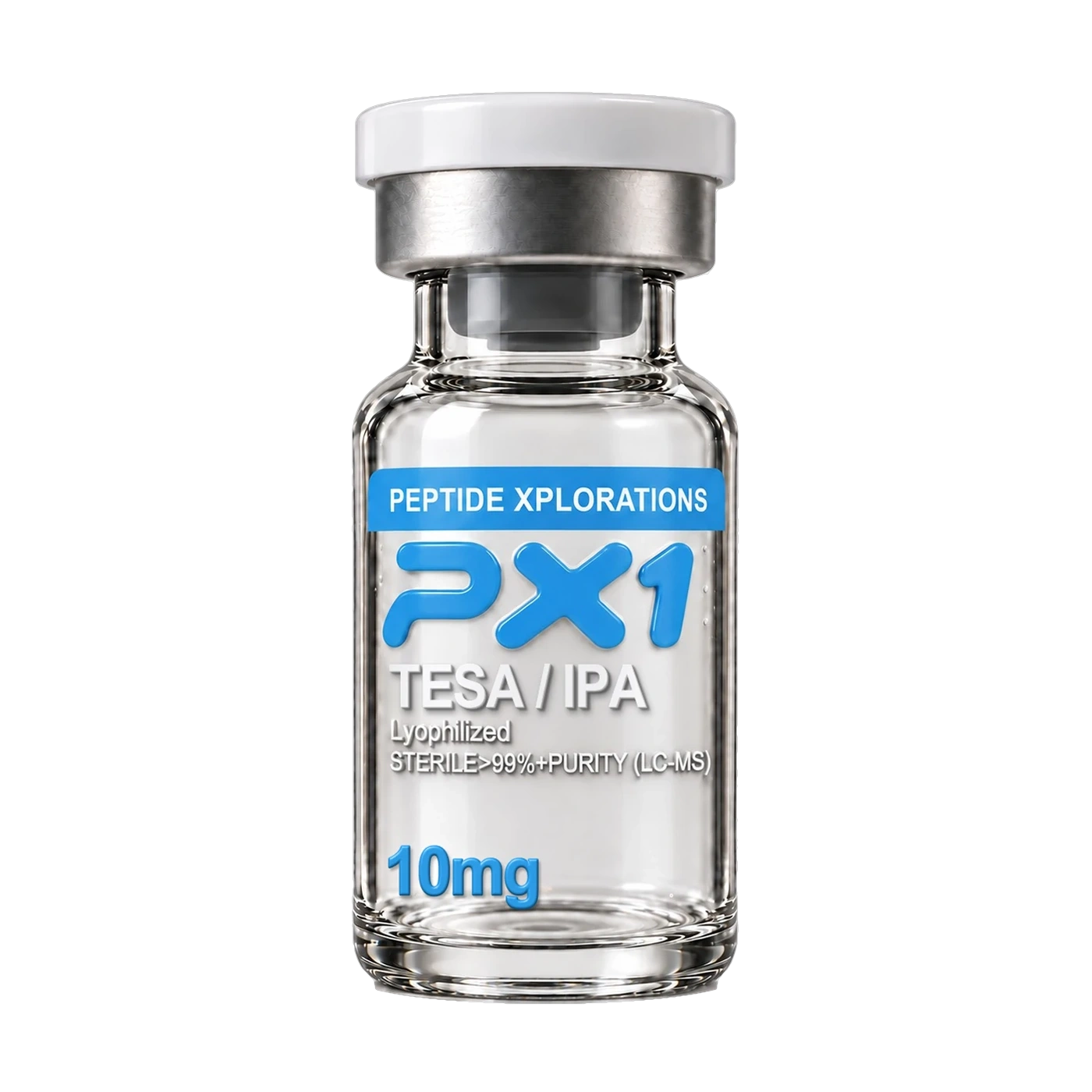
Tesamorelin + Ipamorelin Blend 10mg (5+5)
Lot Pending
Independent laboratory
HPLC purity
Pending
Result pending
Tesamorelin + Ipamorelin · 5/5mg or 10/10mg

Made in the USA
Ships from the USA
Peptide Blends
Research monograph on Tesamorelin — a synthetic 44-amino-acid growth-hormone-releasing hormone (GHRH) analog with a modified N-terminus. Covers mechanism at the GHRH receptor, laboratory handling, purity verification and published literature.
Strength
Quantity
Bundle & Save
Subscribe & Save 10%
Ships every 30 days · Cancel anytime
Per shipment
$95.00 $85.50
Subscription length
Login required. Manage anytime from Account → Subscriptions.
For research use only. Not for human or animal consumption.
Molecular weight
Not assigned for this material
Molecular formula
Not assigned for this material
CAS number
Not assigned for this material
Chain length
Not assigned for this material
Classification: Multi-component research blend
A blend has no single molecular formula, molecular weight, CAS number, or amino-acid sequence. Each component is identified separately on the lot documentation.
Batch verification
Independent testing with lot-specific analytical documentation.
Lot Pending
Independent laboratory
HPLC purity
Pending
Result pending
Full GHS 16-section Safety Data Sheet for Tesamorelin + Ipamorelin, prepared per OSHA HazCom 2012 (29 CFR 1910.1200). Includes substance identity, handling & storage, PPE, stability, transport and regulatory information.
CAS No.
Not assigned
Formula
Not assigned
Mol. Weight
Per COA
Classification
Not hazardous (GHS)
Tesamorelin (TH9507) is a synthetic analogue of growth hormone-releasing hormone (GHRH), consisting of the initial 29 GHRH amino acids merged with a trans-3-hexenoic acid group. This specialty peptide offers a precise method for GH modulation, engineered to boost pulsatile growth hormone discharge while avoiding the risks of constant elevation. The specific pathways utilized by Tesamorelin allow investigators to observe targeted metabolic outcomes without the cell-proliferation anxieties linked to administering raw GH. Consequently, it is a critical resource for exploring visceral fat accumulation, metabolic dysfunction, and age-related physiological changes.
PX1 Research supplies pharmaceutical-grade Tesamorelin (purity ≥98%) in a freeze-dried state, validated through HPLC and mass spectrometry to guarantee consistent performance and stability. This compound is provided strictly for animal model and in vitro research within professional laboratory environments and is not intended for human or veterinary consumption.
Tesamorelin serves as a synthetic growth hormone-releasing hormone (GHRH) mimic intended to prompt natural GH pulses and decrease abdominal fat. Primary research areas include:
The biological activity of Tesamorelin is driven by complex endocrine interactions:
• Pulsatile GH Secretion: It attaches to GHRH receptors located in the anterior pituitary, triggering the body's natural, rhythmic release of growth hormone (Falutz et al., 2010).
• IGF-1 Optimization: It stimulates the liver to increase insulin-like growth factor 1 synthesis, facilitating various metabolic downstream effects (Stanley et al., 2011).
• Selective Action: It focuses its activity on the reduction of visceral adipose tissue while supporting the maintenance of lean tissue via specific metabolic signaling (Driscoll et al., 2014).
• Metabolic Enhancement: It facilitates better lipid profiles and insulin sensitivity through both direct physiological pathways and indirect actions (Svensson et al., 2017).
In various metabolic trials, Tesamorelin has shown significant potential:
Visceral Fat Reduction Study:
Long-Term Metabolic Effects:
Evidence indicates Tesamorelin’s utility in studying cardiovascular health:
Lipid Profile Improvement:
Atherogenic Particle Reduction:
Recent data highlights substantial potential for enhancing metabolic health:
Insulin Sensitivity Enhancement:
Hepatic Fat Reduction:
Notice: The following protocols are strictly for experimental design and not for clinical use.
| Research Model | Dosage Range | Administration | Frequency | Key Parameters |
|---|---|---|---|---|
| In Vitro Studies | 10-100 nM | Culture medium | 24-72 hour cycles | Receptor affinity, gene signaling |
| Primate Models | 1-2 mg/day | Subcutaneous | Daily application | Body metrics, metabolic data |
| Rodent Models | 100-200 μg/kg | Subcutaneous | 4-12 week daily cycle | Visceral fat, IGF-1 concentrations |
| Metabolic Studies | 1-2 mg/day | Subcutaneous | Long-term cycles | Insulin/Lipid assessment |
To ensure precise laboratory results:
PX1 Research upholds strict quality controls for experimental reproducibility:
• Purity Verification: HPLC analysis confirms a chemical purity of ≥98%. • Amino Acid Analysis: Mass spectrometry validates the peptide sequence. • Endotoxin Testing: Levels maintained at <0.1 EU/mg. • Sterility Testing: Certified via membrane filtration. • Batch-Specific CoA: Detailed analysis reports accompany every order.
Versus Direct GH Administration:
Versus Other GHRH Analogs:
Technical Support:
Shipping & Handling:
Intended Use: This item is marketed solely for laboratory-based research and is not intended for veterinary or human use. Use is restricted to animal models and in vitro studies conducted by professionals in a controlled environment.
Regulatory Compliance: The buyer acknowledges and agrees to follow all local, state, and federal laws regarding the acquisition, storage, and application of research chemicals, including IACUC standards and the Animal Welfare Act.
Safety Handling: All personnel must wear proper PPE, including eye protection, lab coats, and gloves. Standard laboratory safety procedures are mandatory when utilizing this compound.
Quality Assurance: PX1 Research provides high-purity materials through strict testing; however, researchers are responsible for performing their own validation to ensure the product meets their specific experimental needs.
Liability: PX1 Research disclaims any responsibility for harm or damage resulting from the unauthorized, improper, or unsafe use of this product. Purchase constitutes acceptance of these conditions.
Storage & Stability: Keep lyophilized powder at -20°C in the provide container, protected from light exposure. Shelf life is 24 months from the date of manufacture if stored correctly. Once dissolved, use within 30 days and keep at 4°C.
Research Ethics: Use of this product must be in accordance with approved ethical protocols, ensuring the humane treatment of subjects and sound scientific design.
Disclaimer: This product is for laboratory research purposes only. Not for human or animal consumption.
Purity (HPLC)
≥99%
Application
For Research Use only
Form
Lyophilized Powder
Storage
-20°C Long Term
Testing
Third Party Tested
Manufacture
USA
99%+ HPLC Purity
Independently verified by accredited US laboratory
Endotoxin-Screened
LAL tested, LPS-free, endotoxin report available
GMP-Certified Manufacturing
USA facility, ISO 9001:2015
Lyophilized for Stability
Shipped cold-packed and sealed for stability
Investigated for selective, pulsatile growth-hormone release without significant cortisol or prolactin elevation.
For research use only — not for human or animal consumption.
Tesamorelin is a synthetic 44-amino-acid analog of growth-hormone-releasing hormone (GHRH) stabilized by a trans-3-hexenoyl group on the N-terminus. Research models use it to study GHRH-receptor binding, pulsatile growth-hormone release and downstream IGF-1 signaling with greater proteolytic stability than native GHRH.
| Compound name | Tesamorelin |
|---|---|
| Research code | TH9507 |
| CAS registry number | 218949-48-5 |
| Molecular formula | C221H366N72O67S |
| Molar mass | ≈5135.9 g/mol |
| Chain length | 44 amino acids |
| Physical form | Lyophilized white powder, acetate salt |
| Purity specification | ≥99% by reversed-phase HPLC; identity confirmed by LC-MS |
| Intended use | Research use only — not for human or veterinary use |
Research monograph
Tesamorelin is a synthetic 44-amino-acid analog of human growth-hormone-releasing hormone (GHRH, sometimes called GRF). It differs from endogenous GHRH by an N-terminal trans-3-hexenoyl modification that increases enzymatic stability in preclinical stability assays.
PX1 Research supplies lyophilized Tesamorelin as a reference compound for in-vitro GHRH-receptor pharmacology, secretagogue-panel studies and analytical method development. It is offered strictly for research use only — not for human or veterinary use.
Tesamorelin binds the growth-hormone-releasing-hormone receptor (GHRH-R), a class B G-protein-coupled receptor expressed on somatotroph cells in the anterior pituitary. Receptor engagement in preclinical systems activates Gs-mediated adenylyl cyclase and elevates intracellular cAMP, producing a pulsatile pattern of growth-hormone (GH) release consistent with endogenous GHRH.
The N-terminal modification confers a longer plasma half-life in animal pharmacokinetic studies compared with unmodified GHRH(1–44), which is the defining pharmacological feature exploited in the published literature.
Tesamorelin was developed in the early 2000s as a stabilized GHRH analog. Its pharmacological profile was characterized in receptor binding, cAMP accumulation and pituitary secretion models before entering clinical investigation.
The peer-reviewed literature includes multiple pharmacokinetic and pharmacodynamic studies characterizing Tesamorelin's GH-releasing profile in animal and clinical research populations, and it is frequently used as a reference GHRH agonist in in-vitro comparator panels for other growth-secretagogue peptides.
Tesamorelin ships as a lyophilized white powder. Store the sealed vial between −20°C and −80°C protected from light. Warm to room temperature before opening to avoid moisture condensation.
Every PX1 Tesamorelin lot is USA-manufactured and released at ≥99% purity by reversed-phase HPLC, with intact-mass identity confirmed by LC-MS against the theoretical monoisotopic mass of the modified 44-mer. The batch-specific COA is published on this product page.
Tesamorelin is a stabilized analog of growth hormone-releasing hormone (GHRH), consisting of the 44-amino-acid GHRH(1-44) sequence with a trans-3-hexenoyl group attached at the N-terminus. That modification is the entire point of the molecule: native GHRH is rapidly cleaved by dipeptidyl peptidase-4 at the N-terminal position, and the hexenoyl cap sharply reduces that cleavage, extending the functional half-life of the analog in preclinical systems.
This places Tesamorelin in a different mechanistic category from the ghrelin-receptor secretagogues such as ipamorelin, GHRP-2 and GHRP-6. GHRH analogs act at the GHRH receptor on somatotrophs and preserve the pulsatile character of endogenous release; ghrelin-mimetics act at the growth hormone secretagogue receptor GHS-R1a. Because the two receptor systems are separate and synergistic in the literature, GHRH analogs and ghrelin-mimetics are routinely co-administered in preclinical study designs rather than treated as alternatives.
Among GHRH analogs, Tesamorelin is distinguished from sermorelin — which is the unmodified GHRH(1-29) fragment — and from CJC-1295, which extends duration through a different strategy (a drug-affinity complex that binds serum albumin in the DAC form, or a tetrasubstituted 1-29 sequence in the non-DAC form). Comparative pharmacology across these three is one of the more common experimental designs in the somatotropic-axis literature.
Laboratories that work with Tesamorelin typically characterize incoming material on three axes before it enters a study: identity, purity and content. Identity is established by high-resolution mass spectrometry against the theoretical monoisotopic mass (≈5,135.9 Da for the modified 44-residue sequence), usually supported by MS/MS fragmentation that walks the backbone and confirms the sequence rather than just the total mass. A matching intact mass alone can be satisfied by a scrambled or partially epimerized sequence, which is why fragmentation data is the stronger identity evidence.
Purity is quantified by reversed-phase HPLC with UV detection, integrating every resolved peak in the chromatogram and expressing the main peak as a percentage of total area. The gradient matters more than the headline number: a shallow, well-optimized gradient resolves closely eluting process impurities such as deamidation products, oxidation variants, truncated sequences and acetate adducts, while an aggressive gradient can co-elute them under the main peak and inflate the reported purity. PX1 publishes the chromatogram itself, not only the integrated figure, so the resolution behind the number is auditable.
Content — how much peptide is actually in the vial once counter-ions and residual water are subtracted — is the axis most often skipped by low-cost suppliers. Net peptide content is a function of the labeled mass, the water content measured by Karl Fischer titration, and the counter-ion (typically trifluoroacetate or acetate) load. A vial that is 99% pure by HPLC can still under-deliver on content if it carries a high salt and moisture fraction, which is why the COA reports both.
Tesamorelin appears in the published record primarily through metabolic and body-composition research, where the compound's effect on visceral adipose tissue in clinical study populations generated the largest body of literature in the class. Those reports have made it a standard comparator when new GHRH analogs are characterized.
A second research area covers the somatotropic axis itself: pulsatility, IGF-1 dynamics, and the interaction between GHRH-receptor and ghrelin-receptor stimulation. Because Tesamorelin preserves receptor-mediated pulsatile release rather than delivering exogenous growth hormone, it is frequently used as the tool compound in studies designed to distinguish axis-mediated effects from direct effects.
A third and more recent cluster covers cognitive and neurometabolic endpoints in aging models, where GHRH-analog exposure has been examined against measures of executive function. As with the rest of the class, laboratory work depends on a stable, well-characterized reference material, since the N-terminal modification is exactly the part of the molecule most likely to be compromised by poor synthesis or degraded storage.
The research-peptide market is unusually wide in quality. The same nominal Tesamorelin listing can represent USA-manufactured material released against a documented specification, or repackaged bulk of unknown origin with a generic certificate that was never generated from the lot in the vial. The distinction is invisible from the product photo and only becomes visible in the paperwork.
The practical test is traceability: the lot number printed on the vial label should appear on the certificate of analysis, and that certificate should show the actual chromatogram and mass spectrum for that lot rather than a representative example. A COA without a lot number, without instrument traces, or dated years before the vial was filled is a document, not evidence. PX1 publishes the batch-specific report directly on the product page so the chain from manufacturing to vial is checkable before purchase.
Beyond the certificate, consistent lab-grade supply depends on synthesis and release happening under one controlled process: domestic solid-phase manufacturing, preparative HPLC purification, lyophilization under validated cycle parameters, and third-party confirmation of purity and endotoxin. Tesamorelin sold by PX1 Research is produced and released on that pathway and is supplied strictly for laboratory research use — not for human or veterinary use.
Because GHRH analogs act through the pituitary rather than replacing growth hormone, study designs in this area must account for feedback. An intact axis will damp a sustained stimulus, so single-timepoint sampling can miss the effect entirely; pulsatile sampling or an area-under-curve design is standard, and IGF-1 is commonly used as the integrated downstream readout because it smooths the pulse structure.
Comparator design usually runs along two axes at once: GHRH analogs against each other to separate protease resistance from clearance strategy — Tesamorelin, sermorelin and both CJC-1295 forms — and GHRH analogs against ghrelin-mimetics to separate the two receptor inputs. A full factorial with a combination arm is the design that resolves synergy, and it is why the somatotropic literature so often reports four or more arms.
In vitro, primary or immortalized somatotroph models with GHRH-receptor expression are the usual system, read out by growth hormone release into the medium and by cAMP accumulation. Because GHRH-receptor density varies considerably between model systems, receptor expression should be characterized in the specific line rather than assumed from a prior publication.
Analytically, quantifying intact Tesamorelin requires a method that distinguishes the modified peptide from any unmodified GHRH(1-44) present, since the two differ by a small acyl group but behave very differently. An LC-MS/MS transition specific to the modified N-terminus is the practical solution and should be part of method validation rather than added after an anomalous result.
For body-composition and metabolic endpoints, which dominate the published record, the design consideration is time course: the reported effects develop over extended periods, so short studies are frequently underpowered for the endpoints they claim to test. Matching study duration to the literature's observed effect window is the difference between a null result and an uninformative one.
How does Tesamorelin differ from sermorelin? Both are GHRH-receptor agonists, but sermorelin is the unmodified GHRH(1-29) fragment while Tesamorelin is the full GHRH(1-44) sequence carrying a trans-3-hexenoyl group at the N-terminus. That cap blocks the dipeptidyl peptidase-4 cleavage site that rapidly inactivates native GHRH, so the two molecules differ mainly in how long they persist as intact agonist rather than in what receptor they engage.
How does it differ from CJC-1295? Both are duration-extended GHRH analogs, but they use different strategies. CJC-1295 with DAC carries a drug-affinity complex that binds covalently to serum albumin, producing a very long circulating reservoir. Tesamorelin uses a small N-terminal acyl modification that resists enzymatic cleavage without creating an albumin depot. Comparative designs use both to separate protease resistance from clearance kinetics.
Why is Tesamorelin often paired with a ghrelin-mimetic? The GHRH receptor and the growth hormone secretagogue receptor GHS-R1a are separate inputs to the same somatotroph, and co-stimulation in preclinical models produces a larger response than either alone. That is why ipamorelin, GHRP-2 and GHRP-6 appear alongside GHRH analogs in study designs rather than as competing alternatives.
Does Tesamorelin supply growth hormone directly? No, and this is the central design distinction of the secretagogue class. Exogenous growth hormone bypasses the pituitary and overrides the endogenous feedback loop. A GHRH analog acts on the receptor and preserves the pulsatile, feedback-regulated character of release, which is why axis-mediated effects can be distinguished experimentally from direct effects using these tools.
What is the most common quality failure for Tesamorelin material? Loss or degradation of the N-terminal hexenoyl modification. The modification is small relative to the 44-residue sequence, so a partially unmodified lot can still look acceptable on a coarse HPLC method while functionally behaving more like native GHRH. High-resolution mass spectrometry against the modified theoretical mass, on the actual lot, is the check that catches this.
Tesamorelin sits at the center of the growth-hormone secretagogue group. The natural comparators in the catalog are Sermorelin, the unmodified GHRH(1-29) fragment, and both CJC-1295 forms, which extend duration by a different mechanism. On the ghrelin-receptor side the companions are Ipamorelin, GHRP-2 and GHRP-6, and the Tesamorelin + Ipamorelin blend exists specifically for co-stimulation designs.
Downstream of the axis, IGF-1 LR3 is frequently stocked alongside as the direct-acting comparator: it bypasses the pituitary entirely, which makes it the cleanest way to separate axis-mediated effects from IGF-mediated ones in a study design.
For metabolic and body-composition endpoints, which dominate the Tesamorelin literature, the catalog neighbors most often paired with it are the incretin compounds and 5-Amino-1MQ, since those programmes share readouts even though the mechanisms are unrelated.
All products are sold strictly for laboratory and research use only. Not for human or veterinary use, diagnosis, treatment or consumption. Statements have not been evaluated by the FDA.
High Quality — 99% Purity Guaranteed
We are continuously conducting HPLC testing on all of our raw powders as well as our finished products to ensure the quality of what we ship. You can have the product you bought from us independently tested at any HPLC-licensed testing facility — and if the results come back negative, we will refund the following:
HPLC Test Fee
$100
Plus a full refund
Total order amount + shipping
Tesamorelin + Ipamorelin Blend
$95.00