Peptide Verified8 assays
Epithalon 10mg
Lot PX1EPIT10-0021
ILS Laboratories
Independent laboratory
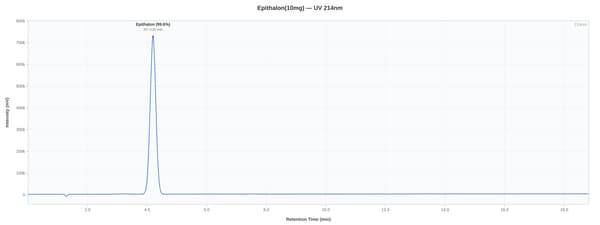
HPLC purity
99.59%
High purity confirmed
Labeled amount10mg
Measured amountSee certificate
IdentityEpitalon
TestedJul 31, 2026
Made in the USA
Ships from the USA
Peptides
Research monograph on Epithalon (Ala-Glu-Asp-Gly) — a synthetic tetrapeptide derived from the pineal extract epithalamin, studied for telomerase and circadian-axis effects.
Strength
Quantity
Bundle & Save
Subscribe & Save 10%
Ships every 30 days · Cancel anytime
Per shipment
$91.99 $82.79
Subscription length
Login required. Manage anytime from Account → Subscriptions.
For research use only. Not for human or animal consumption.
Molecular weight
390.35 g/mol
Molecular formula
C₁₄H₂₂N₄O₉
CAS number
307297-39-8
Chain length
4 amino acids
Amino-acid sequence
Ala-Glu-Asp-Gly
Classification: Research peptide
Batch verification
Independent testing with lot-specific analytical documentation.
Lot PX1EPIT10-0021
ILS Laboratories
Independent laboratory
HPLC purity
99.59%
High purity confirmed
Full GHS 16-section Safety Data Sheet for Epithalon, prepared per OSHA HazCom 2012 (29 CFR 1910.1200). Includes substance identity, handling & storage, PPE, stability, transport and regulatory information.
CAS No.
307297-39-8
Formula
C₁₄H₂₂N₄O₉
Mol. Weight
390.35 g/mol
Classification
Not hazardous (GHS)
Epitalon (alternatively identified as Epithalon or Epithalone) represents a synthetic tetrapeptide (Ala-Glu-Asp-Gly) crafted from the pineal gland-derived peptide known as epithalamin. This innovative molecule stands as a landmark finding within anti-aging science, telomere biology, and the study of circadian rhythm maintenance. The primary functional pathway for Epitalon involves the induction of telomerase enzyme activity and the recalibration of gene expression via epigenetic pathways, serving as an essential instrument for scientists exploring cellular aging, age-linked physical decline, and biological longevity.
At PX1 Research, we supply pharmaceutical-grade Epitalon (≥98% purity) in a freeze-dried state, validated through HPLC and mass spectrometry to ensure maximum research consistency and stability. This substance is developed specifically for in vitro and animal-based experimentation within professional laboratory environments and is not intended for human or veterinary applications.
The biological activity of Epitalon is driven by several complex pathways:
• Telomerase Activation: Boosts the expression of the telomerase reverse transcriptase (TERT) gene, resulting in elongated telomeres and the reversal of cellular aging markers (Khavinson et al., 2002)
• Gene Expression Regulation: Controls the activity of genes associated with senescence and reinstates biological clock regulation over cell functions (Anisimov et al., 2002)
• Epigenetic Modulation: Impacts the patterns of DNA methylation and the reorganization of chromatin in aging cellular structures (Khavinson et al., 2013)
• Antioxidant System Enhancement: Triggers internal protective mechanisms, specifically superoxide dismutase and glutathione peroxidase (Kossoy et al., 2006)
In investigations focusing on telomere biology, Epitalon has shown significant potential:
Human Cell Culture Study:
Aged Primate Model:
Various trials highlight the role of Epitalon in life-extension studies:
Rodent Lifespan Study:
Drosophila Melanogaster Study:
Laboratory data indicates Epitalon’s usefulness in studies regarding age-related vision:
Retinal Degeneration Model:
Age-Related Macular Degeneration:
Recent data points toward notable impacts on neurological health:
Alzheimer’s Disease Models:
Age-Related Cognitive Decline:
Note: The following protocols are intended for experimental design only. Not for human or veterinary use.
| Research Model | Dosage Range | Administration | Frequency | Key Parameters |
|---|---|---|---|---|
| In Vitro Studies | 0.01-10 μg/mL | Culture medium | 24-72 hour periods | Telomere size, aging markers |
| Rodent Models | 0.05-1.0 mg/kg | Subcutaneous injection | Daily for 5-30 days | Longevity, oncology, biomarkers |
| Primate Models | 0.1-0.5 mg/kg | Subcutaneous injection | Daily for 10-20 days | Melatonin cycles, antioxidant levels |
| Cell Senescence | 0.1-5.0 μg/mL | Growth medium | Constant exposure | Division limits, β-galactosidase |
To ensure precise research outcomes:
PX1 Research enforces strict quality controls to ensure experimental repeatability:
• Purity Verification: Minimum 98% chemical purity as validated by HPLC • Amino Acid Analysis: Sequence integrity verified by mass spectrometry • Endotoxin Testing: Levels maintained below 0.1 EU/mg • Sterility Testing: Certified via membrane filtration methods • Batch-Specific CoA: Detailed analytical reports are provided with every order
Versus Other Longevity Compounds:
Versus Synthetic Telomerase Activators:
Technical Support:
Shipping & Handling:
Intended Use: This material is distributed strictly for laboratory-based research and is not intended for human or veterinary use. It is designed for use by expert personnel during in vitro or animal studies in a controlled setting.
Regulatory Compliance: The buyer acknowledges and agrees to follow all local, state, and national regulations regarding the acquisition, storage, and application of research materials. This includes compliance with the Animal Welfare Act and relevant IACUC guidelines.
Safety Handling: Personnel must employ suitable personal protective equipment (PPE), such as lab coats, gloves, and eye shielding, when using this substance. Standard laboratory safety measures must be practiced at all times.
Quality Assurance: Although PX1 Research verifies quality via intensive testing, investigators are encouraged to perform individual validation to confirm the product's fitness for their specific experimental needs.
Liability: PX1 Research disclaims any responsibility for damages resulting from improper storage, misuse, or unauthorized application of this compound. Purchasing this product constitutes acceptance of these terms.
Storage & Stability: Keep the lyophilized powder at -20°C in its original container, away from light. Stability is guaranteed for 24 months from manufacture if stored correctly. Once liquid, use within 30 days and keep at 4°C.
Research Ethics: All use must occur within the framework of ethically sanctioned research protocols, adhering to standards for experimental design and the compassionate treatment of subjects.
Purity (HPLC)
≥99%
Application
For Research Use only
Form
Lyophilized Powder
Storage
-20°C Long Term
Testing
Third Party Tested
Manufacture
USA
99%+ HPLC Purity
Independently verified by accredited US laboratory
Endotoxin-Screened
LAL tested, LPS-free, endotoxin report available
GMP-Certified Manufacturing
USA facility, ISO 9001:2015
Lyophilized for Stability
Shipped cold-packed and sealed for stability
Studied for telomerase activation, telomere maintenance and circadian/longevity research.
For research use only — not for human or animal consumption.
Research monograph
Epithalon is a synthetic tetrapeptide with the sequence Ala-Glu-Asp-Gly (AEDG). It was developed as the defined synthetic counterpart to epithalamin, a peptide extract of the pineal gland characterized in Soviet and later Russian gerontology research beginning in the 1970s. Reducing an undefined tissue extract to a four-residue synthetic sequence is what made the compound reproducible enough to study systematically.
Epithalon belongs to the family of short regulatory peptides — the same conceptual class as the bio-regulator peptides such as pinealon, thymalin and cortagen — where the proposed mechanism involves direct interaction with DNA and modulation of gene expression rather than classical receptor binding.
PX1 Research supplies lyophilized Epithalon as a reference compound for telomere-biology, circadian and cellular-aging research, released against a batch-specific certificate of analysis. Research use only — not for human or veterinary use.
The most-cited mechanistic claim in the Epithalon literature is induction of telomerase activity. Published cell-culture work has reported increased telomerase catalytic subunit expression and elongation of telomeres in somatic cell cultures following exposure, with associated extension of the proliferative lifespan of those cultures. This work is the reason the peptide appears so often in cellular-senescence research designs.
A second proposed mechanism involves sequence-specific interaction with DNA. Reports have described binding of short AEDG-type peptides to promoter regions and consequent modulation of transcription — a model that, if correct, would explain how a four-residue peptide with no known receptor produces gene-expression changes.
A third strand concerns the pineal axis itself: melatonin rhythm, circadian regulation and the antioxidant status associated with pineal function. These reports connect the synthetic tetrapeptide back to the epithalamin extract literature from which it was derived.
Much of the foundational Epithalon work was published by Khavinson and colleagues in Russian-language gerontology journals, with a subset appearing in English translation. Researchers entering the field should read this literature with the same critical eye applied to any body of work concentrated within a single group: the primary findings are interesting and internally consistent, but independent replication outside the original programme remains limited relative to the volume of citations.
That context makes analytical verification of the test article unusually important here. Where an effect size is contested, material of unverified identity or purity is the fastest way to add noise to an already-noisy replication picture.
The compound is frequently studied alongside the wider bio-regulator family and, in metabolic and mitochondrial designs, alongside MOTS-c, SS-31 and NAD+ precursors as part of a broader cellular-aging panel.
Laboratories that work with Epithalon typically characterize incoming material on three axes before it enters a study: identity, purity and content. Identity is established by high-resolution mass spectrometry against the theoretical monoisotopic mass (390.3 Da for the tetrapeptide), usually supported by MS/MS fragmentation that walks the backbone and confirms the sequence rather than just the total mass. A matching intact mass alone can be satisfied by a scrambled or partially epimerized sequence, which is why fragmentation data is the stronger identity evidence.
Purity is quantified by reversed-phase HPLC with UV detection, integrating every resolved peak in the chromatogram and expressing the main peak as a percentage of total area. The gradient matters more than the headline number: a shallow, well-optimized gradient resolves closely eluting process impurities such as deamidation products, oxidation variants, truncated sequences and acetate adducts, while an aggressive gradient can co-elute them under the main peak and inflate the reported purity. PX1 publishes the chromatogram itself, not only the integrated figure, so the resolution behind the number is auditable.
Content — how much peptide is actually in the vial once counter-ions and residual water are subtracted — is the axis most often skipped by low-cost suppliers. Net peptide content is a function of the labeled mass, the water content measured by Karl Fischer titration, and the counter-ion (typically trifluoroacetate or acetate) load. A vial that is 99% pure by HPLC can still under-deliver on content if it carries a high salt and moisture fraction, which is why the COA reports both.
PX1 Epithalon is USA-manufactured and released at ≥99% purity by reversed-phase HPLC with LC-MS identity confirmation, kinetic chromogenic LAL endotoxin, GC residual solvents and Karl Fischer water content. The batch-specific report is published on this product page, and the lot number on that report matches the vial label.
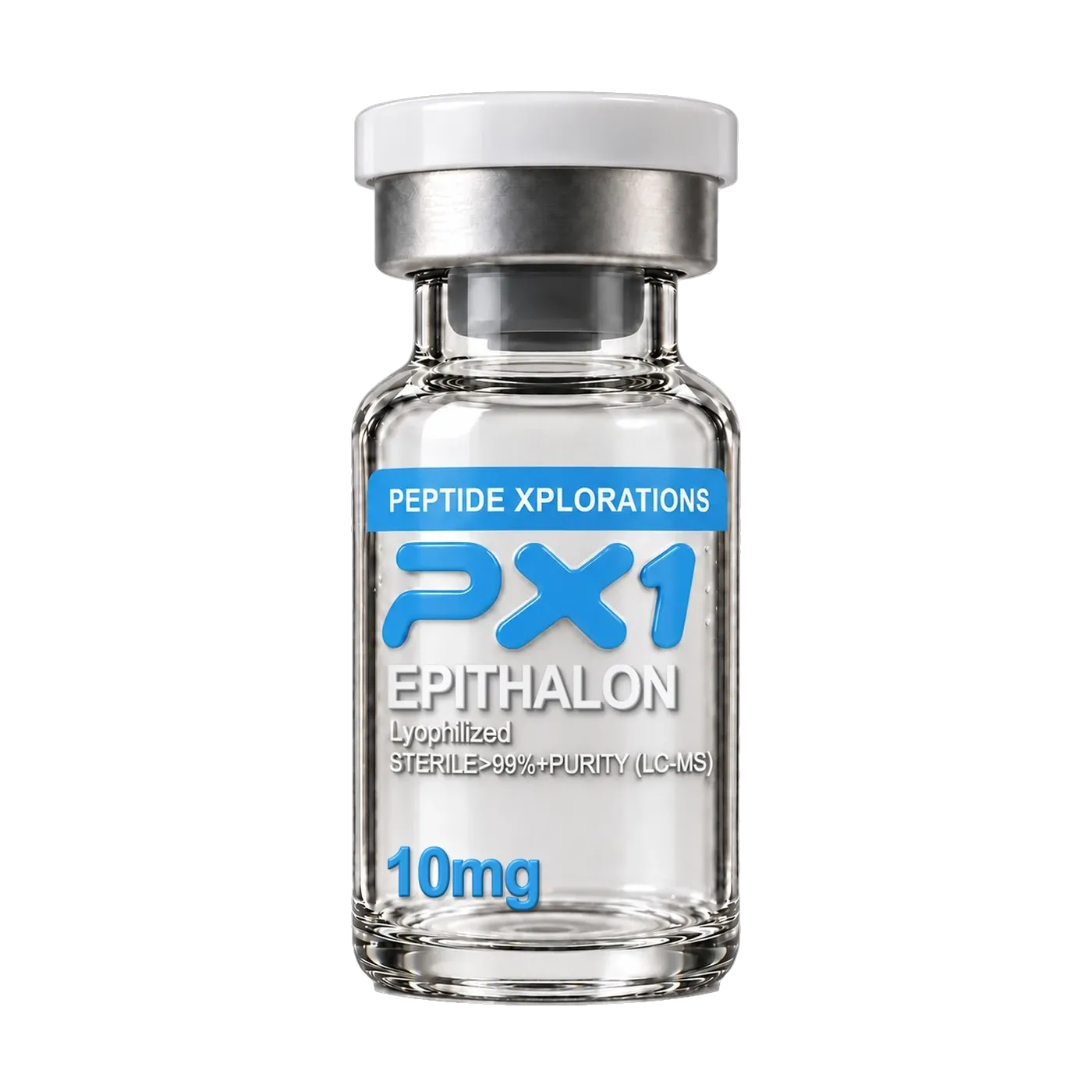
The research-peptide market is unusually wide in quality. The same nominal Epithalon listing can represent USA-manufactured material released against a documented specification, or repackaged bulk of unknown origin with a generic certificate that was never generated from the lot in the vial. The distinction is invisible from the product photo and only becomes visible in the paperwork.
The practical test is traceability: the lot number printed on the vial label should appear on the certificate of analysis, and that certificate should show the actual chromatogram and mass spectrum for that lot rather than a representative example. A COA without a lot number, without instrument traces, or dated years before the vial was filled is a document, not evidence. PX1 publishes the batch-specific report directly on the product page so the chain from manufacturing to vial is checkable before purchase.
Beyond the certificate, consistent lab-grade supply depends on synthesis and release happening under one controlled process: domestic solid-phase manufacturing, preparative HPLC purification, lyophilization under validated cycle parameters, and third-party confirmation of purity and endotoxin. Epithalon sold by PX1 Research is produced and released on that pathway and is supplied strictly for laboratory research use — not for human or veterinary use.
Telomerase and telomere endpoints demand careful method choice. Telomerase activity by TRAP assay, catalytic subunit transcript levels by qPCR, and telomere length by qPCR or terminal restriction fragment analysis measure three related but distinct things, and the literature's strongest claims involve all three moving together. Reporting one alone leaves substantial room for alternative explanations.
Passage number and cell type are decisive variables in this work. Somatic cell cultures approaching replicative senescence behave very differently from early-passage cells, and the reported extension of proliferative lifespan is specific to the former. A study should state passage number at treatment onset and track population doublings, otherwise the central endpoint cannot be interpreted.
Given the concentration of the foundational work within one research programme, an independent replication design carries unusual value in this field. Pre-registering endpoints, running blinded analysis and reporting the full concentration range — including inactive concentrations — addresses the specific criticism most often made of the existing literature.
For the DNA-interaction hypothesis, biophysical methods rather than downstream expression are the informative approach: electrophoretic mobility shift, thermal denaturation or spectroscopic binding studies with defined oligonucleotide sequences test the proposed mechanism directly. Gene-expression changes are consistent with the hypothesis but do not distinguish it from indirect routes.
Where Epithalon is included in a broader cellular-aging panel alongside MOTS-c, SS-31 or NAD+ precursors, the panel should share a common set of senescence markers — SA-β-gal, p16 and p21 expression, proliferative capacity — so that compounds acting through different proposed mechanisms can be compared on the same phenotypic scale rather than each on its own favorable endpoint.
Is Epithalon the same as epithalamin? No. Epithalamin is a peptide extract of pineal tissue — an undefined mixture — while Epithalon is the defined synthetic tetrapeptide Ala-Glu-Asp-Gly developed as its reproducible counterpart. Findings from extract studies cannot be attributed to the tetrapeptide without the tetrapeptide having been tested directly, a distinction that is frequently blurred in secondary sources.
How does a four-residue peptide affect gene expression without a receptor? The model proposed in the literature is direct sequence-specific interaction with DNA at promoter regions, rather than binding to a cell-surface receptor. This is the same mechanistic proposal made across the short bio-regulator peptide family — pinealon, thymalin, cortagen and related sequences — and it remains an active area rather than settled ground.
How strong is the telomerase evidence? Cell-culture reports describe increased telomerase catalytic subunit expression, telomere elongation and extended proliferative lifespan in somatic cell cultures. These are consistent findings within their source programme, but independent replication outside that group is limited relative to how widely the claim is cited. Researchers should treat the effect size as unsettled and design accordingly.
Why does test-article verification matter more than usual here? Because the underlying effect sizes are contested, any variance introduced by unverified material is indistinguishable from a real negative result. A short sequence is cheap to synthesize well and equally cheap to synthesize badly; the certificate, with a lot-matched chromatogram and mass spectrum at 390.3 Da, is what separates the two.
What compounds is Epithalon studied alongside? Within cellular-aging panels it appears with MOTS-c, SS-31 and NAD+ precursors, each addressing a different proposed axis of the same phenotype — transcriptional adaptation, mitochondrial membrane integrity and redox cofactor availability. Within the Russian bio-regulator literature it appears alongside the wider AEDG-type peptide family.
Epithalon is the best-known member of the bio-regulator group, which also includes Pinealon, Thymalin, Cortagen, Vesugen, Vilon and the wider AEDG-type family. These share a common proposed mechanism — short peptides interacting directly with DNA and modulating transcription — and are frequently studied as a set rather than individually.
In cellular-aging panels Epithalon is paired with MOTS-c, SS-31 and NAD+, each addressing a different proposed axis of the same phenotype. Running them against a shared marker set — SA-β-gal, p16 and p21 expression, proliferative capacity — is what allows results across mechanisms to be compared meaningfully.
Epithalon is supplied in multiple vial strengths, USA-manufactured and released at ≥99% purity with a lot-matched certificate published on the product page. Given that effect sizes in this literature remain contested, verified test-article identity is the prerequisite for any result to be interpretable at all.
All products are sold strictly for laboratory and research use only. Not for human or veterinary use, diagnosis, treatment or consumption. Statements have not been evaluated by the FDA.
High Quality — 99% Purity Guaranteed
We are continuously conducting HPLC testing on all of our raw powders as well as our finished products to ensure the quality of what we ship. You can have the product you bought from us independently tested at any HPLC-licensed testing facility — and if the results come back negative, we will refund the following:
HPLC Test Fee
$100
Plus a full refund
Total order amount + shipping
Epithalon
$91.99