Peptide Verified8 assays
GHK-Cu 50mg
Lot PX1GHK50-0021
ILS Laboratories
Independent laboratory
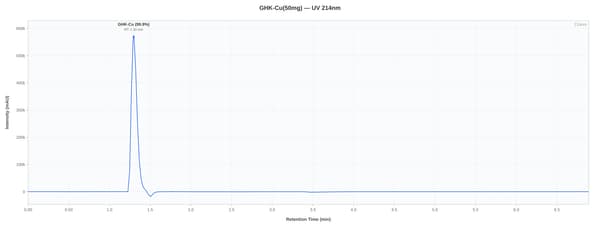
HPLC purity
99.90%
High purity confirmed
Labeled amount50mg
Measured amountSee certificate
IdentityGHK-Cu
TestedSep 9, 2026
Made in the USA
Ships from the USA
Peptides
Research monograph on GHK-Cu — the copper-binding tripeptide glycyl-L-histidyl-L-lysine complexed with Cu(II). Covers copper coordination chemistry, mechanism, laboratory handling and published literature.
Strength
Quantity
Bundle & Save
Subscribe & Save 10%
Ships every 30 days · Cancel anytime
Per shipment
$61.99 $55.79
Subscription length
Login required. Manage anytime from Account → Subscriptions.
For research use only. Not for human or animal consumption.
Molecular weight
403.92 g/mol
Molecular formula
C₁₄H₂₄CuN₆O₄
CAS number
49557-75-7
Chain length
3 amino acids
Amino-acid sequence
Gly-His-Lys · Cu(II)
Classification: Research peptide
Batch verification
Independent testing with lot-specific analytical documentation.
Lot PX1GHK50-0021
ILS Laboratories
Independent laboratory
HPLC purity
99.90%
High purity confirmed
Full GHS 16-section Safety Data Sheet for GHK-Cu, prepared per OSHA HazCom 2012 (29 CFR 1910.1200). Includes substance identity, handling & storage, PPE, stability, transport and regulatory information.
CAS No.
49557-75-7
Formula
C₁₄H₂₄CuN₆O₄
Mol. Weight
403.92 g/mol
Classification
Not hazardous (GHS)
GHK-Cu Copper Peptide Summary GHK-Cu is an endogenous copper-peptide complex formed by the linkage of glycyl-L-histidyl-L-lysine. This specific tripeptide, which is found naturally in human saliva, urine, and blood, has been the subject of intensive scientific investigation. Recognized for its potent capacity to trigger skin renewal and wound closure, GHK-Cu functions by recruiting immune cells and fibroblasts to sites of injury, thereby streamlining the biological processes of tissue restoration.
Dermatological Repair and Anti-Aging Advantages of GHK-Cu
Enhances Collagen Synthesis GHK-Cu serves as an influential peptide that mitigates oxidative stress and inflammation while driving skin recovery. It actively triggers the production of collagen, a foundational protein necessary for the integrity of the skin. This mechanism assists in minimizing the appearance of scars, refining dermal texture, and reversing visible aging by improving suppleness, firmness, and skin density. These characteristics have established GHK-Cu as a staple component in high-performance anti-aging and skincare research.
Mitigates Wrinkles and UV Damage Technical inquiries indicate that GHK-Cu successfully counters the adverse impacts of ultraviolet radiation, including the formation of wrinkles and fine lines. By leveraging its regenerative traits, it restores the skin's health, resulting in a more vibrant, smooth, and refreshed appearance.
Stimulates Neovascularization Efficient circulation is a prerequisite for tissue mending and localized healing. GHK-Cu has demonstrated its ability to promote the development of new blood vessels, ensuring that injured tissues receive the oxygen and nutrients required for expedited recovery.
Antibacterial and Healing Characteristics of GHK-Cu
Combats Fungal and Bacterial Pathogens When integrated with fatty acids, GHK-Cu acts as a vigorous antimicrobial agent capable of neutralizing various fungi and bacteria. This attribute facilitates smoother wound closure and prevents infectious complications that might otherwise stall the healing timeline.
Promotes Rapid Wound Closure Clinical observations involving patients with diabetic ulcers have shown that GHK-Cu improves healing outcomes and lowers the probability of infection. Comparable results were found in individuals suffering from poor circulation and open lacerations, positioning the peptide as a promising tool for managing intricate recovery scenarios.
Analgesic Properties of GHK-Cu
Elevates L-Lysine Concentration Investigations using animal subjects suggest that GHK-Cu raises the presence of L-lysine, an amino acid associated with natural pain modulation. This biological pathway may explain the peptide's observed potential for pain reduction.
Increases L-Arginine Bioavailability GHK-Cu further optimizes levels of L-arginine, which is another amino acid linked to analgesic effects. L-arginine aids in the production of nitric oxide and enhances peripheral blood flow, reinforcing the peptide's utility in pain management contexts.
Neuroprotection and Anti-Degenerative Roles of GHK-Cu The brain contains high concentrations of GHK-Cu, where it serves as a protective element for neural structures. As the body ages, GHK-Cu levels typically fall, a decline that may correlate with neurodegenerative processes. Evidence suggests this tripeptide supports nerve proliferation, decreases neuroinflammation, and improves vascularity within the central nervous system. It shows significant potential in addressing cognitive decline related to Alzheimer’s and possesses the capacity to normalize dysregulated genetic expressions.
PX1 Research GHK-Cu Copper Peptide Data
Important Note: This substance is provided exclusively for in vitro laboratory experimentation by qualified experts. It has not received FDA approval for use in humans or animals and must not be used, labeled, or sold as a medicine, food product, dietary supplement, or cosmetic.
References:
Purity (HPLC)
≥99%
Application
For Research Use only
Form
Lyophilized Powder
Storage
-20°C Long Term
Testing
Third Party Tested
Manufacture
USA
99%+ HPLC Purity
Independently verified by accredited US laboratory
Endotoxin-Screened
LAL tested, LPS-free, endotoxin report available
GMP-Certified Manufacturing
USA facility, ISO 9001:2015
Lyophilized for Stability
Shipped cold-packed and sealed for stability
Researched for collagen and elastin synthesis, skin remodeling, wound closure and reduced fibrotic scarring.
For research use only — not for human or animal consumption.
GHK-Cu is the copper(II) complex of the tripeptide glycyl-L-histidyl-L-lysine, a sequence first isolated from human plasma. In dermal and wound-model research it is studied for copper transport, extracellular-matrix remodeling and gene-expression effects, and it is the most cited copper-binding peptide in the literature.
| Compound name | GHK-Cu |
|---|---|
| Research code | Copper tripeptide-1 |
| CAS registry number | 89030-95-5 (copper complex); 49557-75-7 (GHK free peptide) |
| Molecular formula | C14H24CuN6O4 |
| Molar mass | ≈403.9 g/mol |
| Amino acid sequence | Gly-His-Lys (GHK) · Cu(II) |
| Chain length | 3 amino acids |
| Physical form | Lyophilized blue powder |
| Purity specification | ≥99% by reversed-phase HPLC; copper content verified per lot |
| Intended use | Research use only — not for human or veterinary use |
Research monograph
GHK-Cu is a copper-binding tripeptide consisting of the sequence glycyl-L-histidyl-L-lysine (GHK) complexed with divalent copper, Cu(II). The GHK sequence was first isolated from human plasma in the 1970s and shown to bind copper with high affinity through coordination between the imidazole nitrogen of histidine, the α-amino nitrogen of glycine, and adjacent backbone atoms.
PX1 Research supplies lyophilized GHK-Cu as a reference compound for in-vitro dermatological, extracellular-matrix and wound-healing research. It is offered strictly for research use only — not for human or veterinary use.
GHK-Cu's biological activity in preclinical systems is inseparable from its copper coordination chemistry. The peptide serves as a copper carrier and delivery vehicle, and multiple reports have linked GHK-Cu exposure to changes in expression of extracellular-matrix genes, collagen and glycosaminoglycan synthesis in dermal fibroblast cultures, and modulation of antioxidant enzymes.
Gene-expression profiling studies in the published literature have reported broad transcriptional effects of GHK-Cu across hundreds of genes involved in tissue remodeling and repair, though the exact upstream receptor(s) remain an active area of investigation.
The GHK sequence was first identified by Loren Pickart in 1973 as a component of human plasma that stimulated hepatic growth in cell culture. Subsequent decades established its copper-binding stoichiometry, characterized structural analogs, and extended the research to skin, hair-follicle and wound-healing models.
GHK-Cu remains one of the most cited copper peptides in the biochemical literature.
GHK-Cu ships as a lyophilized blue-tinted powder — the color arises from the Cu(II) chromophore. Store between −20°C and −80°C protected from light. Warm to room temperature before opening.
Every PX1 GHK-Cu batch is USA-manufactured and released at ≥99% purity by reversed-phase HPLC. Identity of the GHK tripeptide is confirmed by LC-MS against the theoretical monoisotopic mass, and copper content is verified against the specified copper-to-peptide stoichiometry. The batch-specific COA is published on this product page.
GHK-Cu cannot be understood as a peptide with a metal impurity; the copper is part of the active species. The glycyl-L-histidyl-L-lysine backbone coordinates Cu(II) through the imidazole nitrogen of the histidine side chain, the N-terminal α-amino nitrogen and the deprotonated backbone amide nitrogen, forming a square-planar complex with high affinity. The binding constant is high enough that GHK competes effectively for copper in physiological environments, which is the basis for describing it as a copper carrier rather than merely a copper salt.
The copper also creates an analytical requirement absent from ordinary peptides: stoichiometry. A release specification for GHK-Cu must confirm not only the purity and identity of the tripeptide but the copper-to-peptide ratio, typically by an elemental method. Material sold as GHK-Cu that is characterized only by HPLC purity of the tripeptide has not actually been characterized as GHK-Cu.
Laboratories that work with GHK-Cu typically characterize incoming material on three axes before it enters a study: identity, purity and content. Identity is established by high-resolution mass spectrometry against the theoretical monoisotopic mass (340.8 Da for the tripeptide-copper complex; 340.4 Da for free GHK), usually supported by MS/MS fragmentation that walks the backbone and confirms the sequence rather than just the total mass. A matching intact mass alone can be satisfied by a scrambled or partially epimerized sequence, which is why fragmentation data is the stronger identity evidence.
Purity is quantified by reversed-phase HPLC with UV detection, integrating every resolved peak in the chromatogram and expressing the main peak as a percentage of total area. The gradient matters more than the headline number: a shallow, well-optimized gradient resolves closely eluting process impurities such as deamidation products, oxidation variants, truncated sequences and acetate adducts, while an aggressive gradient can co-elute them under the main peak and inflate the reported purity. PX1 publishes the chromatogram itself, not only the integrated figure, so the resolution behind the number is auditable.
Content — how much peptide is actually in the vial once counter-ions and residual water are subtracted — is the axis most often skipped by low-cost suppliers. Net peptide content is a function of the labeled mass, the water content measured by Karl Fischer titration, and the counter-ion (typically trifluoroacetate or acetate) load. A vial that is 99% pure by HPLC can still under-deliver on content if it carries a high salt and moisture fraction, which is why the COA reports both.
The GHK-Cu literature is one of the longest-running in the peptide field, beginning with Pickart's 1973 identification of the sequence in human plasma. Dermatological and extracellular-matrix research forms the largest cluster: collagen and glycosaminoglycan synthesis in fibroblast culture, matrix metalloproteinase and tissue inhibitor expression, and remodeling behavior in wound-healing models.
A second cluster uses gene-expression profiling. Broad transcriptional surveys have reported that GHK-Cu exposure shifts expression across a large number of genes associated with tissue remodeling, DNA repair and antioxidant response, and these datasets are frequently reused in bioinformatics work rather than generated fresh.
A third area is hair-follicle and appendage biology, and a fourth examines the peptide's antioxidant and metal-handling behavior directly as coordination chemistry. Because the compound is studied both as a biological signal and as a copper delivery vehicle, laboratories generally specify both the peptide purity and the copper stoichiometry in their methods sections — a level of characterization the batch COA on this page is designed to supply.
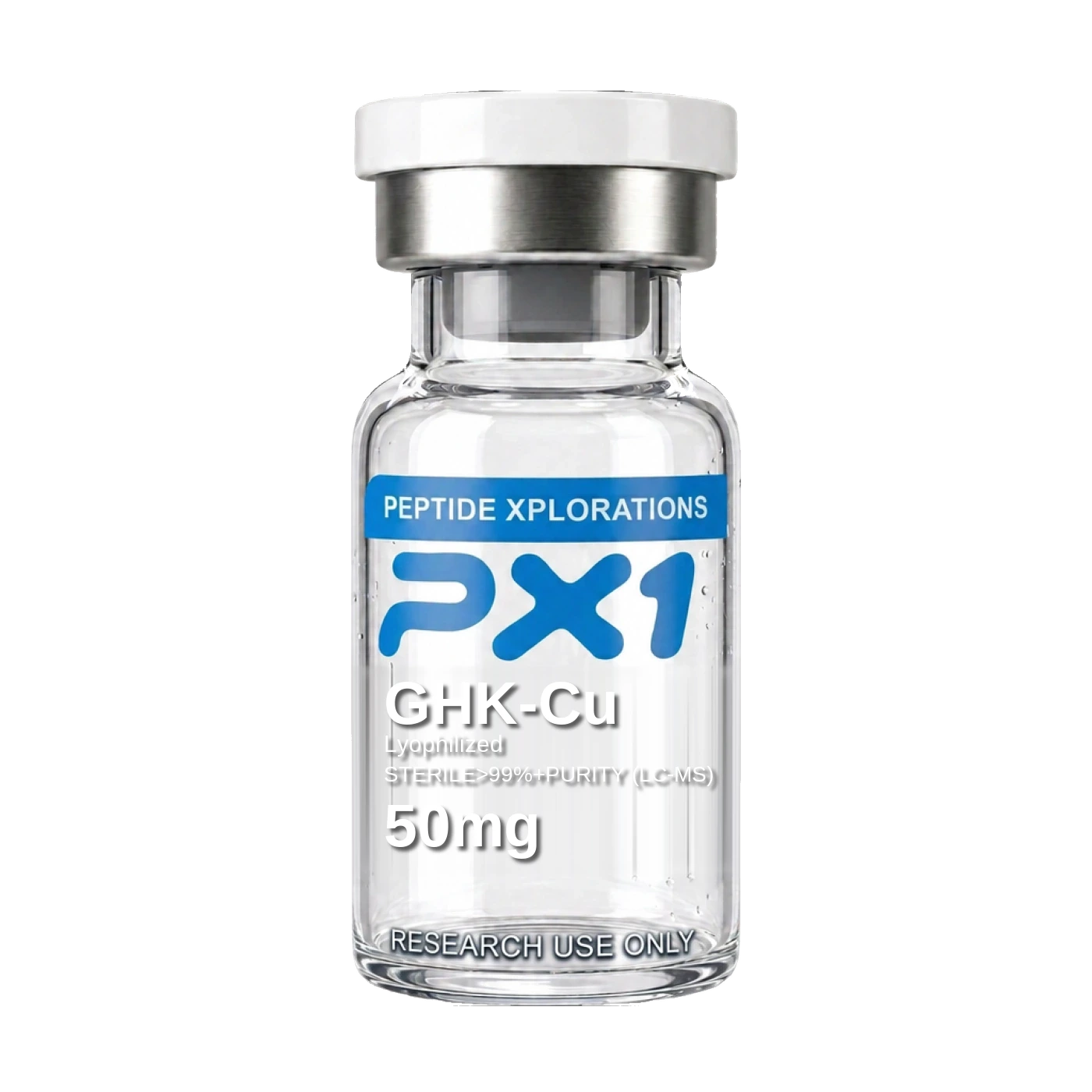
The research-peptide market is unusually wide in quality. The same nominal GHK-Cu listing can represent USA-manufactured material released against a documented specification, or repackaged bulk of unknown origin with a generic certificate that was never generated from the lot in the vial. The distinction is invisible from the product photo and only becomes visible in the paperwork.
The practical test is traceability: the lot number printed on the vial label should appear on the certificate of analysis, and that certificate should show the actual chromatogram and mass spectrum for that lot rather than a representative example. A COA without a lot number, without instrument traces, or dated years before the vial was filled is a document, not evidence. PX1 publishes the batch-specific report directly on the product page so the chain from manufacturing to vial is checkable before purchase.
Beyond the certificate, consistent lab-grade supply depends on synthesis and release happening under one controlled process: domestic solid-phase manufacturing, preparative HPLC purification, lyophilization under validated cycle parameters, and third-party confirmation of purity and endotoxin. GHK-Cu sold by PX1 Research is produced and released on that pathway and is supplied strictly for laboratory research use — not for human or veterinary use.
The first design decision in any GHK-Cu study is the copper control. Because the complex delivers copper, an effect observed with GHK-Cu may reflect the peptide, the copper or the combination. A rigorous design therefore includes three arms — GHK-Cu, free GHK at matched molar concentration, and a copper salt at matched copper concentration — and reports all three. Studies omitting the copper-only arm cannot attribute their result to the peptide.
Buffer chemistry is the second. Chelator-containing media, low pH and competing divalent cations can destabilize the complex during the experiment itself, meaning the test article at hour twenty-four may not be the test article at hour zero. Where the exposure window is long, verifying complex integrity at the end of the window — by absorbance or by an elemental method on the spent medium — converts an assumption into data.
Fibroblast culture is the workhorse system, with collagen and glycosaminoglycan synthesis, matrix metalloproteinase and TIMP expression as the standard readouts. Because these endpoints are sensitive to serum concentration and passage number, both should be fixed across arms and reported; drift in either is a frequent source of irreproducibility in the dermal literature independent of the compound.
For gene-expression work, the large public datasets generated on GHK-Cu make a re-analysis design viable without new bench work, and they also provide a strong prior against which new experiments can be compared. Designing a transcript panel around the pathways those datasets highlighted — remodeling, DNA repair, antioxidant response — is more informative than an unfocused whole-transcriptome run at low replication.
Blend designs follow the same decomposition rule as elsewhere: GLOW and KLOW preparations should be tested against their single components at matched concentrations, and for any copper-containing blend the copper stoichiometry of the finished preparation must be known, since combining a copper complex with additional peptides can alter the effective copper distribution.
Is GHK the same as GHK-Cu? No. GHK is the free glycyl-L-histidyl-L-lysine tripeptide; GHK-Cu is the copper(II) complex of that tripeptide. Nearly all of the biological literature concerns the copper complex, and the copper is part of the active species rather than an additive. Material sold as GHK-Cu but characterized only for tripeptide purity has not been characterized as the complex at all.
How can a laboratory tell the complex is intact? Color is the first-order indicator — the Cu(II) chromophore gives solutions a distinct blue tint, and a colorless solution labeled GHK-Cu warrants investigation. The definitive check is copper-to-peptide stoichiometry by an elemental method reported on the certificate, alongside the tripeptide purity by HPLC.
Why does GHK-Cu appear in gene-expression research so often? Broad transcriptional surveys reported that exposure shifts expression across a large number of genes linked to tissue remodeling, DNA repair and antioxidant response. Those public datasets are widely reused in bioinformatics work, which compounds the citation footprint and keeps the compound central to extracellular-matrix research decades after its 1973 identification in human plasma.
Why is GHK-Cu blended with BPC-157 and TB-500? The three address different axes of a repair model — extracellular matrix and copper handling, angiogenic signaling, and actin-driven cell migration respectively. Blended preparations such as GLOW and KLOW exist for that reason. Blends carry a heavier analytical burden: the release method must resolve every component in one run and, for any copper-containing blend, also confirm stoichiometry.
GHK-Cu is stocked as a single peptide and as a component of the GLOW and KLOW blends, which pair it with BPC-157, TB-500 and, in KLOW, KPV. The blends exist because the copper-peptide extracellular-matrix axis is complementary to angiogenic and actin-driven repair rather than redundant with them.
For dermal and appendage research the relevant catalog neighbors are the copper-peptide preparations and the topical-oriented formats; for wound-model work the pairing with BPC-157 and TB-500 is the standard configuration. Where the copper chemistry itself is the object of study rather than the peptide biology, GHK-Cu is usually the only compound in the panel.
Every GHK-Cu lot is released with both tripeptide purity and copper stoichiometry documented, which is the specification that distinguishes a characterized copper complex from a peptide that merely contains copper. The batch report is published on the product page with a lot number matching the vial label.
All products are sold strictly for laboratory and research use only. Not for human or veterinary use, diagnosis, treatment or consumption. Statements have not been evaluated by the FDA.
High Quality — 99% Purity Guaranteed
We are continuously conducting HPLC testing on all of our raw powders as well as our finished products to ensure the quality of what we ship. You can have the product you bought from us independently tested at any HPLC-licensed testing facility — and if the results come back negative, we will refund the following:
HPLC Test Fee
$100
Plus a full refund
Total order amount + shipping
GHK-Cu
$61.99