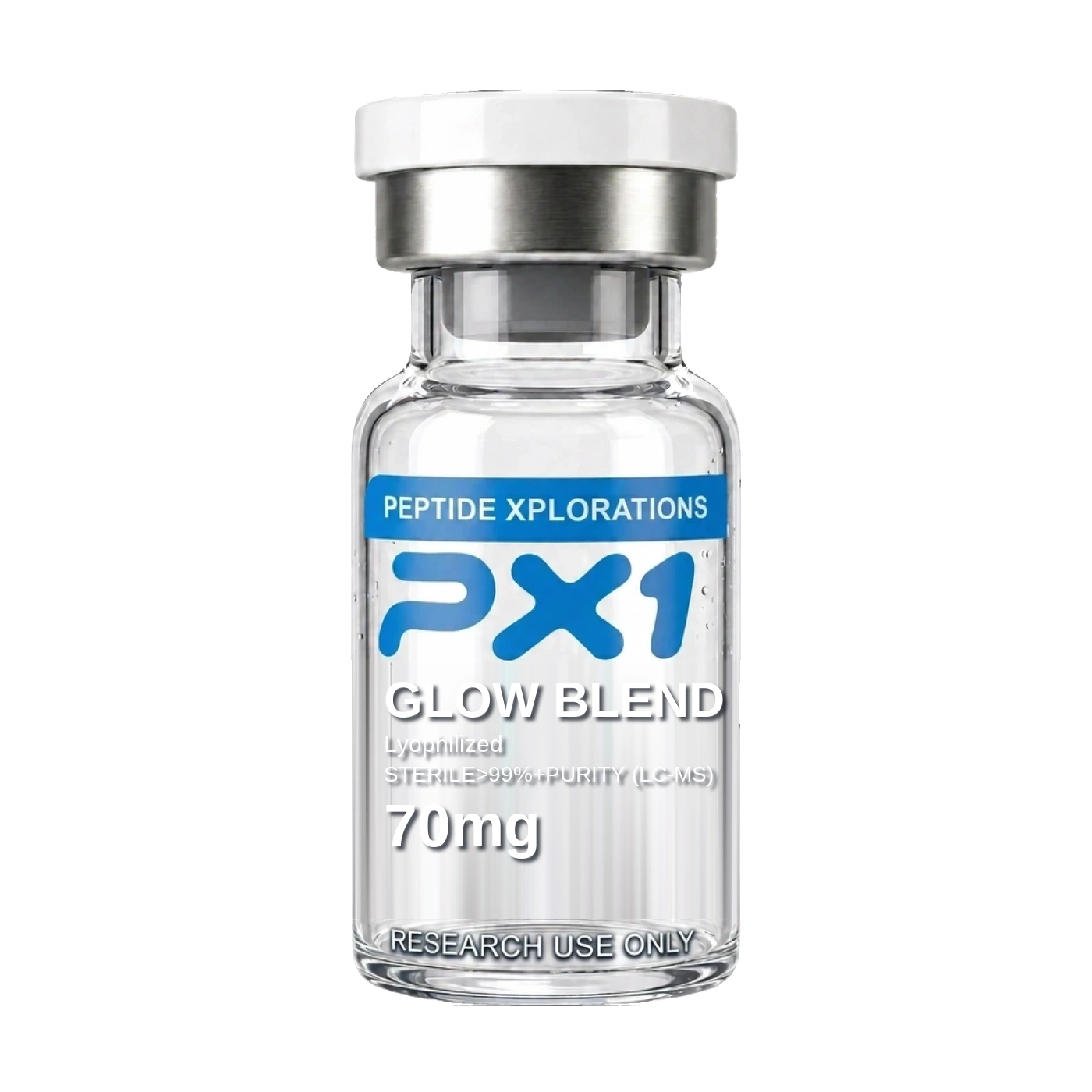
What is the GLOW blend?
GLOW is a three-component research blend of GHK-Cu, BPC-157 and TB-500 supplied as a single lyophilized preparation. It is the most frequently requested combination in dermal and connective-tissue research models, where the copper tripeptide is studied alongside two peptides associated with cell migration and angiogenic signaling.
PX1 Research releases GLOW against component-level analytical data so the ratio and identity of each constituent are documented on the batch certificate.
Why the components are studied together
GHK-Cu is one of the most characterized copper-binding peptides in dermatology literature, reported to influence collagen I and III expression in fibroblast culture. TB-500 addresses actin dynamics and cell motility; BPC-157 contributes angiogenic and cytoprotective readouts.
Combining them in one vial removes cross-vial concentration error, which is a common confound when researchers prepare three separate solutions for the same well plate.
Laboratory handling and storage
GLOW ships as a lyophilized powder in a sealed, tamper-evident vial. Store the unopened vial between −20°C and −80°C, protected from light, until the day of use. In this state the peptide is stable through the labeled expiration date printed on the lot documentation.
Allow the vial to reach room temperature before opening so atmospheric moisture does not condense onto the lyophilized cake. Introduce bacteriostatic or sterile water slowly against the vial wall, then swirl — never shake — until the solution is clear. Store the reconstituted solution at 2–8°C, aliquot to avoid repeated freeze–thaw cycles, and record the lot number in your laboratory notebook alongside the reconstitution date.
Purity, testing and Certificate of Analysis
Every PX1 Research lot of each GLOW component is manufactured in the United States and released against a documented specification of ≥99% purity by reversed-phase HPLC, with identity confirmed on the same lot by high-resolution LC-MS against the theoretical mass of the sequence.
Release testing covers six layers: HPLC purity, LC-MS identity, endotoxin by kinetic chromogenic LAL, residual solvents by gas chromatography, water content by Karl Fischer titration, and visual inspection of appearance and reconstitution. The batch-specific Certificate of Analysis is published on this page, and the lot number on the vial label matches the report so the material in your hand traces back to the data you can read online.
Research use only
The GLOW blend supplied by PX1 Research is intended strictly for in-vitro laboratory and research applications. It is not a drug, food, cosmetic, or medical device, and it is not for human or veterinary use, diagnosis, treatment, or consumption.
Researchers are responsible for handling the compound in accordance with their institution's safety procedures and all applicable local regulations. Safety data sheets and current lot documentation are available on this site.
References
- Pickart 2018. Pickart L, Margolina A. Regenerative and protective actions of the GHK-Cu peptide. International Journal of Molecular Sciences. 2018;19(7):1987.
- Goldstein 2012. Goldstein AL, Hannappel E, Sosne G, Kleinman HK. Thymosin β4: a multi-functional regenerative peptide. Expert Opinion on Biological Therapy. 2012;12(1):37-51.
All products are sold strictly for laboratory and research use only. Not for human or veterinary use, diagnosis, treatment or consumption. Statements have not been evaluated by the FDA.