Peptide Verified8 assays
PX12-T 10mg
Lot PX1T10-0021
ILS Laboratories
Independent laboratory
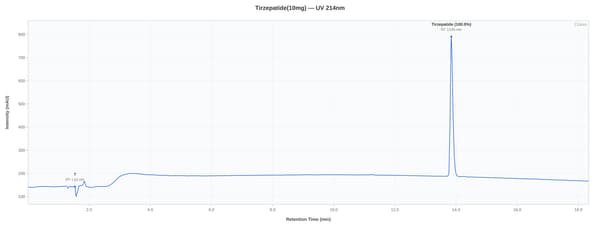
HPLC purity
99.90%
High purity confirmed
Labeled amount10mg
Measured amountSee certificate
IdentityPX12-T
TestedSep 9, 2026
Made in the USA
Ships from the USA
Peptides
Research monograph on PX12-T (LY-3298176) — a dual GIP / GLP-1 receptor agonist. Covers receptor pharmacology, comparison against PX1-S and PX13-R, laboratory handling, analytical release testing and the published literature.
Strength
Quantity
Bundle & Save
Subscribe & Save 10%
Ships every 30 days · Cancel anytime
Per shipment
$71.99 $64.79
Subscription length
Login required. Manage anytime from Account → Subscriptions.
For research use only. Not for human or animal consumption.
Molecular weight
4813.45 g/mol
Molecular formula
C₂₂₅H₃₄₈N₄₈O₆₈
CAS number
2023788-19-2
Chain length
39 amino acids
Classification: Research peptide
The complete primary structure is reported only when it can be verified for the exact compound and modification supplied.
Batch verification
Independent testing with lot-specific analytical documentation.
Lot PX1T10-0021
ILS Laboratories
Independent laboratory
HPLC purity
99.90%
High purity confirmed
Full GHS 16-section Safety Data Sheet for PX12-T, prepared per OSHA HazCom 2012 (29 CFR 1910.1200). Includes substance identity, handling & storage, PPE, stability, transport and regulatory information.
CAS No.
2023788-19-2
Formula
C₂₂₅H₃₄₈N₄₈O₆₈
Mol. Weight
4813.45 g/mol
Classification
Not hazardous (GHS)
Research monograph on PX12-T (LY-3298176) — a dual GIP / GLP-1 receptor agonist. Covers receptor pharmacology, comparison against PX1-S and PX13-R, laboratory handling, analytical release testing and the published literature.
PX12-T is classified on this page as a research peptide and is supplied in a lyophilized research preparation. The presentation is intended to support controlled laboratory workflows, analytical method development, and documented preclinical or in-vitro investigation appropriate to the compound.
PX1 Research manufactures and finishes this product in American GMP laboratories rather than purchasing finished vials from overseas. Each released lot is evaluated through the PX1 quality program, with identity, purity, appearance, and applicable contaminant or endotoxin results documented on the lot-linked Certificate of Analysis. Researchers should review the current COA and Safety Data Sheet shown on this page before beginning work.
Store the sealed preparation at −20°C for long-term stability and protect it from light. Bring the closed vial to room temperature before opening, follow the laboratory's validated preparation protocol, and minimize repeated freeze–thaw cycles. Use calibrated equipment, document concentration and storage conditions, and follow institutional safety procedures throughout the study.
For research use only. Not for human or veterinary use, consumption, diagnosis, treatment, or medical application. This material should be handled only by qualified professionals in an appropriate laboratory setting.
Purity (HPLC)
≥99%
Application
For Research Use only
Form
Lyophilized Powder
Storage
-20°C Long Term
Testing
Third Party Tested
Manufacture
USA
99%+ HPLC Purity
Independently verified by accredited US laboratory
Endotoxin-Screened
LAL tested, LPS-free, endotoxin report available
GMP-Certified Manufacturing
USA facility, ISO 9001:2015
Lyophilized for Stability
Shipped cold-packed and sealed for stability
Supplied as a research-grade compound for in-vitro and laboratory investigation.
For research use only — not for human or animal consumption.
PX12-T (LY-3298176) is a synthetic 39-amino-acid dual agonist that activates both the GIP and GLP-1 receptors from one molecule. Research models use it to study incretin cross-talk, insulin secretion and appetite signaling, and it is frequently referenced as the comparator for triple-agonist peptides such as PX13-R.
| Compound name | PX12-T |
|---|---|
| Research code | LY-3298176 |
| CAS registry number | 2023788-19-2 |
| Molecular formula | C225H348N48O68 |
| Molar mass | ≈4813.5 g/mol |
| Chain length | 39 amino acids |
| Reported half-life | ≈5 days (reported in published pharmacokinetic literature) |
| Physical form | Lyophilized white powder, acetate salt |
| Purity specification | ≥99% by reversed-phase HPLC; identity confirmed by LC-MS |
| Intended use | Research use only — not for human or veterinary use |
| Property | PX13-R | PX12-T | PX1-S |
|---|---|---|---|
| Receptor targets | GLP-1 / GIP / glucagon (triple) | GLP-1 / GIP (dual) | GLP-1 (single) |
| Development code | LY-3437943 | LY-3298176 | NN9535 |
| Chain length | 39 amino acids | 39 amino acids | 31 amino acids |
| Molar mass | ≈4730 g/mol | ≈4813 g/mol | ≈4114 g/mol |
| Reported plasma half-life | ≈6 days | ≈5 days | ≈7 days |
| Lyophilized presentation | Vial, acetate salt | Vial, acetate salt | Vial, acetate salt |
Research monograph
PX12-T (development code LY-3298176) is a synthetic 39-amino-acid peptide built on a GIP backbone and engineered to act as a balanced dual agonist at the glucose-dependent insulinotropic polypeptide (GIP) receptor and the glucagon-like peptide-1 (GLP-1) receptor. A C20 fatty di-acid moiety attached via a linker at position 20 supports albumin binding, which is the structural basis for its extended duration in preclinical systems.
The molecule is a landmark in the incretin field because it demonstrated that a single sequence could engage two distinct incretin receptors with a deliberately unbalanced potency profile — higher relative activity at GIP than at GLP-1 — rather than simply summing two agonists. That design principle directly informed the later triple agonists.
PX1 Research supplies lyophilized PX12-T as a reference compound for in-vitro receptor characterization, comparative incretin pharmacology and analytical method development. Every vial ships with a batch-specific certificate of analysis. Research use only — not for human or veterinary use.
At the GLP-1 receptor, agonism in preclinical systems potentiates glucose-dependent insulin secretion, slows gastric emptying and engages central appetite circuitry. At the GIP receptor, agonism amplifies incretin-mediated insulin release and has been associated in adipose models with altered lipid handling and improved insulin sensitivity of the adipocyte.
PX12-T's signaling profile is one of the most-studied examples of biased agonism in the class. Reports have described a preference for cAMP generation over β-arrestin recruitment at the GLP-1 receptor, producing reduced receptor internalization and more sustained signaling relative to a conventional GLP-1 agonist. Whether that bias explains the compound's preclinical efficacy remains an active question in the literature and is a common subject for cell-based comparative assays.
For laboratory characterization, PX12-T is typically profiled in cAMP accumulation assays in cells expressing human GIPR and GLP-1R, β-arrestin recruitment panels, and receptor-internalization imaging, with PX1-S and native GIP as reference agonists.
The three compounds map cleanly onto three generations of receptor coverage: PX1-S (GLP-1 only), PX12-T (GIP + GLP-1) and PX13-R (GIP + GLP-1 + glucagon). Studies that compare them generally hold the assay system constant and vary only the test article, which makes consistent purity across the three reference materials a methodological requirement rather than a preference.
Structurally they are quite different molecules. PX1-S is a 31-residue GLP-1 analog with an AIB substitution at position 8 and a C18 di-acid; PX12-T is a 39-residue GIP-based sequence with a C20 di-acid; PX13-R is a 39-residue sequence with its own modification pattern. An HPLC method validated for one will not automatically resolve the impurity profile of the others.
Practically, laboratories stocking the incretin class tend to buy all three from a single supplier and a single release process, so that lot-to-lot analytical variance is common across the comparison rather than confounded with the pharmacology being measured.
Laboratories that work with PX12-T typically characterize incoming material on three axes before it enters a study: identity, purity and content. Identity is established by high-resolution mass spectrometry against the theoretical monoisotopic mass (≈4,813.5 Da for the modified 39-residue sequence), usually supported by MS/MS fragmentation that walks the backbone and confirms the sequence rather than just the total mass. A matching intact mass alone can be satisfied by a scrambled or partially epimerized sequence, which is why fragmentation data is the stronger identity evidence.
Purity is quantified by reversed-phase HPLC with UV detection, integrating every resolved peak in the chromatogram and expressing the main peak as a percentage of total area. The gradient matters more than the headline number: a shallow, well-optimized gradient resolves closely eluting process impurities such as deamidation products, oxidation variants, truncated sequences and acetate adducts, while an aggressive gradient can co-elute them under the main peak and inflate the reported purity. PX1 publishes the chromatogram itself, not only the integrated figure, so the resolution behind the number is auditable.
Content — how much peptide is actually in the vial once counter-ions and residual water are subtracted — is the axis most often skipped by low-cost suppliers. Net peptide content is a function of the labeled mass, the water content measured by Karl Fischer titration, and the counter-ion (typically trifluoroacetate or acetate) load. A vial that is 99% pure by HPLC can still under-deliver on content if it carries a high salt and moisture fraction, which is why the COA reports both.
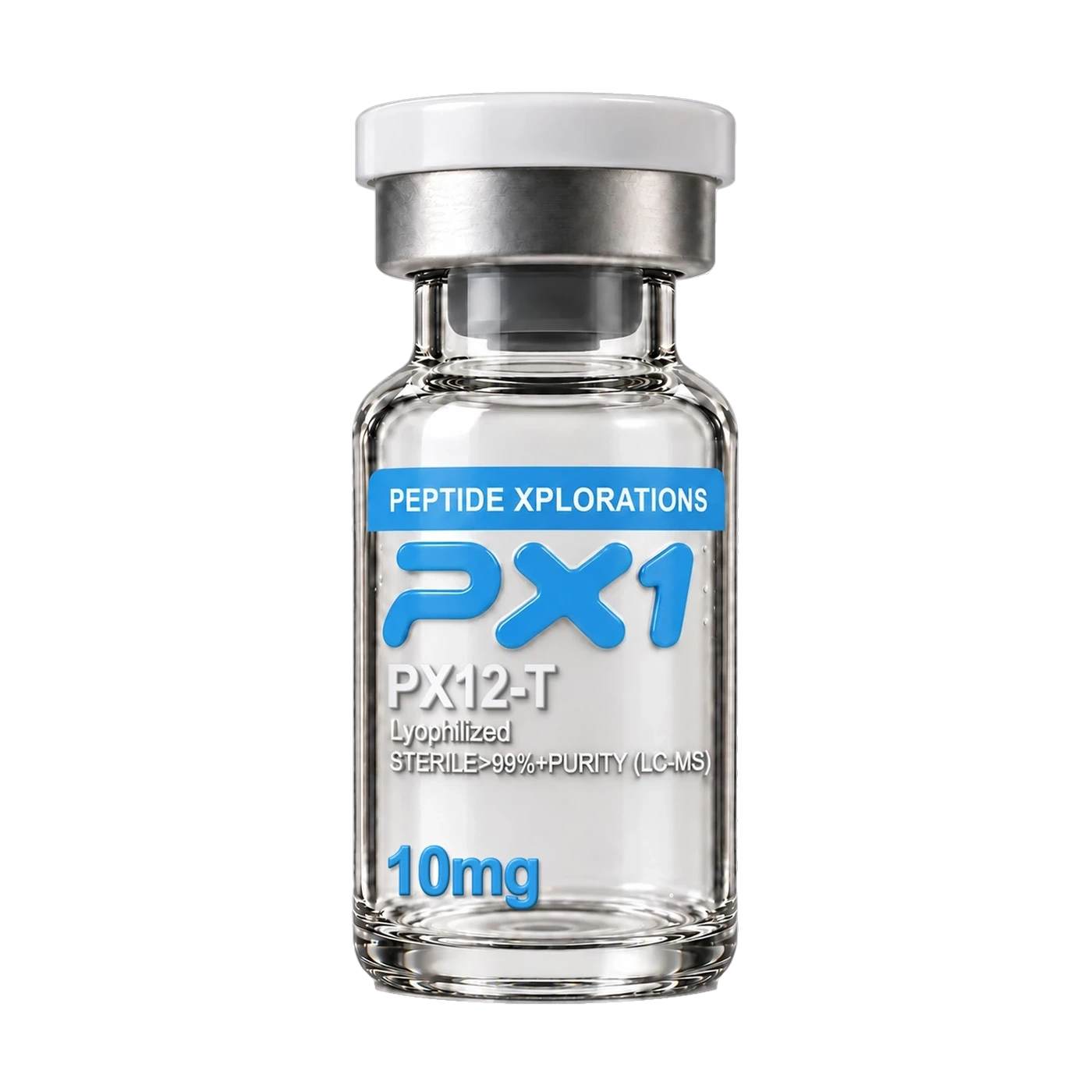
The lot number on the COA matches the lot number printed on the vial label, so the material in hand traces back to the specific chromatogram published on this product page rather than to a representative example document.
The research-peptide market is unusually wide in quality. The same nominal PX12-T listing can represent USA-manufactured material released against a documented specification, or repackaged bulk of unknown origin with a generic certificate that was never generated from the lot in the vial. The distinction is invisible from the product photo and only becomes visible in the paperwork.
The practical test is traceability: the lot number printed on the vial label should appear on the certificate of analysis, and that certificate should show the actual chromatogram and mass spectrum for that lot rather than a representative example. A COA without a lot number, without instrument traces, or dated years before the vial was filled is a document, not evidence. PX1 publishes the batch-specific report directly on the product page so the chain from manufacturing to vial is checkable before purchase.
Beyond the certificate, consistent lab-grade supply depends on synthesis and release happening under one controlled process: domestic solid-phase manufacturing, preparative HPLC purification, lyophilization under validated cycle parameters, and third-party confirmation of purity and endotoxin. PX12-T sold by PX1 Research is produced and released on that pathway and is supplied strictly for laboratory research use — not for human or veterinary use.
Dual-agonist characterization requires both receptors assayed in parallel and, increasingly, both signaling branches. The standard panel is cAMP accumulation and β-arrestin recruitment at GLP-1R and at GIPR, with native ligands as reference agonists, plus a receptor-internalization readout by imaging. Reporting cAMP alone hides the biased-signaling property that most distinguishes the molecule.
Species selection is a real variable in incretin work. GIP receptor pharmacology differs meaningfully between human and rodent receptors, so a compound profiled on the human receptor may not reproduce in a rodent-derived line. Studies should state which receptor ortholog was used, and cross-species comparison is itself a common experimental design in this literature.
As with all acylated incretins, the albumin question shapes in vitro design. Serum-containing media sequester a fraction of the compound, shifting apparent potency relative to serum-free conditions. Running a matched serum-free arm, or reporting the free-fraction assumption explicitly, is what makes potency values comparable between publications.
Analytical method development for PX12-T in biological matrix is an active area precisely because the di-acid complicates extraction and because closely related des-acyl species must be chromatographically resolved from the parent. Validation should include recovery, matrix effect and stability in matrix, each across the working range rather than at a single concentration.
For comparative programmes, holding the analytical release process constant across the incretin reference set — PX12-T, PX1-S, PX13-R — removes supplier variance from the comparison. This is a procurement decision with direct experimental consequences, and it is the reason laboratories in this field tend to consolidate the class with one supplier.
Why is PX12-T described as an imbalanced agonist? Balanced would mean comparable potency at both target receptors. Published characterization instead reports higher relative activity at the GIP receptor than at the GLP-1 receptor, and additionally a signaling preference at GLP-1R for cAMP generation over β-arrestin recruitment. Both asymmetries are deliberate design outcomes and both are routinely re-measured when laboratories benchmark new dual agonists against it.
Does the GIP arm add anything beyond GLP-1? That question drove much of the early literature, since GIP agonism and GIP antagonism have both been proposed as metabolically favorable. The prevailing experimental approach is to compare a dual agonist against a matched GLP-1-only agonist in the same system, which is why PX1-S reference material is nearly always purchased alongside PX12-T.
Is PX12-T the same thing as PX12-T? No. PX12-T is a market shorthand for the second-generation dual agonist and does not correspond to any receptor or endogenous ligand called GLP-2 in this context — GLP-2 is a real and unrelated intestinotrophic peptide. The literature uses PX12-T or LY-3298176 exclusively, and PX1's analytical documentation uses the canonical name even where the listing uses the shorthand.
What distinguishes a good PX12-T COA? A lot-specific chromatogram with a gradient shallow enough to resolve des-acyl and positional-isomer impurities; a high-resolution mass spectrum matching the theoretical mass of the modified 39-residue sequence; endotoxin, residual solvent and water content data; and a lot number that matches the vial. Anything less leaves the most consequential impurities — the ones that retain partial receptor activity — unmeasured.
PX12-T is the middle term of the incretin reference set: PX1-S below it as the GLP-1-only anchor, PX13-R above it as the triple agonist. Comparative pharmacology in this class is only interpretable when all three are assayed together, so laboratories generally stock the full set rather than a single compound.
Cagrilintide is the fourth compound most often added, bringing the amylin pathway into the panel and enabling combination designs that pair an incretin agonist with an amylin analog. Those designs are among the most active areas in current metabolic research.
All products are sold strictly for laboratory and research use only. Not for human or veterinary use, diagnosis, treatment or consumption. Statements have not been evaluated by the FDA.
High Quality — 99% Purity Guaranteed
We are continuously conducting HPLC testing on all of our raw powders as well as our finished products to ensure the quality of what we ship. You can have the product you bought from us independently tested at any HPLC-licensed testing facility — and if the results come back negative, we will refund the following:
HPLC Test Fee
$100
Plus a full refund
Total order amount + shipping
PX12-T
$71.99