Peptide Verified8 assays
MOTS-C 10mg
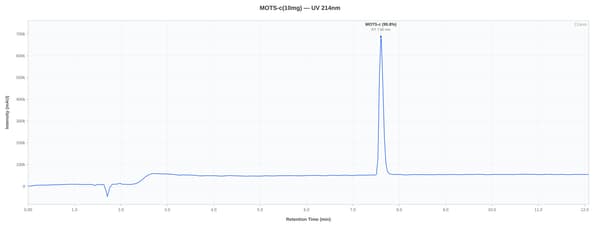
Lot PX1MOTS10-0021
ILS Laboratories
Independent laboratory
HPLC purity
99.81%
High purity confirmed
Labeled amount10mg
Measured amount10.31 mg
IdentityMOTS-C
TestedJul 31, 2026
Made in the USA
Ships from the USA
Peptides
Research monograph on MOTS-c — a 16-amino-acid mitochondrial-derived peptide encoded within the 12S rRNA region of the mitochondrial genome. Covers mitochondrial-nuclear signaling, laboratory handling, purity verification and published literature.
Strength
Quantity
Bundle & Save
PX1 Autoship 10%
Ships every 30 days · Cancel anytime
Per shipment
$76.99 $69.29
Subscription length
Login required. Manage anytime from Account → Subscriptions.
For research use only. Not for human or animal consumption.
Molecular weight
2174.6 g/mol
Molecular formula
C₁₀₁H₁₅₂N₂₈O₂₂S₂
CAS number
1627580-64-6
Chain length
16 amino acids
Amino-acid sequence
Met-Arg-Trp-Gln-Glu-Met-Gly-Tyr-Ile-Phe-Tyr-Pro-Arg-Lys-Leu-Arg
Classification: Research peptide
Batch verification
Independent testing with lot-specific analytical documentation.
Lot PX1MOTS10-0021
ILS Laboratories
Independent laboratory
HPLC purity
99.81%
High purity confirmed
Full GHS 16-section Safety Data Sheet for MOTS-c, prepared per OSHA HazCom 2012 (29 CFR 1910.1200). Includes substance identity, handling & storage, PPE, stability, transport and regulatory information.
CAS No.
1627580-64-6
Formula
C₁₀₁H₁₅₂N₂₈O₂₂S₂
Mol. Weight
2174.6 g/mol
Classification
Not hazardous (GHS)
MOTS-c (Mitochondrial Open Reading Frame of the 12S rRNA-c) is a 16-amino acid peptide derived from the mitochondria that represents a significant milestone in metabolic, gerontological, and physical performance studies. Programmed by the mitochondrial DNA itself, MOTS-c fine-tunes nuclear gene transcription, carbohydrate metabolism, and insulin response, positioning it as a critical subject for investigating age-associated metabolic decline, obesity, and mitochondrial insufficiency.
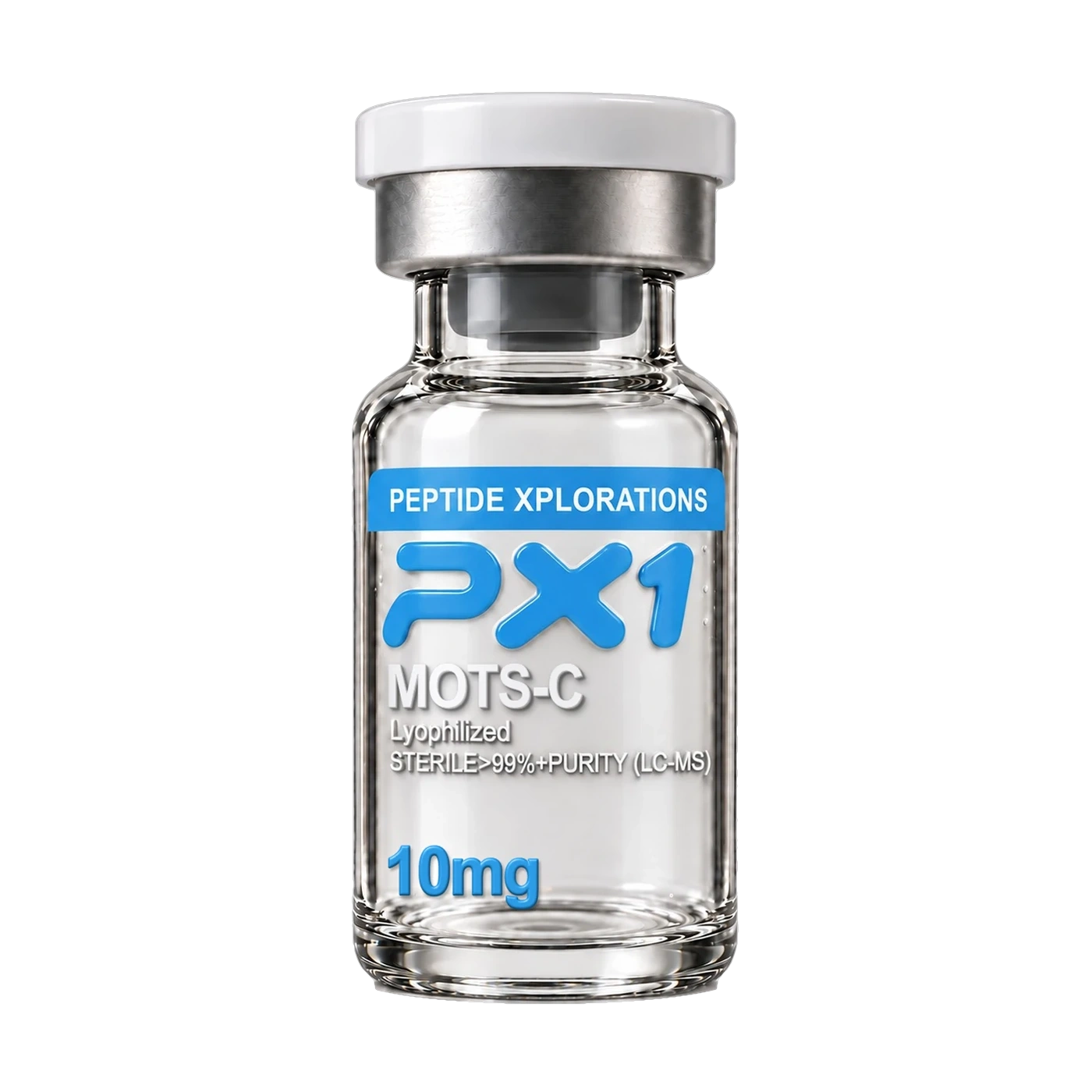
At PX1 Research, we supply professional-grade MOTS-c peptide (purity ≥98%), verified through HPLC and mass spectrometry to guarantee maximum stability and reliability for laboratory settings. This compound is developed exclusively for in vitro and animal-based experimentation within controlled environments and is not for use in humans or animals.
MOTS (Mitochondrial ORF of the 12S rRNA-c) is a 16-residue mitochondrial-encoded peptide with significant impacts on glucose homeostasis, insulin sensitivity, and cellular durability. It is an ideal candidate for researching:
Biological aging & lifespan duration Physical endurance & muscular recuperation Neuroprotective effects & mental acuity
Disclaimer: This product is designed solely for laboratory research. It is not intended for human or veterinary consumption.
MOTS has been observed to stimulate glucose consumption and refine insulin sensitivity, making it a primary peptide for the study of:
Mechanism of Action:
Supporting Studies:
MOTS has shown significant anti-aging properties through:
Supporting Studies: 3. Kim et al. (2018) – “MOTS-c attenuates age-related oxidative stress in skeletal muscle.” PubMed Link 4. Wan et al. (2020) – “MOTS-c extends lifespan in aging models via mitochondrial regulation.” PubMed Link
MOTS is currently being investigated for its performance-enhancing potential, such as:
Supporting Studies: 5. Qin et al. (2018) – “MOTS-c enhances running endurance in mice via metabolic adaptation.” PubMed Link
New evidence indicates that MOTS may:
Supporting Studies: 7. Cohen et al. (2022) – “MOTS-c reduces amyloid-beta accumulation in Alzheimer’s models.” PubMed Link 8. Lu et al. (2023) – “MOTS-c improves hippocampal-dependent memory in aged mice.” PubMed Link
Note: These figures are intended as research benchmarks only. Not for human or animal use.
| Research Model | Proposed Dosage Range | Method of Delivery |
|---|---|---|
| In vitro models | 10-100 µM | Cell culture medium |
| Murine models | 0.5-5 mg/kg | Intraperitoneal or Sub-Q |
| Physical exertion studies | 1-3 mg/kg (pre-trial) | Subcutaneous |
Verified purity of ≥98% via HPLC Lyophilized format for superior long-term shelf life Third-party laboratory validation available Rapid and confidential shipping within the USA Exclusively for research use (non-human/non-animal)
MOTS is a pioneering research molecule with diverse uses in metabolic health, gerontology, sports science, and neurology. At PX1 Research, we offer the most reliable peptides strictly for scientific inquiry.
Disclaimer: This item is distributed solely for laboratory experimentation. It is not for human ingestion, clinical treatment, or veterinary application. By completing a purchase, you agree to follow all relevant regulatory guidelines.
Purity (HPLC)
≥99%
Application
For Research Use only
Form
Lyophilized Powder
Storage
-20°C Long Term
Testing
Third Party Tested
Manufacture
USA
99%+ HPLC Purity
Independently verified by accredited US laboratory
Endotoxin-Screened
LAL tested, LPS-free, endotoxin report available
GMP-Certified Manufacturing
USA facility, ISO 9001:2015
Lyophilized for Stability
Shipped cold-packed and sealed for stability
Investigated for mitochondrial function, metabolic regulation and exercise-capacity research.
For research use only — not for human or animal consumption.
Research monograph
MOTS-c (Mitochondrial Open reading frame of the Twelve S rRNA type-c) is a 16-amino-acid peptide encoded within the mitochondrial 12S ribosomal RNA gene. Discovered in 2015 by the Cohen laboratory, it is one of a small class of mitochondrial-derived peptides (MDPs) that includes humanin and the SHLP series.
PX1 Research supplies lyophilized MOTS-c as a reference compound for in-vitro mitochondrial signaling, metabolic-stress and AMPK-pathway research. It is offered strictly for research use only — not for human or veterinary use.
In preclinical systems, MOTS-c translocates from mitochondria to the nucleus under metabolic stress and regulates nuclear gene expression through interactions with stress-response transcription factors. It is reported to activate AMP-activated protein kinase (AMPK) signaling and modulate the folate-methionine cycle, positioning it as a metabolic-regulatory peptide that bridges mitochondrial and nuclear compartments.
The nuclear translocation of MOTS-c is one of the earliest examples of retrograde mitochondrial-to-nuclear peptide signaling described in the mammalian literature and remains an active area of research.
MOTS-c was first described by Lee and colleagues in 2015, identifying its coding sequence within the 12S rRNA region and characterizing its systemic metabolic effects in rodent models. Subsequent work extended the story to include age-related decline of MOTS-c levels, exercise-induced upregulation and stress-responsive nuclear translocation.
It appears in the peer-reviewed literature as a metabolic-regulatory and stress-responsive peptide with a growing body of comparative work against other mitochondrial-derived peptides.
Every PX1 MOTS-c lot is USA-manufactured to ≥99% purity by reversed-phase HPLC with LC-MS identity confirmation against the theoretical monoisotopic mass of the 16-mer. The batch-specific COA is published on this product page.
MOTS-c belongs to a small and unusual class: peptides encoded not in nuclear DNA but in the mitochondrial genome. The 16-amino-acid sequence is transcribed from a short open reading frame within the mitochondrial 12S rRNA gene, which puts it alongside humanin (encoded in the 16S rRNA region) and the SHLP family as a mitochondrial-derived peptide, or MDP.
Functionally MOTS-c is described in the literature as a retrograde signaling molecule — a message from the mitochondrion to the nucleus. Under metabolic stress the peptide has been reported to translocate to the nucleus and associate with stress-responsive transcription factors, altering expression of nuclear genes involved in antioxidant response and metabolic adaptation. That nuclear translocation is what separates MOTS-c mechanistically from mitochondrially targeted small molecules that act only within the organelle.
This distinction matters when MOTS-c is compared with SS-31 (elamipretide), the other compound most often stocked alongside it. SS-31 is a mitochondria-targeted tetrapeptide that concentrates at the inner mitochondrial membrane and interacts with cardiolipin, acting locally on membrane and respiratory-chain integrity. MOTS-c signals outward to the nucleus. Studies that pair them are usually testing local membrane protection against global transcriptional adaptation.
Laboratories that work with MOTS-c typically characterize incoming material on three axes before it enters a study: identity, purity and content. Identity is established by high-resolution mass spectrometry against the theoretical monoisotopic mass (≈2,174.6 Da for the 16-residue sequence), usually supported by MS/MS fragmentation that walks the backbone and confirms the sequence rather than just the total mass. A matching intact mass alone can be satisfied by a scrambled or partially epimerized sequence, which is why fragmentation data is the stronger identity evidence.
Purity is quantified by reversed-phase HPLC with UV detection, integrating every resolved peak in the chromatogram and expressing the main peak as a percentage of total area. The gradient matters more than the headline number: a shallow, well-optimized gradient resolves closely eluting process impurities such as deamidation products, oxidation variants, truncated sequences and acetate adducts, while an aggressive gradient can co-elute them under the main peak and inflate the reported purity. PX1 publishes the chromatogram itself, not only the integrated figure, so the resolution behind the number is auditable.
Content — how much peptide is actually in the vial once counter-ions and residual water are subtracted — is the axis most often skipped by low-cost suppliers. Net peptide content is a function of the labeled mass, the water content measured by Karl Fischer titration, and the counter-ion (typically trifluoroacetate or acetate) load. A vial that is 99% pure by HPLC can still under-deliver on content if it carries a high salt and moisture fraction, which is why the COA reports both.
The MOTS-c literature centers on metabolic homeostasis: AMPK pathway activation, glucose handling in skeletal muscle models, and the folate–methionine cycle intermediates through which the peptide's AMPK effects have been proposed to operate. These reports established MOTS-c as a metabolic regulator rather than a purely mitochondrial housekeeping factor.
A second area is exercise physiology and aging. Published work has reported MOTS-c induction following exercise and has examined its relationship to age-dependent physical decline in animal models, which drove considerable interest in the peptide as a candidate exercise-mimetic tool compound.
A third, genetics-flavored cluster examines mitochondrial DNA polymorphisms within the MOTS-c open reading frame and their population-level associations, an approach only possible because the peptide is mitochondrially encoded. Laboratories replicating any of this work depend on identity confirmation by MS/MS, since the short sequence offers little margin for error and truncated variants are the most common synthesis-related impurity.
The research-peptide market is unusually wide in quality. The same nominal MOTS-c listing can represent USA-manufactured material released against a documented specification, or repackaged bulk of unknown origin with a generic certificate that was never generated from the lot in the vial. The distinction is invisible from the product photo and only becomes visible in the paperwork.
The practical test is traceability: the lot number printed on the vial label should appear on the certificate of analysis, and that certificate should show the actual chromatogram and mass spectrum for that lot rather than a representative example. A COA without a lot number, without instrument traces, or dated years before the vial was filled is a document, not evidence. PX1 publishes the batch-specific report directly on the product page so the chain from manufacturing to vial is checkable before purchase.
Beyond the certificate, consistent lab-grade supply depends on synthesis and release happening under one controlled process: domestic solid-phase manufacturing, preparative HPLC purification, lyophilization under validated cycle parameters, and third-party confirmation of purity and endotoxin. MOTS-c sold by PX1 Research is produced and released on that pathway and is supplied strictly for laboratory research use — not for human or veterinary use.
MOTS-c work benefits from pairing a signaling readout with a functional one. AMPK phosphorylation state establishes that the pathway was engaged; glucose uptake, respirometry or a transcript panel establishes that engagement produced a consequence. Reporting phosphorylation alone leaves open whether the pathway activation was of sufficient magnitude or duration to matter, which is a common criticism of the thinner reports in this area.
Metabolic stress is often part of the design rather than a confounder. Because the peptide is described as a stress-responsive retrograde signal, its nuclear translocation and downstream effects are frequently more pronounced under glucose restriction or metabolic challenge than under standard culture conditions. A study run only in replete conditions may be testing the compound outside the state in which it is described to act.
Nuclear translocation itself is a measurable endpoint. Immunofluorescence or subcellular fractionation with a labeled or antibody-detected peptide provides direct evidence of the proposed mechanism rather than inferring it from downstream gene expression, and designs that include it are considerably more informative than those that do not.
Exercise-physiology designs add a further wrinkle: endogenous MOTS-c is reported to rise with exercise, so an exercised control arm establishes the endogenous baseline against which exogenous exposure is interpreted. Without it, an effect attributed to the administered peptide may partly reflect the intervention that accompanied it.
In genetic work, the mitochondrial encoding permits an approach unavailable elsewhere — stratifying by mitochondrial haplogroup or by polymorphisms within the MOTS-c open reading frame. Those designs require sequencing of the mitochondrial region rather than nuclear genotyping, and the sample sizes needed are correspondingly larger than for a straightforward exposure study.
What does it mean that MOTS-c is mitochondrially encoded? Nearly all human peptides are transcribed from nuclear DNA. MOTS-c is transcribed from a short open reading frame inside the mitochondrial 12S rRNA gene, making it one of a small set of mitochondrial-derived peptides alongside humanin and the SHLP family. This is not a technicality: it means mitochondrial DNA polymorphisms can alter the peptide's sequence at a population level, which is an experimental avenue unavailable for nuclear-encoded peptides.
What is retrograde signaling? Conventional signaling runs from the nucleus outward, directing mitochondrial function. Retrograde signaling runs the other way — the mitochondrion reports its metabolic state back to the nucleus and alters nuclear gene expression. MOTS-c is described in the literature as doing exactly this, translocating to the nucleus under metabolic stress and associating with stress-responsive transcription factors.
How is MOTS-c different from SS-31? SS-31 is an exogenous synthetic tetrapeptide that concentrates inside the mitochondrion and acts locally on cardiolipin and cristae organization. MOTS-c is endogenous, mitochondrially encoded, and signals outward to the nucleus. Studies pairing them are typically contrasting local structural protection with global transcriptional adaptation, and the readouts differ accordingly.
What readouts are standard in MOTS-c work? AMPK phosphorylation state, folate–methionine cycle intermediates, glucose uptake in skeletal muscle models, and transcript panels for metabolic and antioxidant genes. Exercise-physiology designs additionally track endogenous MOTS-c induction, since published work reports that exercise itself raises circulating levels.
What impurities matter most for a 16-mer? Truncated sequences. Short peptides give synthesis fewer opportunities to fail but also less analytical margin — a des-residue impurity differs from the target by a small fraction of the total mass and can hide under the main peak on an aggressive gradient. MS/MS fragmentation confirming the full backbone, not intact mass alone, is the meaningful identity check.
MOTS-c belongs to the mitochondrial and cellular-aging group. Its closest catalog neighbor is SS-31, which acts inside the organelle on cardiolipin and cristae structure while MOTS-c signals outward to the nucleus — the two are complementary arms of the same experimental question and are frequently purchased together.
NAD+ is the third member of that group, addressing redox cofactor availability rather than membrane structure or transcriptional adaptation. Epithalon and the bio-regulator peptides extend the panel further into telomere and gene-expression territory, giving a four-axis view of the same aging phenotype on shared senescence endpoints.
For metabolic designs, MOTS-c is often run alongside SLU-PP-332 and 5-Amino-1MQ, where the shared readouts are AMPK signaling, glucose handling and energy expenditure in skeletal muscle models.
All products are sold strictly for laboratory and research use only. Not for human or veterinary use, diagnosis, treatment or consumption. Statements have not been evaluated by the FDA.
High Quality — 99% Purity Guaranteed
We are continuously conducting HPLC testing on all of our raw powders as well as our finished products to ensure the quality of what we ship. You can have the product you bought from us independently tested at any HPLC-licensed testing facility — and if the results come back negative, we will refund the following:
HPLC Test Fee
$100
Plus a full refund
Total order amount + shipping
MOTS-C
$76.99