Peptide Verified8 assays
SS-31 10mg
Lot PX1SS15-0021
ILS Laboratories
Independent laboratory
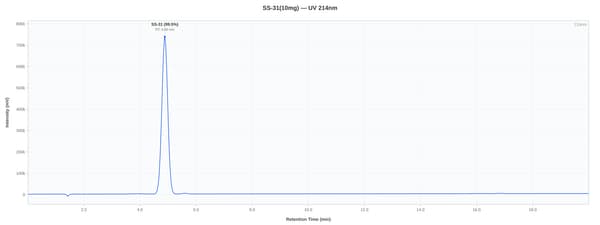
HPLC purity
99.52%
High purity confirmed
Labeled amount10mg
Measured amount10.51 mg
IdentitySS-31
TestedJul 31, 2026
Made in the USA
Ships from the USA
Peptides
Research monograph on SS-31 (elamipretide) — a mitochondria-targeted tetrapeptide that associates with cardiolipin at the inner mitochondrial membrane. Covers mechanism, comparison against MOTS-c, laboratory handling and published literature.
Strength
Quantity
Bundle & Save
PX1 Autoship 10%
Ships every 30 days · Cancel anytime
Per shipment
$99.99 $89.99
Subscription length
Login required. Manage anytime from Account → Subscriptions.
For research use only. Not for human or animal consumption.
Molecular weight
639.79 g/mol
Molecular formula
C₃₂H₄₉N₉O₅
CAS number
736992-21-5
Chain length
4 amino acids
Amino-acid sequence
D-Arg-Dmt-Lys-Phe-NH2
Classification: Research peptide
Batch verification
Independent testing with lot-specific analytical documentation.
Lot PX1SS15-0021
ILS Laboratories
Independent laboratory
HPLC purity
99.52%
High purity confirmed
Full GHS 16-section Safety Data Sheet for SS-31, prepared per OSHA HazCom 2012 (29 CFR 1910.1200). Includes substance identity, handling & storage, PPE, stability, transport and regulatory information.
CAS No.
736992-21-5
Formula
C₃₂H₄₉N₉O₅
Mol. Weight
639.79 g/mol
Classification
Not hazardous (GHS)
Category: Peptide Research Compounds / Mitochondrial Research / Anti-Aging & Cell Death Studies
Disclaimer: ATTENTION: PX1 Research PRODUCTS ARE INTENDED FOR LABORATORY RESEARCH AND IN-VITRO STUDIES ONLY. The data provided on this platform is strictly for academic and scientific inquiry purposes. These substances are absolutely not intended for use in humans or animals, nor for therapeutic, food, or diagnostic use. By placing an order with PX1 Research, you certify that you are a trained professional conducting research within a sanctioned laboratory setting. Compliance with all regional, state, and national laws regarding the use of research grade chemicals is required. All substances must be managed using appropriate safety gear (PPE) and following standard laboratory safety measures.
This ultra-pure peptide, targeted specifically at mitochondria, is intended for high-level cellular investigations. SS-31 migrates specifically to the inner mitochondrial membrane, where it preserves cristae integrity and mitigates oxidative stress at its point of origin.
This 30mg supply of freeze-dried powder is meant solely for use by qualified personnel in in-vitro research. Not for therapeutic or veterinary applications.
Sequence: D-Arg-Dmt-Lys-Phe-NH₂ Purity: ≥98% (Confirmed by HPLC) Storage: Maintain at a temperature of -20°C or colder
PX1 Research is pleased to provide a comprehensive look at a pivotal molecule in mitochondrial science: SS-31, also referred to as Elamipretide. This offering includes 30mg of high-grade, lyophilized peptide, serving as a vital instrument for studying biological energy production, oxidative management, and programmed cell death. A specialized, water-soluble tetra-peptide (D-Arg-Dmt-Lys-Phe-NH₂), SS-31 is designed to navigate to and safeguard the inner mitochondrial membrane. This overview provides the scientific foundation necessary to structure experiments in the sectors of longevity science, cardiology, neurology, and nephrology.
The experimental utility of SS-31 stems from its capacity to permeate cell membranes and concentrate significantly—up to several hundred times—within the inner mitochondrial membrane (IMM). This is the critical site for ATP synthesis and the electron transport chain (ETC). Its functionality is centered on two specific interactions in this organelle.
The high affinity of SS-31 for the mitochondrial space makes it a more precise research tool than general antioxidants, as it stops oxidative damage at the source without interfering with necessary redox signaling in other cellular areas.
Our 30mg SS-31 vial is optimized for complex in-vitro experimental use. The following areas represent major research fields supported by existing literature.
2.1 Investigating Ischemia-Reperfusion Injury
Ischemia-reperfusion (IR) injury occurs when tissue damage is paradoxically intensified by the return of blood flow to previously oxygen-starved areas. This is primarily caused by an explosion of mitochondrial ROS once oxygen is reintroduced.
2.2 Research on Age-Related Mitochondrial Dysfunction and Neurodegeneration
The theory that aging is driven by cumulative mitochondrial protein and DNA damage is a primary focus of biogerontology. SS-31 is a centerpiece for exploring methods to slow this decline.
2.3 Exploring Heart Failure and Cardiomyopathy Models
As a metabolically demanding organ, the heart's health is intrinsically tied to mitochondrial performance. Mitochondrial failure is a hallmark of heart disease.
2.4 Studies on Sarcopenia and Muscular Degeneration
The loss of muscle due to aging (sarcopenia) is linked to failing mitochondria in the muscle fibers.
Advanced research often looks for collective benefits when combining several compounds.
Product Specification:
Why Choose PX1 Research for Your SS-31 Research?
PX1 Research’s 30mg vial of SS-31 is an essential, high-precision tool for exploring the role of mitochondria in disease, aging, and general health. Its specific interaction with the internal mitochondrial membrane provides deep insight into energy production, cell death, and oxidation. Studies involving SS-31 continue to highlight the organelle as a master regulator in various degenerative states.
We are dedicated to providing the high-caliber materials needed for your groundbreaking scientific work.
Purchase your SS-31 (30mg) vial now to advance your investigation into cellular energy and health.
Disclaimer: All PX1 Research products are for laboratory research use only. Not for human or animal consumption.
Purity (HPLC)
≥99%
Application
For Research Use only
Form
Lyophilized Powder
Storage
-20°C Long Term
Testing
Third Party Tested
Manufacture
USA
99%+ HPLC Purity
Independently verified by accredited US laboratory
Endotoxin-Screened
LAL tested, LPS-free, endotoxin report available
GMP-Certified Manufacturing
USA facility, ISO 9001:2015
Lyophilized for Stability
Shipped cold-packed and sealed for stability
Studied for binding cardiolipin at the inner mitochondrial membrane and for effects on electron transport, ATP production and oxidative-stress readouts.
For research use only — not for human or animal consumption.
Research monograph
SS-31, also known as elamipretide and by the research code MTP-131, is a synthetic tetrapeptide with the sequence D-Arg-dimethylTyr-Lys-Phe-NH2. It belongs to the Szeto-Schiller (SS) family of cell-permeable, mitochondria-targeted peptides, whose defining property is that they concentrate in the inner mitochondrial membrane without requiring a membrane potential to get there.
The alternating cationic and aromatic residue pattern is what drives that localization, and the D-arginine and dimethyltyrosine modifications confer resistance to peptidase cleavage. The molecule is unusually short for a signaling peptide, which makes it comparatively easy to synthesize to high purity but also means that a single truncation or epimerization is a proportionally large structural change.
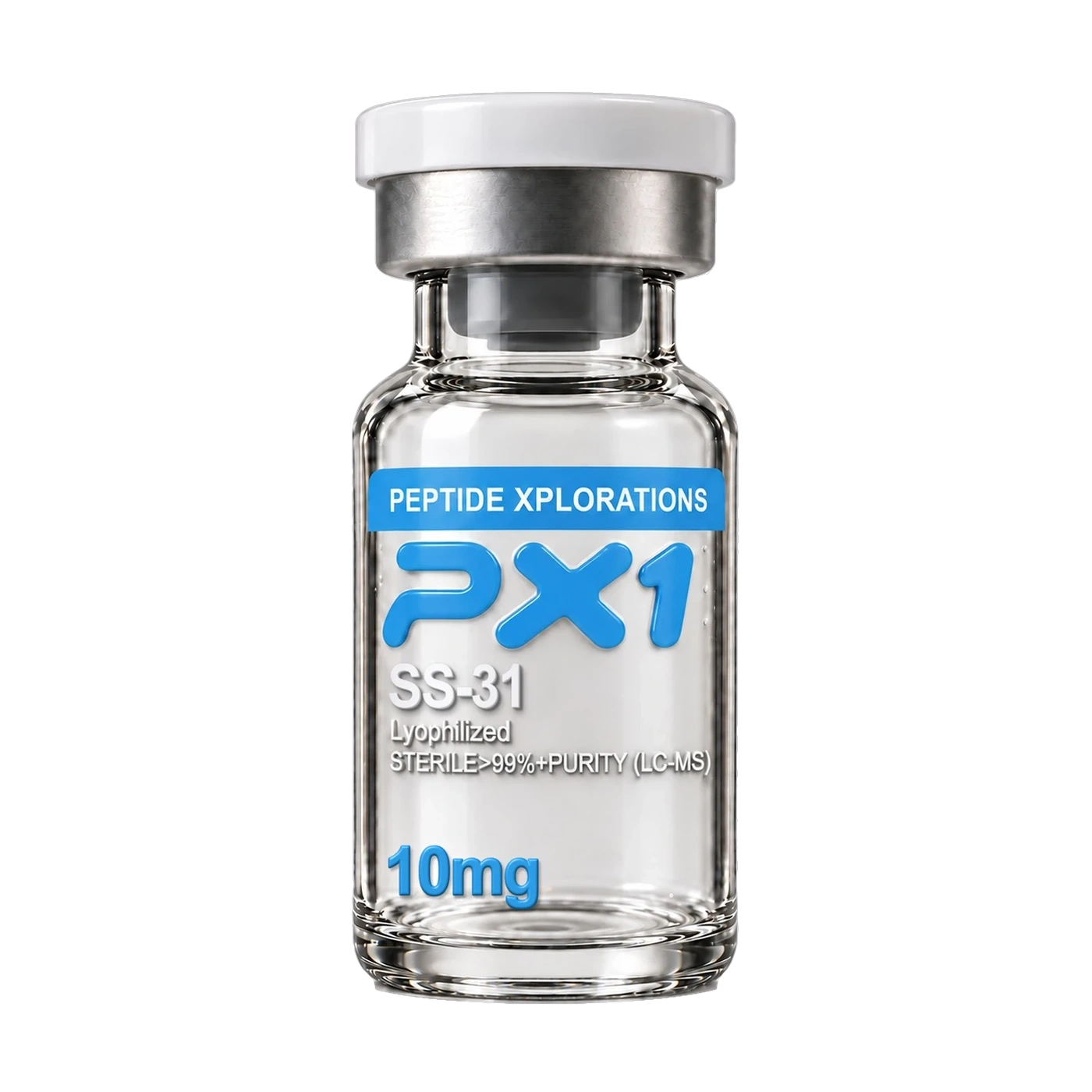
PX1 Research supplies lyophilized SS-31 as a reference compound for mitochondrial bioenergetics, oxidative-stress and cardiolipin research, released against a batch-specific certificate of analysis. Research use only — not for human or veterinary use.
The described mechanism centers on cardiolipin, the signature phospholipid of the inner mitochondrial membrane. SS-31 associates with cardiolipin and, in published models, stabilizes the curvature and organization of cristae membranes, which in turn is associated with improved efficiency of the electron transport chain supercomplexes that depend on that membrane architecture.
Downstream, reports describe reduced electron leak and reduced reactive oxygen species generation, along with preserved ATP synthesis under stress conditions. Importantly the literature frames SS-31 as acting on membrane structure rather than as a conventional antioxidant scavenger — the reduction in oxidative species is presented as a consequence of a better-organized respiratory chain.
Because the mechanism is structural and local, SS-31 effects in cell models are typically read out through respirometry (oxygen consumption rate), membrane-potential dyes, cristae morphology by electron microscopy, and cardiolipin-binding assays rather than through receptor pharmacology.
SS-31 and MOTS-c are frequently stocked together and just as frequently conflated, but they act at opposite ends of the mitochondrial signaling problem. SS-31 is an exogenous synthetic tetrapeptide that concentrates inside the organelle and acts on membrane and respiratory-chain integrity. MOTS-c is an endogenous mitochondrially encoded 16-mer that translocates outward to the nucleus and alters nuclear gene expression under metabolic stress.
A study pairing them is usually testing local structural protection against global transcriptional adaptation, and the readouts differ accordingly — respirometry and cristae imaging for SS-31, AMPK signaling and transcript panels for MOTS-c.
Their analytical profiles also differ. The four-residue SS-31 sequence with non-canonical residues requires a method that resolves D/L epimers, while the longer MOTS-c sequence is most vulnerable to truncation impurities. Neither is adequately characterized by a generic method.
Laboratories that work with SS-31 typically characterize incoming material on three axes before it enters a study: identity, purity and content. Identity is established by high-resolution mass spectrometry against the theoretical monoisotopic mass (639.8 Da for the tetrapeptide amide), usually supported by MS/MS fragmentation that walks the backbone and confirms the sequence rather than just the total mass. A matching intact mass alone can be satisfied by a scrambled or partially epimerized sequence, which is why fragmentation data is the stronger identity evidence.
Purity is quantified by reversed-phase HPLC with UV detection, integrating every resolved peak in the chromatogram and expressing the main peak as a percentage of total area. The gradient matters more than the headline number: a shallow, well-optimized gradient resolves closely eluting process impurities such as deamidation products, oxidation variants, truncated sequences and acetate adducts, while an aggressive gradient can co-elute them under the main peak and inflate the reported purity. PX1 publishes the chromatogram itself, not only the integrated figure, so the resolution behind the number is auditable.
Content — how much peptide is actually in the vial once counter-ions and residual water are subtracted — is the axis most often skipped by low-cost suppliers. Net peptide content is a function of the labeled mass, the water content measured by Karl Fischer titration, and the counter-ion (typically trifluoroacetate or acetate) load. A vial that is 99% pure by HPLC can still under-deliver on content if it carries a high salt and moisture fraction, which is why the COA reports both.
PX1 SS-31 is USA-manufactured and released at ≥99% purity by reversed-phase HPLC with high-resolution LC-MS identity confirmation, endotoxin by kinetic chromogenic LAL, residual solvents by GC and water content by Karl Fischer titration. Because the sequence contains non-canonical residues, identity confirmation by fragmentation — not intact mass alone — is the meaningful check, and the batch report published on this page reflects that.
The research-peptide market is unusually wide in quality. The same nominal SS-31 listing can represent USA-manufactured material released against a documented specification, or repackaged bulk of unknown origin with a generic certificate that was never generated from the lot in the vial. The distinction is invisible from the product photo and only becomes visible in the paperwork.
The practical test is traceability: the lot number printed on the vial label should appear on the certificate of analysis, and that certificate should show the actual chromatogram and mass spectrum for that lot rather than a representative example. A COA without a lot number, without instrument traces, or dated years before the vial was filled is a document, not evidence. PX1 publishes the batch-specific report directly on the product page so the chain from manufacturing to vial is checkable before purchase.
Beyond the certificate, consistent lab-grade supply depends on synthesis and release happening under one controlled process: domestic solid-phase manufacturing, preparative HPLC purification, lyophilization under validated cycle parameters, and third-party confirmation of purity and endotoxin. SS-31 sold by PX1 Research is produced and released on that pathway and is supplied strictly for laboratory research use — not for human or veterinary use.
Respirometry is the anchor readout. Extracellular flux analysis giving basal respiration, ATP-linked respiration, maximal capacity and proton leak provides a mechanistically interpretable profile, and the proton-leak term in particular speaks directly to the membrane-organization hypothesis. A single ATP measurement, by contrast, cannot distinguish improved coupling from increased substrate supply.
Model state matters more here than in most compound classes. The described benefit concerns damaged or stressed mitochondria, so a study run in healthy, unstressed cells may show little because there is little to restore. Including an injury or stress arm — ischemia-reperfusion, oxidative challenge or a genetic mitochondrial defect — is generally necessary for the design to be capable of detecting the reported effect.
Cardiolipin should be measured where the mechanism is being tested rather than assumed. Cardiolipin content and oxidation state by lipidomics, together with cristae morphology by transmission electron microscopy, are the endpoints that distinguish the structural mechanism from a generic antioxidant effect. Pairing SS-31 with a conventional scavenging antioxidant as a comparator arm sharpens that distinction further.
Because the tetrapeptide accumulates in mitochondria, exposure inside the organelle can differ greatly from concentration in the medium, and nominal medium concentration is therefore a poor proxy for target exposure. Studies that quantify intracellular or mitochondrial accumulation produce results that transfer between laboratories far better than those that do not.
On the chemistry side, the non-canonical residues mean that identity confirmation should be part of study documentation rather than left to the supplier's summary. Stating the lot, the measured purity, the confirmation method and the counter-ion in the methods section is the practical minimum for a compound whose stereochemistry cannot be checked by mass alone.
Is SS-31 an antioxidant? Not in the conventional scavenging sense, and the distinction matters for study design. The published mechanism is structural: association with cardiolipin stabilizes inner-membrane and cristae organization, which improves the efficiency of the respiratory chain supercomplexes embedded there, and the reduction in reactive oxygen species follows as a consequence of less electron leak. Comparing SS-31 against a scavenging antioxidant therefore tests two different hypotheses.
Why does SS-31 concentrate in mitochondria without a membrane potential? The alternating cationic and aromatic residue pattern drives partitioning into the inner membrane independent of the potential gradient, which is the property that distinguishes the Szeto-Schiller family from potential-dependent targeting strategies such as triphenylphosphonium conjugation. In a depolarized or damaged mitochondrion — precisely the condition of interest in most models — potential-dependent targeting fails and this approach does not.
What is elamipretide, and is it a different compound? Elamipretide is the assigned nonproprietary name for the same molecule; MTP-131 and Bendavia are development codes for it. All four names appear in the literature and refer to the identical D-Arg-dimethylTyr-Lys-Phe-NH2 tetrapeptide.
What analytical issue is specific to this sequence? Non-canonical residues. The molecule contains a D-amino acid, a dimethylated tyrosine and a C-terminal amide, and each is a point where synthesis can go subtly wrong in a way that intact mass will not reveal — an L-arginine epimer has the same mass as the D form. Chiral or fragmentation-based confirmation is the check that matters here, not the mass number alone.
What readouts are standard? Oxygen consumption rate by extracellular flux respirometry, ATP output, membrane-potential dyes, cardiolipin-binding assays, and cristae morphology by transmission electron microscopy. Cross-linking mass spectrometry has also been used to map the protein interaction landscape of the peptide inside the organelle.
SS-31 anchors the mitochondrial group. MOTS-c is its natural counterpart — local membrane protection versus global transcriptional adaptation — and NAD+ completes the trio by addressing redox cofactor availability. Study panels covering mitochondrial function usually include all three because each reports on a different failure mode.
For aging-phenotype work the panel extends to Epithalon and the bio-regulator peptides, which bring telomere and gene-expression endpoints. Sharing a common set of senescence markers across the panel is what makes compounds with unrelated mechanisms comparable on the same scale.
SS-31 is listed in several vial strengths. Because the sequence contains non-canonical residues, identity confirmation on every lot is done by fragmentation rather than intact mass alone, and that data appears on the batch certificate published on the product page.
All products are sold strictly for laboratory and research use only. Not for human or veterinary use, diagnosis, treatment or consumption. Statements have not been evaluated by the FDA.
High Quality — 99% Purity Guaranteed
We are continuously conducting HPLC testing on all of our raw powders as well as our finished products to ensure the quality of what we ship. You can have the product you bought from us independently tested at any HPLC-licensed testing facility — and if the results come back negative, we will refund the following:
HPLC Test Fee
$100
Plus a full refund
Total order amount + shipping
SS-31
$99.99