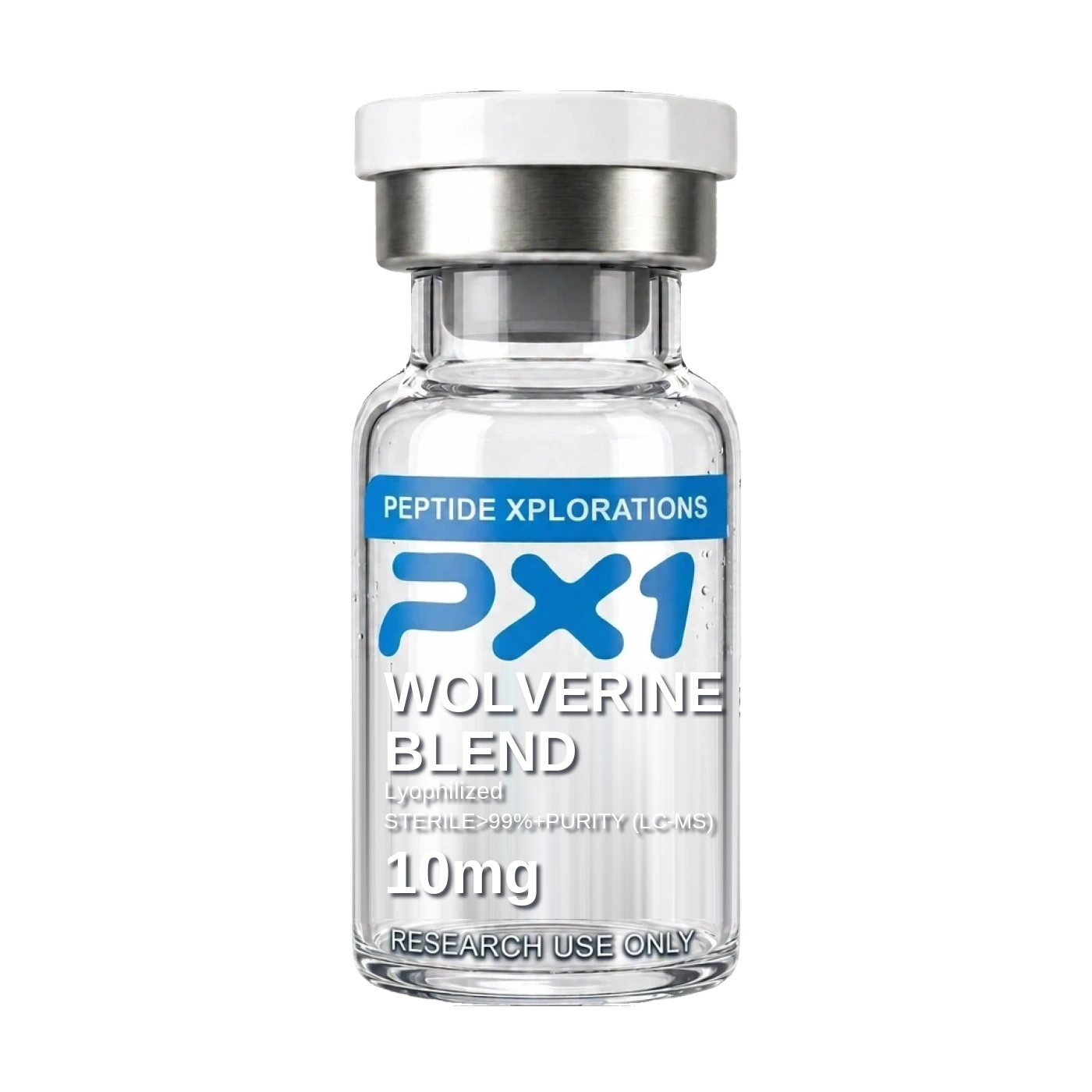
What the Wolverine blend contains
Wolverine is a two-component research blend of BPC-157 and TB-500 supplied together in a single lyophilized vial, typically in equal mass. It is the most widely studied pairing in soft-tissue repair models, and the pairing is a mechanistic hypothesis rather than a marketing construct: the two compounds address different parts of the same described repair sequence.
BPC-157 is a synthetic 15-amino-acid sequence corresponding to a partial region of body protection compound, described in the literature in terms of angiogenic and nitric-oxide-pathway signaling. TB-500 corresponds to the active fragment region of thymosin beta-4 and is described in terms of actin sequestration and cell migration. A model that requires both new vasculature and cell movement engages both descriptions, which is why the two appear together in study designs as well as in separate arms.
PX1 supplies Wolverine as a lyophilized reference blend for in-vitro and analytical work, with a lot-specific certificate of analysis. It is offered strictly for research use only and is not for human or veterinary use.
Purity, identity and certificate of analysis
A two-component blend certificate reports identity and purity for each component separately, along with the mass ratio in the vial. The two peptides differ substantially in length and hydrophobicity, so they resolve cleanly on a reversed-phase gradient — but only if the method is shallow enough to also separate each component from its own deamidation and truncation impurities rather than reporting one broad peak per component.
Identity is confirmed by LC-MS against each theoretical mass, including 1,419.5 Da for BPC-157. Endotoxin by kinetic chromogenic LAL, residual solvents by gas chromatography and water content by Karl Fischer titration are determined on the finished blend rather than inferred from component data.
Net peptide content is reported because it, not label mass, determines how much of each peptide is present per vial. For a blend this figure also fixes the real ratio, which is the parameter a comparative study needs to state in its methods section.
Handling, reconstitution and storage
Lyophilized material is stored at -20 °C protected from light and brought to room temperature before the stopper is pierced. Reconstitution is performed by directing bacteriostatic or sterile water down the vial wall and swirling gently until the cake dissolves completely; agitation foams and denatures preferentially, and partial dissolution shifts the effective ratio in every aliquot drawn.
Both components are comparatively robust for peptides of their length, and BPC-157 in particular has been examined in aqueous and acidic conditions in the published literature. Comparatively robust is not indefinitely stable: reconstituted blend is refrigerated, protected from light, aliquoted for single use and consumed on a defined schedule rather than held for months.
Low-binding polypropylene labware is used for working dilutions. Repeated freeze-thaw cycling of the reconstituted blend is avoided because each cycle concentrates solutes at the ice front and promotes aggregation that visual inspection does not reliably reveal.
Common research questions about the Wolverine blend
Why are BPC-157 and TB-500 studied together? Their described mechanisms cover different stages of the same repair process — angiogenic and nitric-oxide signaling for one, actin sequestration and cell migration for the other. A model requiring both is the standard rationale for the pairing, and separate arms are used when the question is which component contributed what.
Is the blend equivalent to two separate vials? Not analytically. A blend is one lot, one certificate and a fixed ratio in every aliquot, which removes ratio variability. Two vials allow the ratio to be varied deliberately and are the correct format for attribution studies.
How is the blend verified on receipt? Match the lot number on the vial to the certificate, confirm the certificate carries per-component chromatograms and mass spectra for that lot rather than a summary table, and confirm each reported mass matches the theoretical mass within instrument tolerance.
What is the most common quality failure? Ratio drift, from either incomplete dissolution during reconstitution or a certificate that reports only aggregate purity. Requesting per-component data for the actual lot is the check that catches both.
References
- Sikirić 2018. Sikirić P. et al. Stable gastric pentadecapeptide BPC 157: novel therapy in gastrointestinal tract. Current Pharmaceutical Design.
- Goldstein 2012. Goldstein A.L., Hannappel E., Sosne G., Kleinman H.K. Thymosin β4: a multi-functional regenerative peptide. Expert Opinion on Biological Therapy.
- Crockford 2010. Crockford D. et al. Preclinical development of thymosin beta-4. Annals of the New York Academy of Sciences.
All products are sold strictly for laboratory and research use only. Not for human or veterinary use, diagnosis, treatment or consumption. Statements have not been evaluated by the FDA.