Written by PX1 Research Team
PX1 chemists and research educators with hands-on experience in US-based peptide manufacturing, HPLC / mass-spectrometry lot testing, and endotoxin QC. All content is citation-backed and peer-reviewed for accuracy.
The Essential Guide to 5-Amino-1MQ Research in 2026
Research Guide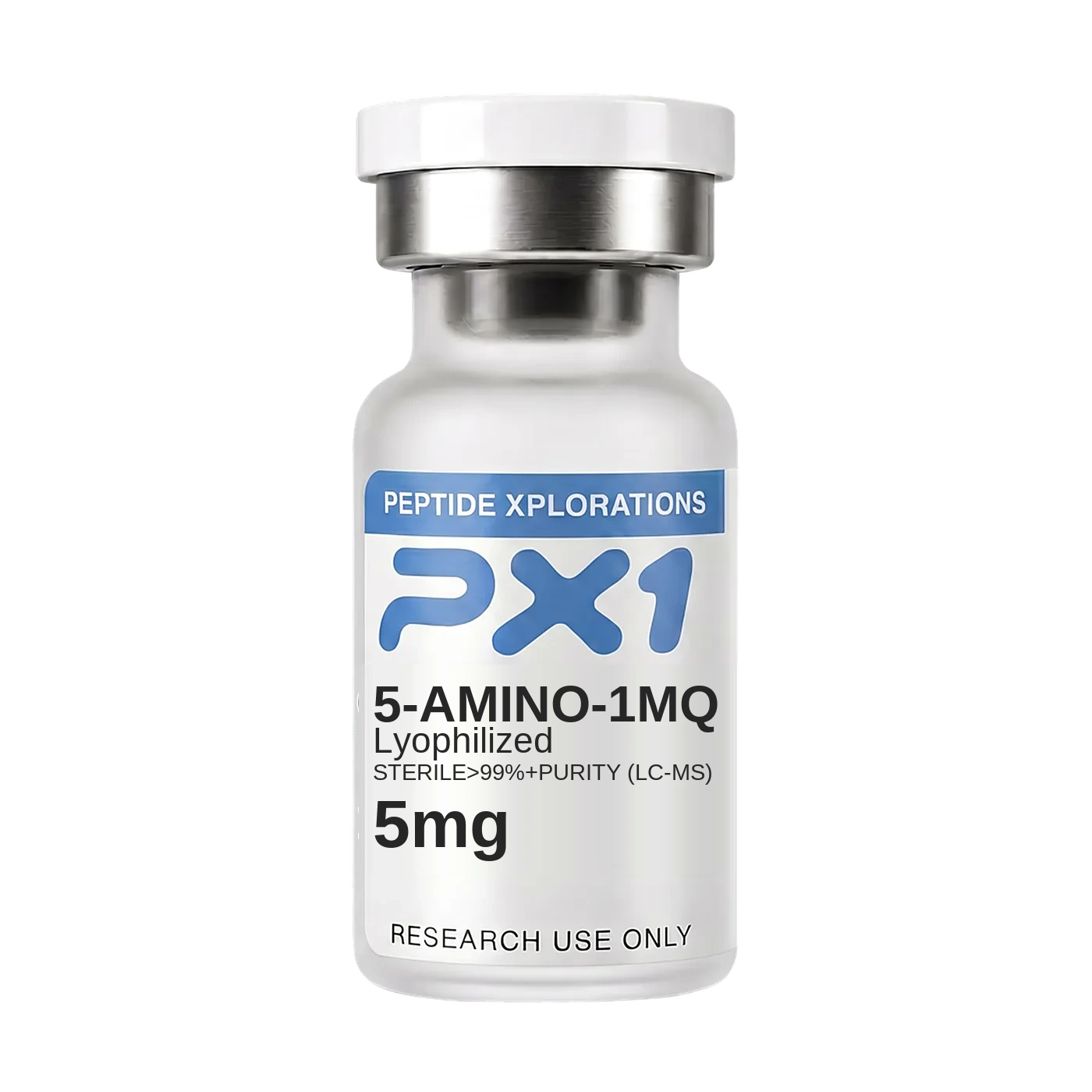
Reviewed By
PX1 QC — Analytical Chemistry Team
Every article is reviewed by PX1's in-house analytical team for accuracy on mechanism, dosing ranges reported in the literature, and lab-handling guidance. We do not publish clinical or medical advice.
Quick answer
5-Amino-1MQ inhibits NNMT — a metabolic brake on the NAD+ salvage pathway. Mechanism, animal data, and purity considerations.
Key takeaways
- Reduced adipose tissue mass without reducing food intake
- Improved insulin sensitivity
- Increased NAD+ levels in adipose tissue
- [NAD+ Research Guide](/research/nad-plus-research-guide)
What 5-Amino-1MQ is
5-Amino-1MQ (5-amino-1-methylquinolinium) is a small-molecule inhibitor of nicotinamide N-methyltransferase (NNMT) — an enzyme that consumes cellular methyl donors (S-adenosyl methionine) and methylates nicotinamide, pulling it out of the NAD+ salvage pathway.
In simple terms: NNMT is a metabolic brake. Inhibiting NNMT unblocks NAD+ salvage and preserves methyl-donor availability.
Research findings
In animal models of diet-induced obesity, NNMT inhibition with 5-Amino-1MQ produced:
- Reduced adipose tissue mass without reducing food intake
- Improved insulin sensitivity
- Preserved lean mass
- Increased NAD+ levels in adipose tissue
The mechanism is metabolic, not appetite-driven — a distinction from GLP-1-class compounds.
Mechanism deep dive
NNMT expression is elevated in obese adipose tissue and correlates with metabolic dysfunction. By methylating nicotinamide to 1-methylnicotinamide (1-MNA), NNMT drains two resources at once: the NAD+ pool and cellular methylation capacity.
5-Amino-1MQ competitively inhibits NNMT, restoring both.
Structural notes
Technically 5-Amino-1MQ is a small molecule, not a peptide — but it's frequently grouped with metabolic research peptides because of its adjacent mechanism (NAD+ pathway) and its supply chain overlap with peptide research suppliers.
Laboratory handling
5-Amino-1MQ is typically supplied as a stable lyophilized powder. It is not sensitive to standard room-temperature handling. Reconstitution with bacteriostatic water is standard for research protocols.
Purity considerations
Because 5-Amino-1MQ is a small molecule, purity is verified by HPLC and NMR rather than mass spec + HPLC. Look for HPLC ≥98% and NMR identity confirmation on the COA.
Related research
- NAD+ Research Guide
- MOTS-c Research Guide
Research use only.