Written by PX1 Research Team
PX1 chemists and research educators with hands-on experience in US-based peptide manufacturing, HPLC / mass-spectrometry lot testing, and endotoxin QC. All content is citation-backed and peer-reviewed for accuracy.
The Complete Guide to CagriSema Research
Research Guide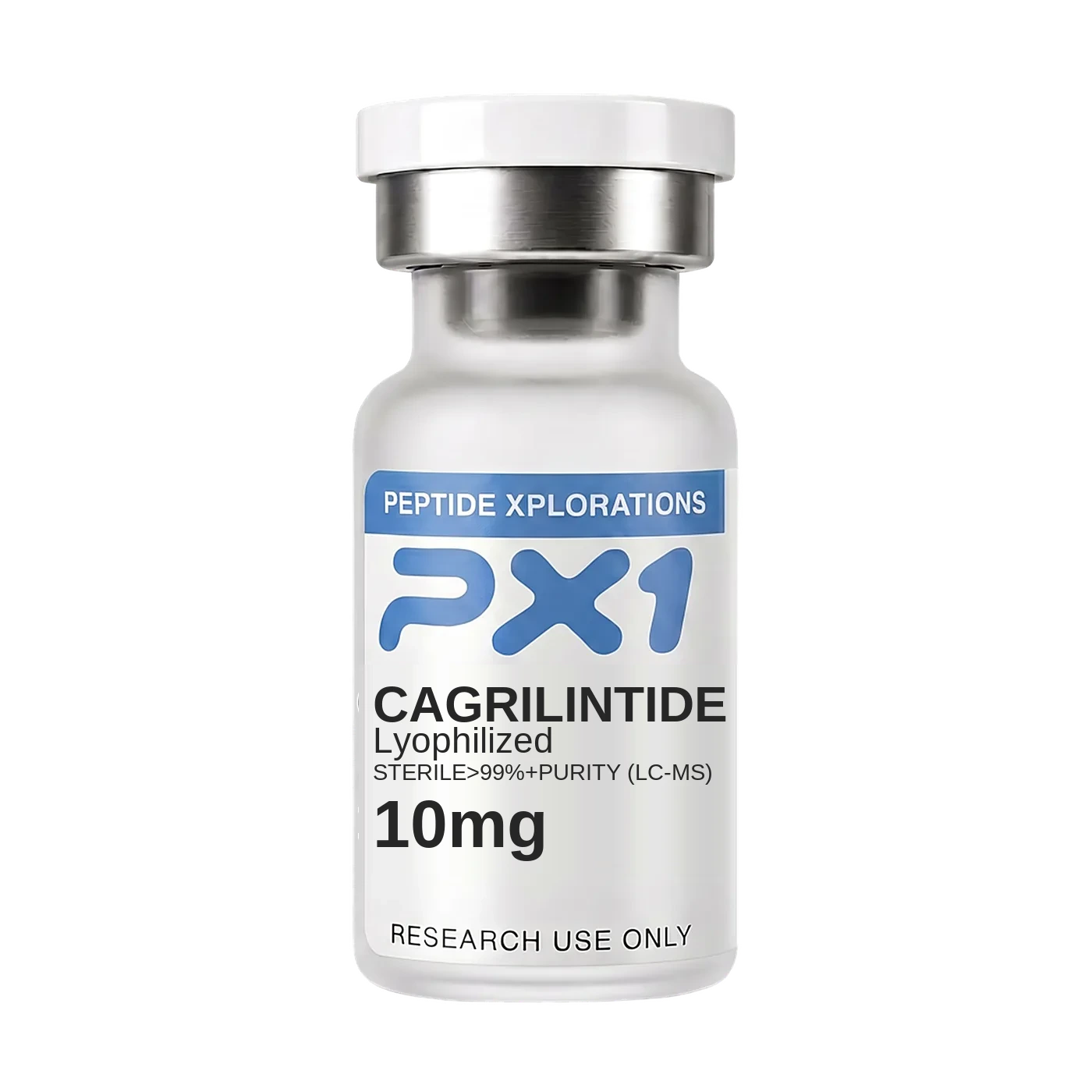
Reviewed By
PX1 QC — Analytical Chemistry Team
Every article is reviewed by PX1's in-house analytical team for accuracy on mechanism, dosing ranges reported in the literature, and lab-handling guidance. We do not publish clinical or medical advice.
Quick answer
CagriSema combines cagrilintide (amylin analog) with PX1-S (GLP-1). REDEFINE Phase 3 data, mechanism, and handling for research.
Key takeaways
- vs PX13-R: PX13-R's triple-agonist mechanism produced ~24% weight loss in Phase 2 at 48 weeks — more magnitude, less clinical maturity. See [CagriSema vs PX13-R](/research/cagrisema-vs-PX13-R).
- vs PX12-T: CagriSema achieved ~20.4% vs PX12-T's ~22.5%, comparable magnitude, different mechanism stack.
- vs PX1-S alone: adding cagrilintide roughly doubles PX1-S's monotherapy weight-loss magnitude.
What CagriSema is
CagriSema is a fixed-ratio combination of two peptides: cagrilintide (a long-acting amylin analog) and PX1-S (a GLP-1 receptor agonist). It is Novo Nordisk's answer to PX12-T and PX13-R — combining two complementary mechanisms rather than engineering a single multi-receptor peptide.
Why the combination matters
Amylin is a hormone co-secreted with insulin from pancreatic beta cells. It suppresses glucagon, slows gastric emptying, and reinforces satiety through a pathway distinct from GLP-1. Combining an amylin analog with a GLP-1 analog engages two independent satiety mechanisms in parallel.
Research findings
In Phase 3 REDEFINE-1 (adults with obesity, no diabetes), CagriSema at 68 weeks produced mean body-weight reduction of ~20.4% — substantial, though slightly below the ~22.5% reported for PX12-T 15 mg in SURMOUNT-1. Response was heterogeneous: a large subgroup lost >25%, while non-responders were more common than expected.
In participants with type 2 diabetes (REDEFINE-2), weight reduction was ~13.7% — GLP-1-class compounds consistently produce less weight loss in diabetic populations.
Dosing used in trials
CagriSema was studied as a once-weekly subcutaneous injection with a target dose of 2.4 mg cagrilintide + 2.4 mg PX1-S, titrated over 16 weeks to reduce GI adverse events.
Laboratory handling
In a research setting, cagrilintide and PX1-S are typically supplied as separate lyophilized peptides. Reconstitution follows standard protocols with bacteriostatic water; refrigerated storage post-reconstitution is standard.
Purity and identity
Both components should ship with lot-specific HPLC purity and mass-spec identity data. PX1 publishes chromatograms for each lot at /purity-reports.
Comparison shortcuts
- vs PX13-R: PX13-R's triple-agonist mechanism produced ~24% weight loss in Phase 2 at 48 weeks — more magnitude, less clinical maturity. See CagriSema vs PX13-R.
- vs PX12-T: CagriSema achieved ~20.4% vs PX12-T's ~22.5%, comparable magnitude, different mechanism stack.
- vs PX1-S alone: adding cagrilintide roughly doubles PX1-S's monotherapy weight-loss magnitude.
Research use only.