Written by PX1 Research Team
PX1 chemists and research educators with hands-on experience in US-based peptide manufacturing, HPLC / mass-spectrometry lot testing, and endotoxin QC. All content is citation-backed and peer-reviewed for accuracy.
The Essential Guide to DSIP Peptide Research in 2026
Research Guide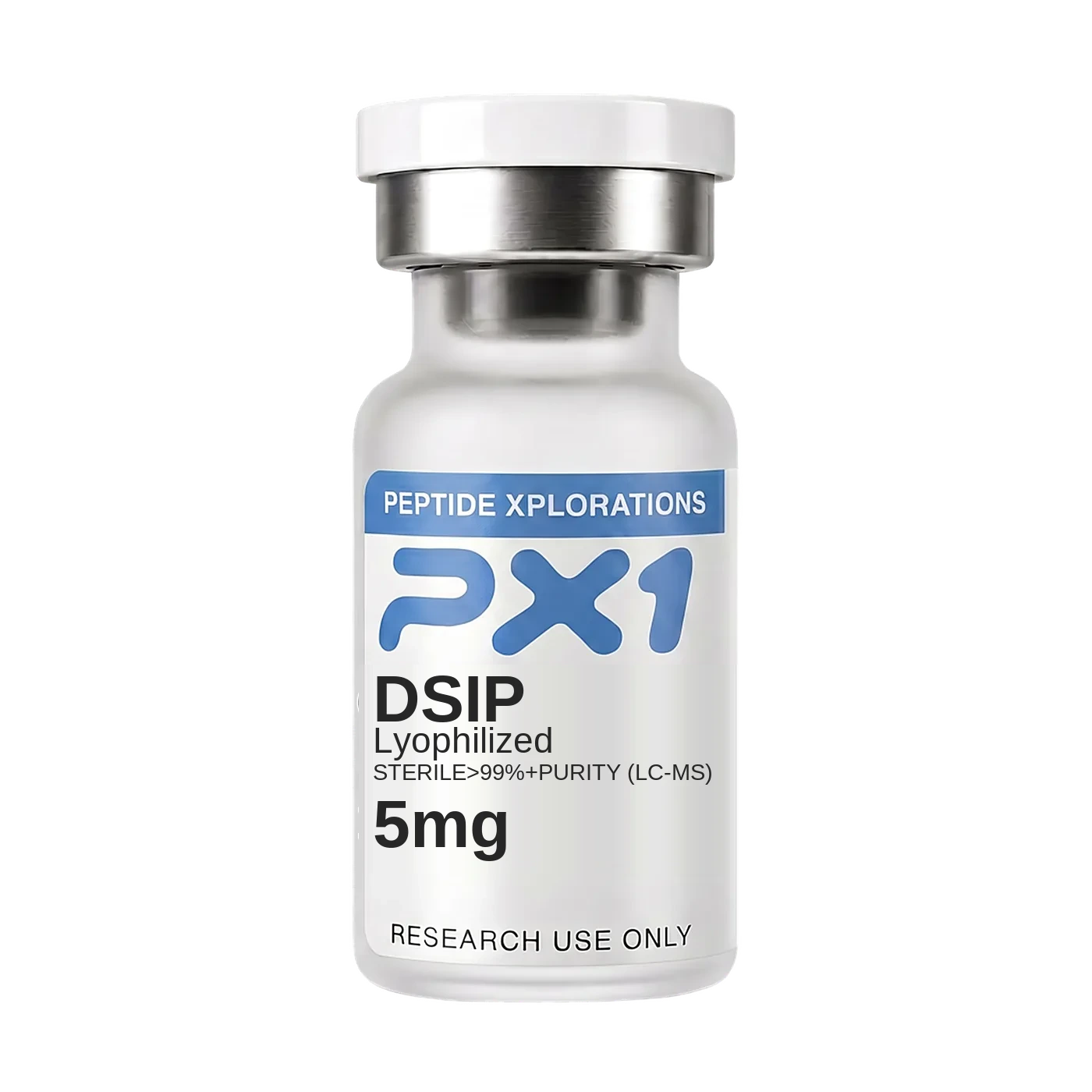
Reviewed By
PX1 QC — Analytical Chemistry Team
Every article is reviewed by PX1's in-house analytical team for accuracy on mechanism, dosing ranges reported in the literature, and lab-handling guidance. We do not publish clinical or medical advice.
Quick answer
DSIP (Delta Sleep-Inducing Peptide) is a nine-residue neuropeptide studied for sleep architecture, analgesia, and stress response.
Key takeaways
- Sleep architecture — increases in slow-wave sleep in some but not all studies
- Chronic pain — reported analgesic effects in animal models
- Stress adaptation — modulation of ACTH and cortisol response
- Opioid withdrawal — early clinical reports of symptom modulation
What DSIP is
DSIP (Delta Sleep-Inducing Peptide) is a nine-amino-acid neuropeptide first isolated from rabbit brain in 1977. It's named for its association with delta-wave (slow-wave) sleep. Nearly five decades of research have explored its role in sleep architecture, stress response, and analgesia.
Structure and pharmacology
DSIP is a small hydrophilic nonapeptide (Trp-Ala-Gly-Gly-Asp-Ala-Ser-Gly-Glu). No specific DSIP receptor has been identified — a lingering puzzle in the literature. Its effects appear mediated through modulation of neurotransmitter systems including GABA, serotonin, and opioid signaling.
Serum half-life is short (~15 minutes), but reported effects persist far longer, consistent with a signaling rather than direct-agonist mechanism.
Research areas
DSIP has been studied in:
- Sleep architecture — increases in slow-wave sleep in some but not all studies
- Chronic pain — reported analgesic effects in animal models
- Stress adaptation — modulation of ACTH and cortisol response
- Opioid withdrawal — early clinical reports of symptom modulation
Results are heterogeneous, and DSIP has not achieved clinical approval for any indication. It remains an active area of neuropeptide research.
Laboratory handling
DSIP is supplied lyophilized, stable at room temperature 18–24 months sealed. Reconstitution with bacteriostatic water; refrigerated storage of reconstituted solution.
Purity considerations
A nine-residue peptide has fewer manufacturing impurity risks than longer sequences, but LC-MS identity confirmation remains essential — deletion sequences of one or two residues can co-elute on standard HPLC methods.
Research use only.