Written by PX1 Research Team
PX1 chemists and research educators with hands-on experience in US-based peptide manufacturing, HPLC / mass-spectrometry lot testing, and endotoxin QC. All content is citation-backed and peer-reviewed for accuracy.
The Complete Guide to Oxytocin Peptide Research
Research Guide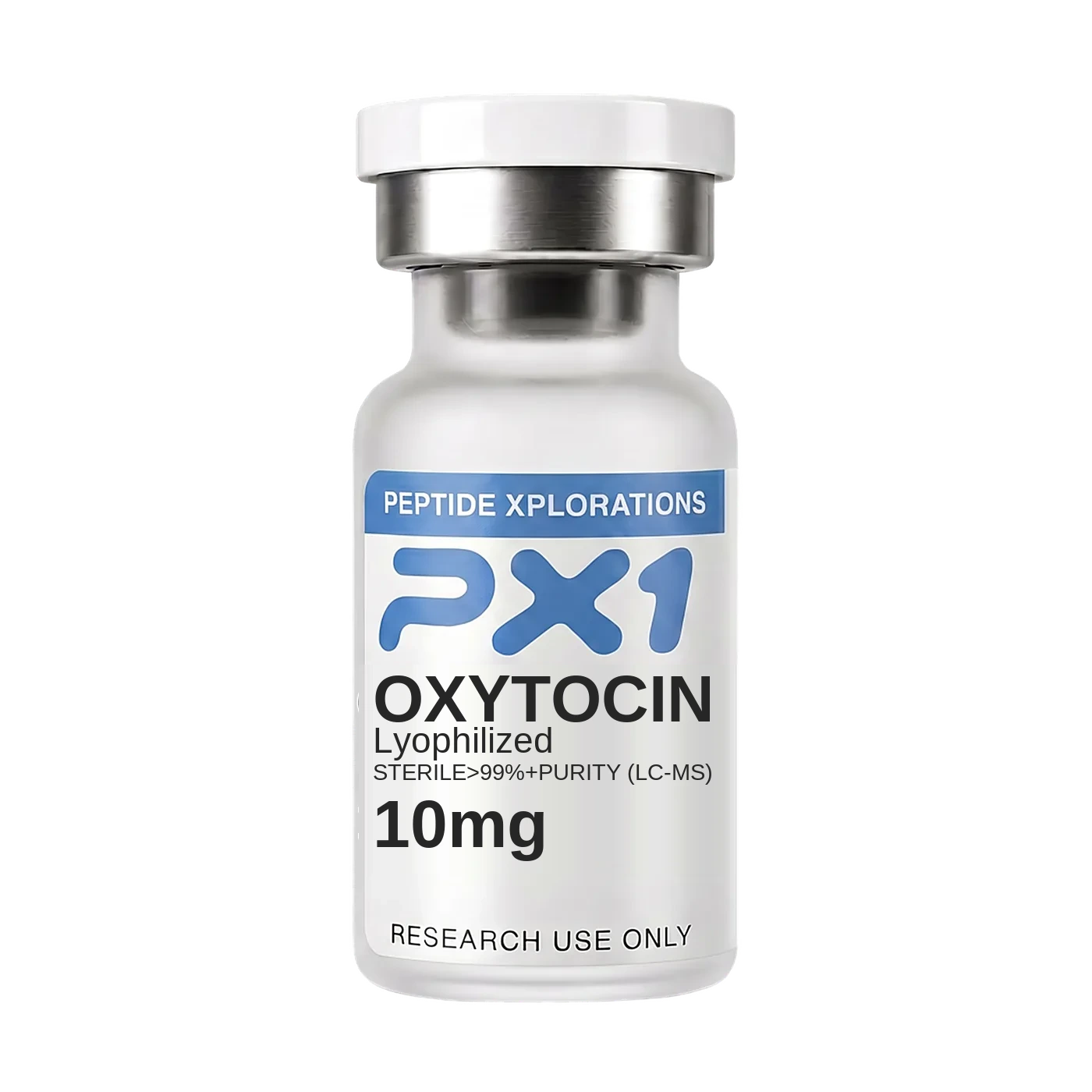
Reviewed By
PX1 QC — Analytical Chemistry Team
Every article is reviewed by PX1's in-house analytical team for accuracy on mechanism, dosing ranges reported in the literature, and lab-handling guidance. We do not publish clinical or medical advice.
Quick answer
Oxytocin is a disulfide-bridged nonapeptide with a vast literature on social behavior, stress, and obstetrics. Mechanism, handling, and stability.
Key takeaways
- Social cognition and trust behavior
- Autism spectrum disorder (mixed results)
- Post-traumatic stress response
- Obstetric applications (approved clinical uses)
What oxytocin is
Oxytocin is a nine-amino-acid neuropeptide manufactured in the hypothalamus and released from the posterior pituitary. It is one of the most extensively studied neuropeptides — over 25,000 published papers — with documented roles in labor, lactation, and a wide range of social and affiliative behaviors.
Structure and pharmacology
Oxytocin is a disulfide-bridged cyclic nonapeptide (Cys-Tyr-Ile-Gln-Asn-Cys-Pro-Leu-Gly-NH2). The disulfide bridge is essential for receptor binding; oxidative degradation of this bond inactivates the peptide.
Half-life in circulation is short (~3–5 minutes). Intranasal administration is the most common research route for CNS effects because it partially bypasses first-pass metabolism.
Research areas
Oxytocin has been studied in:
- Social cognition and trust behavior
- Autism spectrum disorder (mixed results)
- Post-traumatic stress response
- Obstetric applications (approved clinical uses)
Findings in social and behavioral research are heterogeneous — earlier enthusiasm has moderated as replication studies produced smaller effects.
Laboratory handling
Oxytocin is sensitive to oxidation and heat. Lyophilized vials are stable refrigerated (2–8°C); room-temperature storage of reconstituted solution should be minimized. Bacteriostatic water is the standard research diluent.
Purity considerations
HPLC ≥99% with mass-spec identity confirming the disulfide-bridged 9-residue peptide. Reduced (linear) oxytocin is a common contaminant and is inactive.
Research use only.