Written by PX1 Research Team
PX1 chemists and research educators with hands-on experience in US-based peptide manufacturing, HPLC / mass-spectrometry lot testing, and endotoxin QC. All content is citation-backed and peer-reviewed for accuracy.
Half-Life of Reta (PX13-R), Storage and Stability: A Handling Reference
Research Guide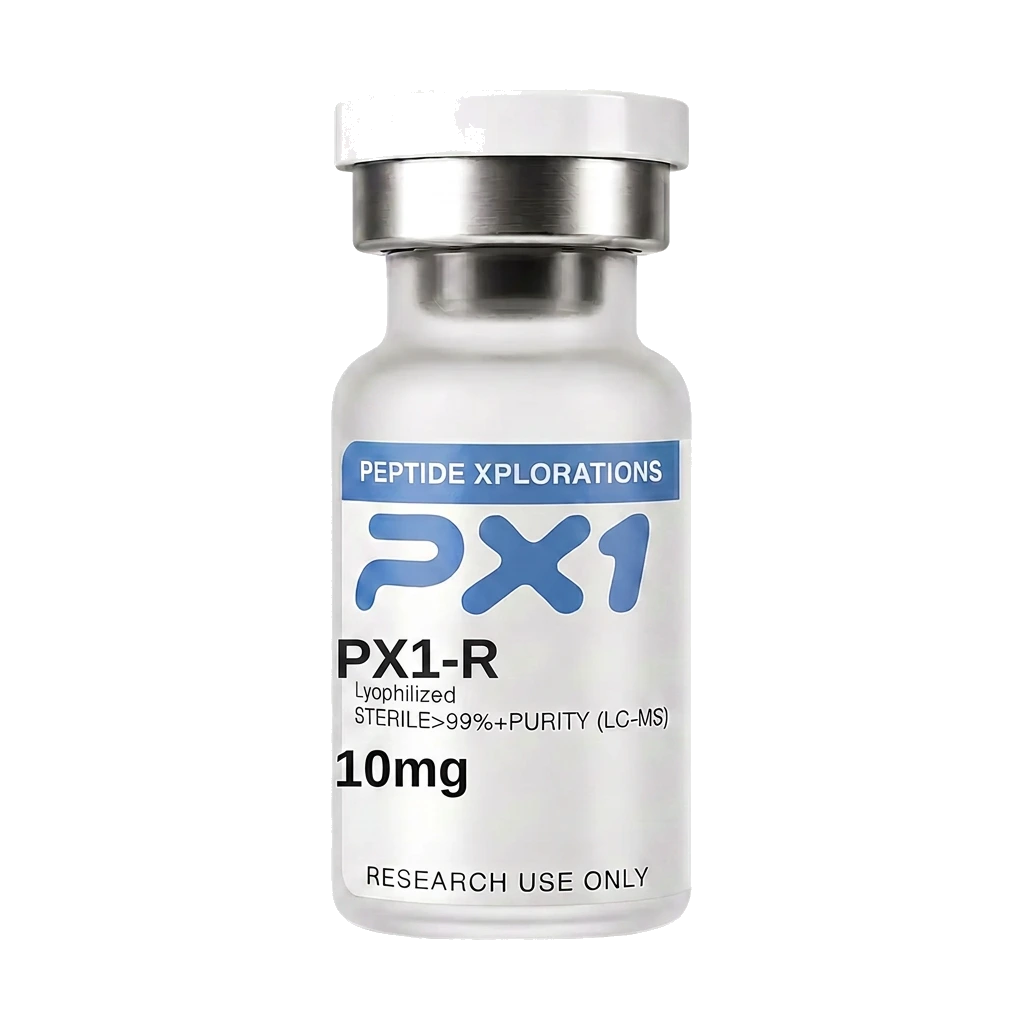
Reviewed By
PX1 QC — Analytical Chemistry Team
Every article is reviewed by PX1's in-house analytical team for accuracy on mechanism, dosing ranges reported in the literature, and lab-handling guidance. We do not publish clinical or medical advice.
Quick answer
The half life of reta explained — PX13-R's ~6-day half-life, albumin binding, freeze-thaw behavior, light sensitivity, and exact storage windows for lyophilized and reconstituted material.
Key takeaways
- Once-weekly dosing is the interval every published protocol uses.
- Steady state takes roughly 4–5 half-lives, so plasma concentrations continue rising for about a month after any dose step. This is why titration holds are four weeks, not one.
- A missed weekly dose does not reset accumulation — the compound is still present at meaningful concentration.
- Freeze-thaw cycling. Each cycle on reconstituted material drives aggregation. Aliquot before freezing if repeated access is required.
Half-life
PX13-R carries a fatty-acid side chain that binds circulating serum albumin. Albumin binding slows renal clearance and enzymatic degradation, producing a half-life of approximately six days in published pharmacokinetic data. Practical consequences:
- Once-weekly dosing is the interval every published protocol uses.
- Steady state takes roughly 4–5 half-lives, so plasma concentrations continue rising for about a month after any dose step. This is why titration holds are four weeks, not one.
- A missed weekly dose does not reset accumulation — the compound is still present at meaningful concentration.
Storage windows
| State | Temperature | Stability |
|---|---|---|
| Lyophilized, sealed, desiccated | -20°C | 18–24 months |
| Lyophilized, refrigerated | 2–8°C | ~12 months |
| Lyophilized, in transit | Ambient | 2–4 weeks |
| Reconstituted in bacteriostatic water | 2–8°C | Up to 30 days |
| Reconstituted, ambient | 20–25°C | Hours — avoid |
What degrades PX13-R
- Freeze-thaw cycling. Each cycle on reconstituted material drives aggregation. Aliquot before freezing if repeated access is required.
- Moisture ingress. A compromised desiccant or a lyophilized cake exposed to humid air accelerates hydrolysis and deamidation.
- Light. Keep vials in the original carton.
- Mechanical shear. Shaking and forceful diluent injection denature peptide at the air-liquid interface — visible as foam, and irreversible.
- Heat excursions in transit. Short ambient windows are fine; a package sitting in a hot vehicle for days is not.
Verifying a lot arrived intact
- Inspect the cake. It should be a uniform white-to-off-white plug, not shrunken, melted, or shifted to the side wall.
- Confirm the vacuum seal — the stopper should sit tight.
- Check the lot number against the COA before opening anything.
- After reconstitution, hold against light: clear, particulate-free, no strands.
A Karl Fischer moisture result on the lot COA tells you whether the material was properly lyophilized before it ever shipped. PX1 publishes that alongside HPLC, LC-MS and endotoxin at /purity-reports.
Research use only. Not for human consumption. Not intended to diagnose, treat, cure, or prevent any disease.