Written by PX1 Research Team
PX1 chemists and research educators with hands-on experience in US-based peptide manufacturing, HPLC / mass-spectrometry lot testing, and endotoxin QC. All content is citation-backed and peer-reviewed for accuracy.
The Complete Guide to SS-31 (Elamipretide) Research
Research Guide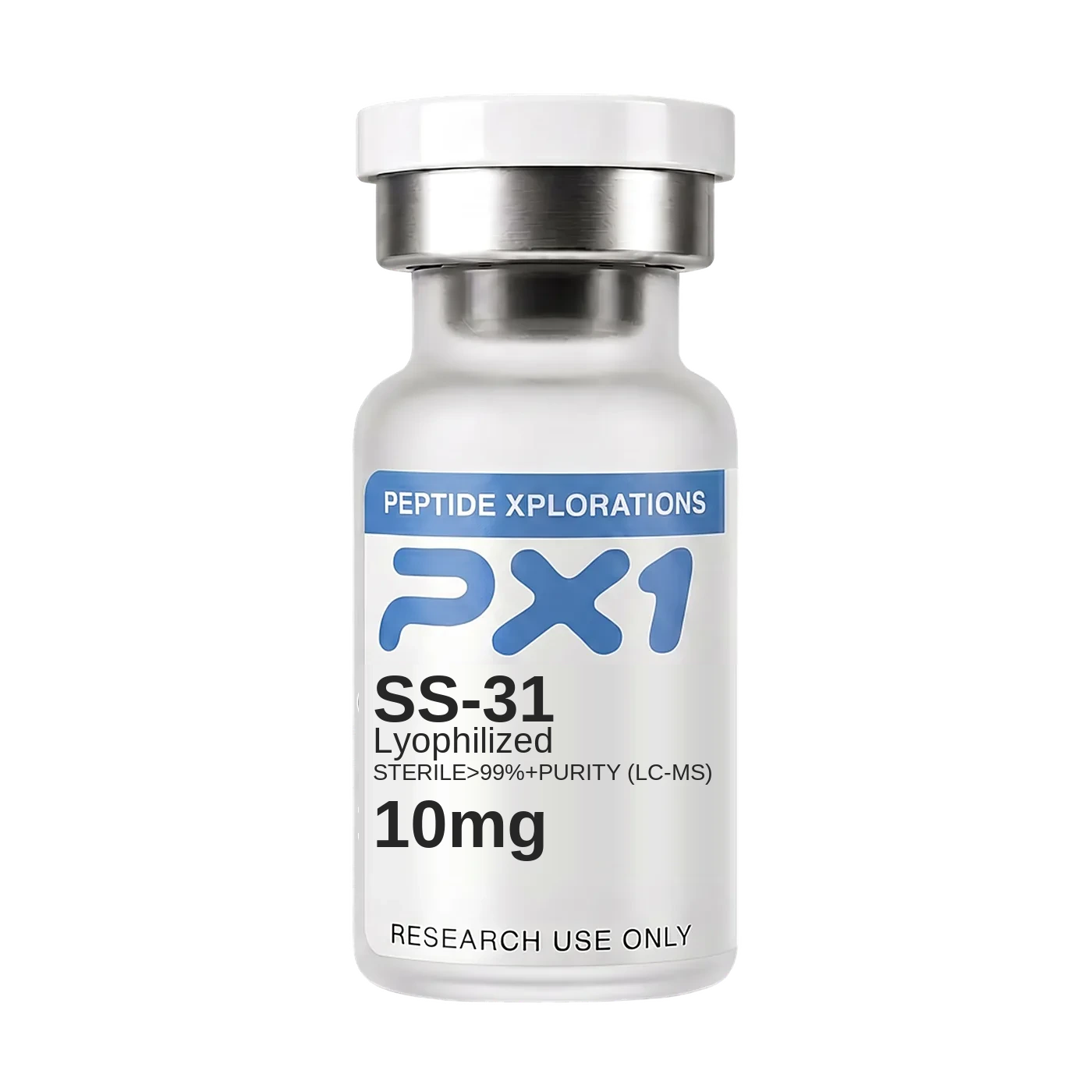
Reviewed By
PX1 QC — Analytical Chemistry Team
Every article is reviewed by PX1's in-house analytical team for accuracy on mechanism, dosing ranges reported in the literature, and lab-handling guidance. We do not publish clinical or medical advice.
Quick answer
SS-31 is a mitochondria-targeted tetrapeptide that binds cardiolipin. Structure, MMPOWER trial data, and purity considerations for research.
Key takeaways
- Binds cardiolipin, stabilizing supercomplexes of the electron transport chain
- Reduces reactive oxygen species leakage
- Preserves ATP production under oxidative stress
- Prevents cardiolipin peroxidation
What SS-31 is
SS-31 (also called elamipretide, Bendavia, MTP-131) is a small tetrapeptide with a unique property: it selectively concentrates in the inner mitochondrial membrane, where it binds cardiolipin — a phospholipid essential for the electron transport chain.
SS-31 is the most clinically advanced mitochondria-targeted peptide, with completed Phase 2 and Phase 3 trials in conditions ranging from primary mitochondrial myopathy to age-related macular degeneration and heart failure.
Structure and mechanism
SS-31 is a four-residue peptide (D-Arg-Dmt-Lys-Phe-NH2) engineered with alternating aromatic and cationic residues — the "SS" (Szeto-Schiller) motif that drives selective mitochondrial uptake without requiring a membrane potential.
Once inside the mitochondrion, SS-31:
- Binds cardiolipin, stabilizing supercomplexes of the electron transport chain
- Reduces reactive oxygen species leakage
- Preserves ATP production under oxidative stress
- Prevents cardiolipin peroxidation
Research history
SS-31 has been evaluated in more than 20 clinical trials. Notable results:
- MMPOWER-3 (primary mitochondrial myopathy): missed its primary endpoint at 24 weeks, but showed signal on 6-minute walk test at earlier timepoints.
- ReCLAIM / ReCLAIM-2 (dry AMD, geographic atrophy): showed structural retinal improvements.
- Barth syndrome, heart failure with reduced EF, ischemia-reperfusion: preclinical and early clinical signals.
Laboratory handling
SS-31 is a small, water-soluble peptide. It is typically supplied lyophilized in single-use vials. Reconstitution with bacteriostatic water is standard; refrigerated storage of reconstituted solution is recommended and standard practice is to use within 30 days.
Purity considerations
Because SS-31 is a short peptide, small manufacturing impurities have outsized impact on activity. HPLC ≥99% with a clean chromatogram matters more here than for longer sequences. Verify LC-MS identity — a common contaminant is a deletion sequence missing one residue, which HPLC alone may not distinguish from the target.
PX1 verifies every SS-31 lot with HPLC + LC-MS and publishes chromatograms at /purity-reports.
SS-31 vs MOTS-c
Both are mitochondria-associated peptides but they operate very differently. MOTS-c is a mitochondrially-encoded peptide involved in metabolic signaling; SS-31 is a synthetic tetrapeptide that structurally protects the inner mitochondrial membrane. See SS-31 vs MOTS-c (coming in next research batch).
Research use only.