Written by PX1 Research Team
PX1 chemists and research educators with hands-on experience in US-based peptide manufacturing, HPLC / mass-spectrometry lot testing, and endotoxin QC. All content is citation-backed and peer-reviewed for accuracy.
The Complete Guide to Tesamorelin Research
Research Guide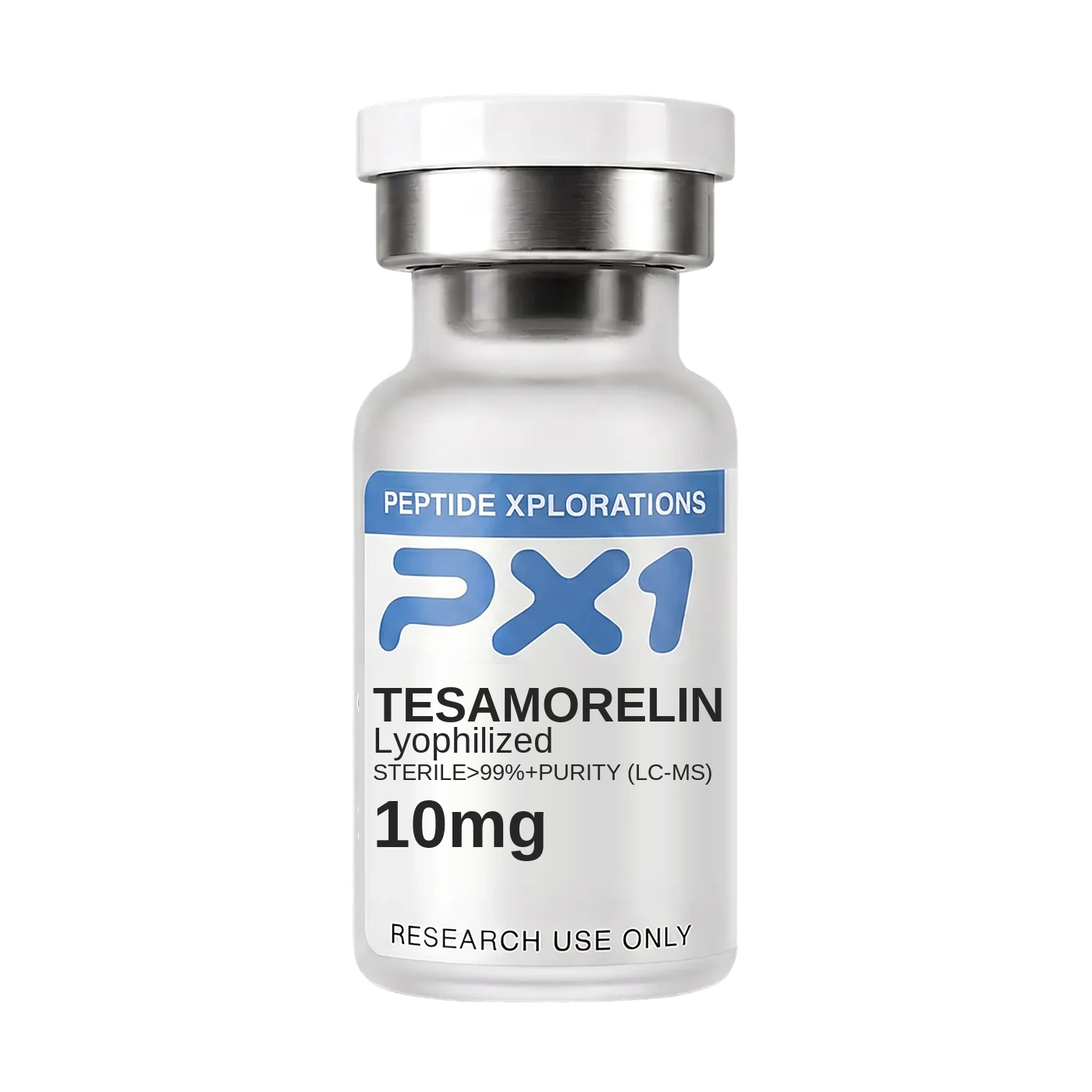
Reviewed By
PX1 QC — Analytical Chemistry Team
Every article is reviewed by PX1's in-house analytical team for accuracy on mechanism, dosing ranges reported in the literature, and lab-handling guidance. We do not publish clinical or medical advice.
Quick answer
Tesamorelin is an FDA-approved 44-residue GHRH analog. Mechanism, HIV-lipodystrophy trial data, and comparisons with other GHRH analogs.
Key takeaways
- 15–18% reduction in visceral adipose tissue at 26 weeks
- Improved lipid profile
- Preservation of subcutaneous fat
- Non-alcoholic fatty liver disease (reductions in hepatic fat fraction)
What Tesamorelin is
Tesamorelin is a synthetic 44-amino-acid GHRH analog. It is one of the few peptides in this class with FDA approval — indicated for reduction of excess abdominal fat in HIV-associated lipodystrophy (Egrifta, 2010).
Mechanism
Tesamorelin is a GHRH analog with an added trans-3-hexenoic acid moiety at the N-terminus that stabilizes it against dipeptidyl peptidase-IV (DPP-4) degradation. It binds the GHRH receptor on somatotroph cells and stimulates pulsatile GH release, which in turn increases circulating IGF-1.
Half-life is short — ~26 minutes — but biological effects persist through the downstream GH pulse.
Research findings
FDA approval was based on trials in HIV-lipodystrophy showing:
- 15–18% reduction in visceral adipose tissue at 26 weeks
- Improved lipid profile
- Preservation of subcutaneous fat
Off-label research has explored tesamorelin in:
- Non-alcoholic fatty liver disease (reductions in hepatic fat fraction)
- Cognitive function in older adults
- Age-related visceral adiposity
Comparison with other GHRH analogs
- vs sermorelin: tesamorelin has a longer effective half-life due to DPP-4 resistance
- vs CJC-1295 with DAC: tesamorelin preserves pulsatile GH release; DAC-bearing CJC-1295 produces sustained non-pulsatile elevation
Laboratory handling
Tesamorelin is supplied lyophilized. Sealed vials are stable at room temperature 18–24 months. Reconstituted solutions require refrigeration and are typically used within 14 days per FDA labeling on the approved product; research handling follows similar convention.
Purity considerations
A 44-residue peptide is longer than most GHRH analogs, increasing the surface area for manufacturing impurities. Verify HPLC ≥99% and mass-spec identity per lot.
Research use only. Tesamorelin's approval is specific to HIV-lipodystrophy; other uses are investigational.