Written by PX1 Research Team
PX1 chemists and research educators with hands-on experience in US-based peptide manufacturing, HPLC / mass-spectrometry lot testing, and endotoxin QC. All content is citation-backed and peer-reviewed for accuracy.
What Is Retatrutide? The Triple-Agonist Peptide Explained
Research Guide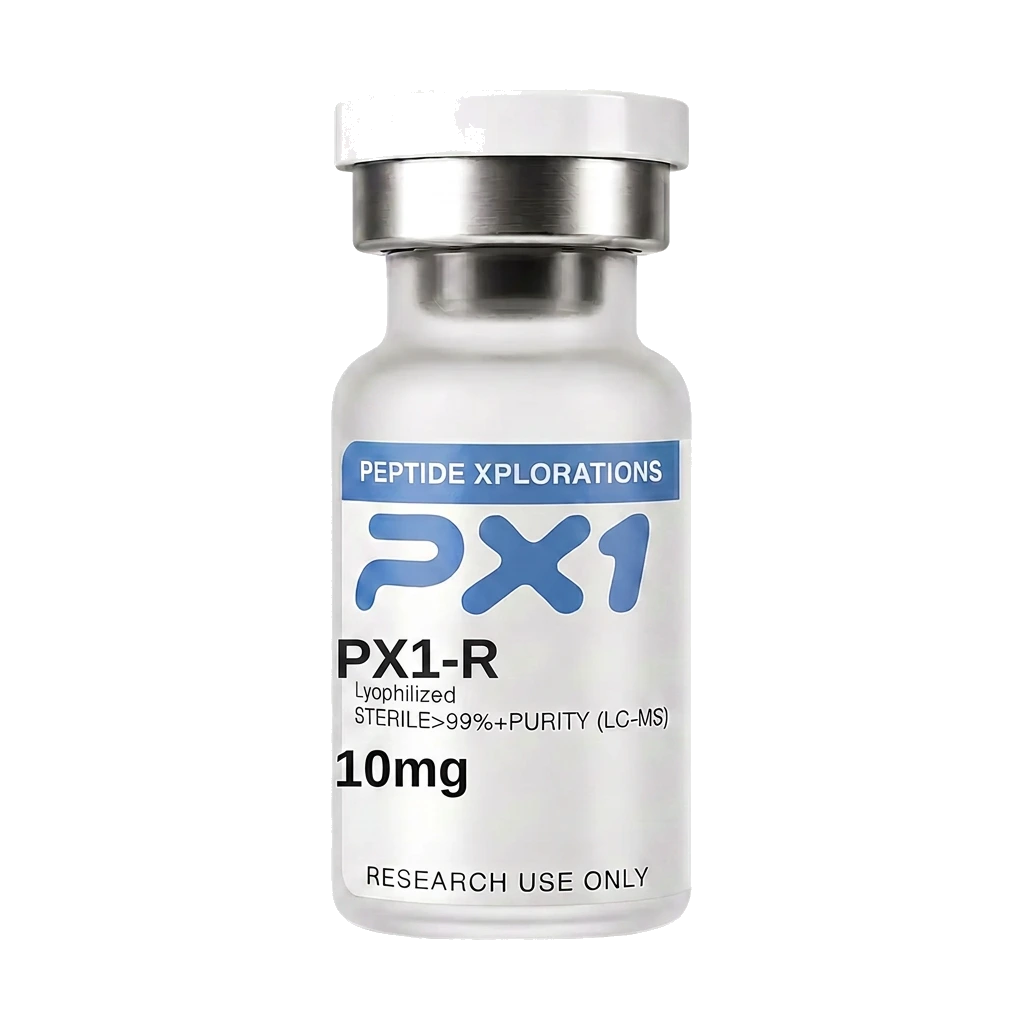
Reviewed By
PX1 QC — Analytical Chemistry Team
Every article is reviewed by PX1's in-house analytical team for accuracy on mechanism, dosing ranges reported in the literature, and lab-handling guidance. We do not publish clinical or medical advice.
Quick answer
Plain-language explainer: what retatrutide ('reta') is, how its GLP-1/GIP/glucagon triple mechanism differs from semaglutide and tirzepatide, and what the trials show.
Key takeaways
- Retatrutide (development code LY-3437943, often shortened to "reta" in research communities) is an investigational peptide developed by Eli Lilly.
- How it compares to semaglutide and tirzepatide
- What the trials have shown
- Side-effect profile in trials
The short answer
Retatrutide (development code LY-3437943, often shortened to "reta" in research communities) is an investigational peptide developed by Eli Lilly. It is a triple receptor agonist: one molecule that activates three receptors involved in metabolism — GLP-1, GIP, and glucagon.
That third target is the headline. Every approved drug in this class hits GLP-1; tirzepatide added GIP; retatrutide adds glucagon receptor activation on top of both.
How it compares to semaglutide and tirzepatide
| Compound | Targets | Status |
|---|---|---|
| Semaglutide | GLP-1 | Approved (Ozempic, Wegovy) |
| Tirzepatide | GLP-1 + GIP | Approved (Mounjaro, Zepbound) |
| Retatrutide | GLP-1 + GIP + glucagon | Phase 3 (TRIUMPH program) |
Each added receptor has translated to greater average weight reduction in trials so far.
What the trials have shown
In the published Phase 2 trial (New England Journal of Medicine, 2023), adults with obesity receiving the highest studied dose (12 mg weekly) lost a mean of roughly 24% of body weight at 48 weeks — the largest mean reduction reported for an incretin-class drug at that time. Notably, the weight-loss curve had not clearly plateaued at 48 weeks.
The glucagon component is the mechanistic differentiator: glucagon receptor activation increases energy expenditure and has direct effects on liver fat metabolism. In a Phase 2 substudy in participants with fatty liver disease, retatrutide produced large reductions in liver fat — over 80% of participants at the higher doses reached normal liver fat levels at 48 weeks.
Phase 3 trials (the TRIUMPH program, covering obesity, cardiovascular outcomes, and related indications) are underway, with results expected over the coming years.
Side-effect profile in trials
The adverse-event pattern so far resembles the rest of the class: mostly gastrointestinal (nausea, diarrhea, vomiting, constipation), dose-dependent, and most common during dose escalation. A dose-dependent increase in heart rate was also observed, which researchers are tracking in Phase 3.
Why it is called "reta"
"Reta" is simply the research-community shorthand for retatrutide. You will also see it written as LY-3437943 (its Lilly development code). All three names refer to the same 39-amino-acid peptide with a C20 fatty-diacid side chain that extends its half-life to roughly 6 days, supporting once-weekly administration in studies.
Research-grade material
Retatrutide is not an approved drug. For laboratory research, it is supplied as a lyophilized peptide. PX1 Research stocks retatrutide as PX13-R in 10–60mg vials, every lot verified at ≥99% purity by HPLC with LC-MS identity confirmation and a published third-party COA — see the lot-specific reports on our COA pages before selecting any supplier's material.
Research use only. Retatrutide is investigational and not approved for human use; nothing here is medical advice.