CJC-1295 (NO DAC) + IPAMORELIN
CJC-1295 (no DAC) + Ipamorelin is a two-component synthetic peptide blend pairing a 29-amino-acid growth-hormone-releasing hormone (GHRH) analog with a 5-amino-acid growth hormone secretagogue, supplied as a lyophilized
Disclaimer: All articles and product details provided on this website are intended for educational and informational purposes only. The products listed here are for in-vitro research only. In-vitro studies are conducted outside of living organisms. These products are not intended as medicines or drugs and have not been approved by the FDA to prevent, treat, or cure any medical condition, ailment, or disease. The direct or indirect administration of these substances to humans or animals is unequivocally prohibited under applicable law.
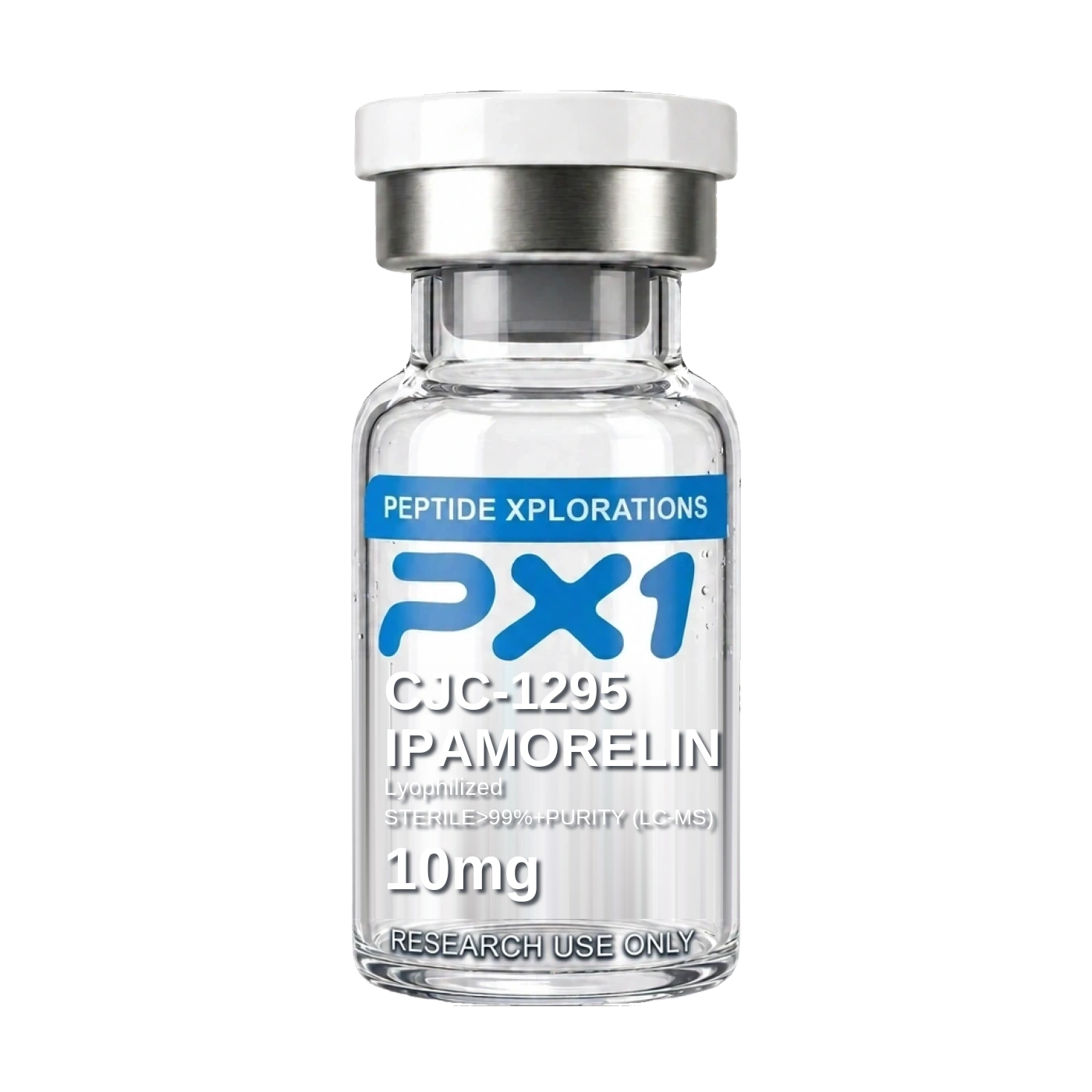
CJC-1295 (no DAC) + Ipamorelin is a two-component synthetic peptide blend pairing a 29-amino-acid growth-hormone-releasing hormone (GHRH) analog with a 5-amino-acid growth hormone secretagogue, supplied as a lyophilized research material for in-vitro laboratory use only.
| Property | Detail |
|---|---|
| Also known as | Mod-GRF(1-29) / Ipamorelin blend |
| CAS Number | CJC-1295 (no DAC): 863288-34-0 · Ipamorelin: 170851-70-4 |
| Molecular Formula | CJC-1295 (no DAC): C152H252N44O42 · Ipamorelin: C38H49N9O5 |
| Molecular Weight | CJC-1295 (no DAC): 3367.93 · Ipamorelin: 711.85 |
| Amino Acid Count | CJC-1295 (no DAC): 29 · Ipamorelin: 5 |
| Sequence | CJC-1295 (no DAC / Mod GRF 1-29): Tyr-D-Ala-Asp-Ala-Ile-Phe-Thr-Gln-Ser-Tyr-Arg-Lys-Val-Leu-Ala-Gln-Leu-Ser-Ala-Arg-Lys-Leu-Leu-Gln-Asp-Ile-Met-Ser-Arg-NH2 · Ipamorelin: Aib-His-D-2-Nal-D-Phe-Lys-NH2 |
| Purity | ≥99% by HPLC · COA available |
| Physical Form | Lyophilized powder |
What is CJC-1295 (NO DAC) + IPAMORELIN?
CJC-1295 (no DAC) + Ipamorelin is a defined blend of two chemically distinct synthetic peptides studied together within the growth-hormone (GH) axis research area. CJC-1295 (no DAC), also referred to as Modified GRF (1-29), is a 29-residue analog of the N-terminal fragment of human growth-hormone-releasing hormone (GHRH). It carries the molecular formula C152H252N44O42, a molecular weight of 3367.93 g/mol, CAS number 863288-34-0, and the amidated sequence Tyr-D-Ala-Asp-Ala-Ile-Phe-Thr-Gln-Ser-Tyr-Arg-Lys-Val-Leu-Ala-Gln-Leu-Ser-Ala-Arg-Lys-Leu-Leu-Gln-Asp-Ile-Met-Ser-Arg-NH2. The "no DAC" designation indicates the absence of the Drug Affinity Complex (maleimidoproprionic acid) moiety used in longer-circulating variants; the incorporated substitutions (including a D-alanine at position 2) are structural features characterized in peptide-chemistry literature. It is classified as a GHRH-receptor peptide agonist in research models.
Ipamorelin is a pentapeptide growth hormone secretagogue and a member of the growth-hormone-releasing peptide (GHRP) class studied as a selective ghrelin/GHS-receptor (GHS-R) agonist. It has the molecular formula C38H49N9O5, a molecular weight of 711.85 g/mol, CAS number 170851-70-4, and the amidated sequence Aib-His-D-2-Nal-D-Phe-Lys-NH2, comprising five amino acids including the non-proteinogenic residues alpha-aminoisobutyric acid (Aib), D-2-naphthylalanine, and D-phenylalanine. These unnatural and D-configured residues are recognized structural determinants of its receptor selectivity and stability profile in the peptide-chemistry record.
Combined in a single research preparation, the two peptides represent complementary molecular tools that act at distinct receptor targets within the somatotropic signaling pathway, which is why they are frequently investigated as a paired system in laboratory and cell-based studies of GH-axis regulation. This monograph describes only the physicochemical identity, handling, and analytical characterization of the material. It is intended strictly for research use only (RUO) and is not a drug, supplement, or article intended for human or veterinary use; no physiological or therapeutic properties are described or implied.
Reconstitution & handling
Both peptides are supplied as a lyophilized (freeze-dried) powder and are typically reconstituted in the laboratory with sterile or bacteriostatic water to yield a working stock solution. Because the two components differ substantially in molecular weight (3367.93 g/mol for CJC-1295 no DAC versus 711.85 g/mol for Ipamorelin), researchers should calculate concentrations against each component's respective mass when preparing molar solutions. To dissolve, the diluent is directed slowly down the interior wall of the vial rather than injected directly onto the powder cake, and the vial is gently swirled — not shaken or vortexed vigorously — until the solution is clear, since mechanical agitation and shear can promote peptide aggregation and degrade these amidated sequences.
Both peptides carry ionizable residues (arginine, lysine, and histidine among them) that influence aqueous solubility and pH-dependent behavior. For sparingly soluble material, a small volume of dilute acetic acid or a compatible buffer may be used to aid initial dissolution before dilution to the final working concentration, keeping the preparation cold and protected from prolonged light exposure. Reconstituted solutions should be visually inspected for clarity and the absence of particulates, and are best aliquoted to minimize repeated freeze-thaw cycles. This information addresses reconstitution chemistry and physical handling only.
Storage & stability
In lyophilized form, both peptides are stable for extended periods when sealed and stored desiccated at -20 degrees C, with short-term handling at refrigerated temperatures (2-8 degrees C) generally acceptable; the dry powders should be shielded from moisture, heat, and light to preserve integrity. Once reconstituted, the solution is far less stable and should be kept refrigerated at 2-8 degrees C for near-term use or frozen in single-use aliquots at -20 degrees C or below for longer retention. Repeated freeze-thaw cycles are the principal driver of peptide degradation and aggregation and should be avoided by portioning stock into working aliquots. The methionine and other oxidation-sensitive residues present in the CJC-1295 (no DAC) sequence make protection from air, heat, and light particularly important for maintaining chromatographic purity over time.
How it's tested
Identity and purity of each component are verified analytically before release. Reversed-phase high-performance liquid chromatography (RP-HPLC) is used to quantify chromatographic purity, with this material characterized at ≥99% by HPLC. Mass spectrometry (MS) confirms molecular identity by matching the observed mass against the calculated masses derived from the molecular formulas (C152H252N44O42, 3367.93 g/mol for CJC-1295 no DAC; C38H49N9O5, 711.85 g/mol for Ipamorelin). A Certificate of Analysis (COA) documenting these results is available for the lot, and supporting analytics may include additional identity, water-content, and appearance checks consistent with a research-grade peptide specification.
Frequently asked questions
What is CJC-1295 (no DAC) + Ipamorelin?
It is a research-only blend of two synthetic peptides: CJC-1295 (no DAC), a 29-amino-acid GHRH analog (Modified GRF 1-29), and Ipamorelin, a 5-amino-acid growth hormone secretagogue. It is supplied as a lyophilized powder for in-vitro laboratory research only and is not for human or animal use.
What does the "no DAC" designation mean?
"No DAC" indicates the peptide lacks the Drug Affinity Complex (a maleimidoproprionic acid moiety) found in longer-circulating CJC-1295 variants. Without that group, this molecule corresponds to Modified GRF (1-29) and is characterized by CAS 863288-34-0 and molecular weight 3367.93 g/mol.
What are the molecular details of each component?
CJC-1295 (no DAC): CAS 863288-34-0, formula C152H252N44O42, molecular weight 3367.93 g/mol, 29 amino acids. Ipamorelin: CAS 170851-70-4, formula C38H49N9O5, molecular weight 711.85 g/mol, 5 amino acids (sequence Aib-His-D-2-Nal-D-Phe-Lys-NH2).
How is the blend reconstituted?
The lyophilized powder is dissolved by adding sterile or bacteriostatic water slowly down the vial wall and swirling gently until clear — never shaking or vortexing. Because the two peptides differ greatly in molecular weight, concentrations are calculated against each component's respective mass.
How should the material be stored?
Store the lyophilized powder desiccated at -20 degrees C, protected from light and moisture. After reconstitution, keep it refrigerated at 2-8 degrees C for near-term use or frozen in single-use aliquots for longer retention, avoiding repeated freeze-thaw cycles.
How is purity and identity verified?
Each component is analyzed by reversed-phase HPLC for purity (≥99%) and by mass spectrometry to confirm molecular identity against the calculated masses. A Certificate of Analysis (COA) documenting these results is available for the lot.