TESAMORELIN
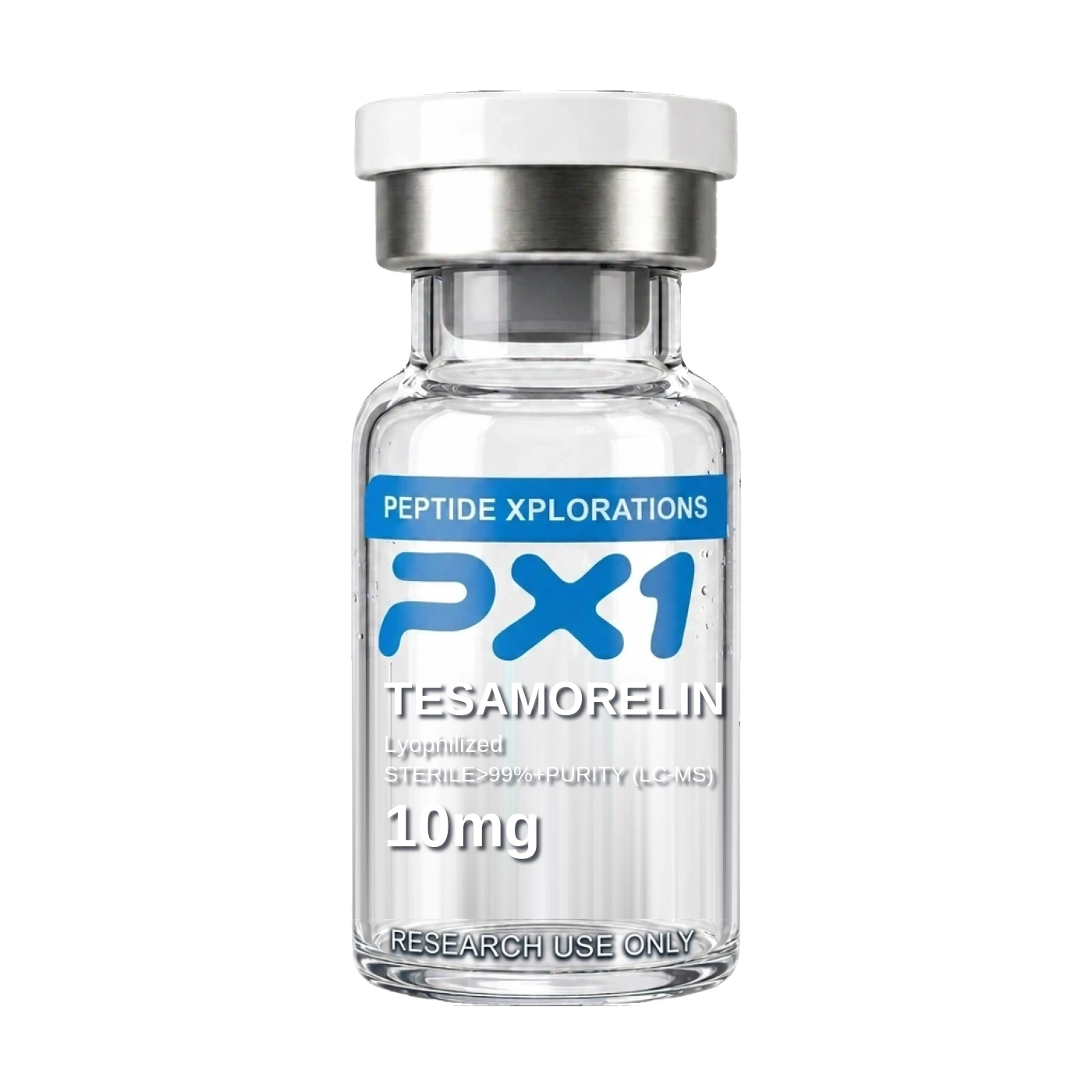
Tesamorelin is a synthetic 44-amino-acid peptide analog of human growth hormone-releasing hormone (GHRH), supplied as a lyophilized research-grade material at ≥99% HPLC purity for laboratory use only.
Disclaimer: All articles and product details provided on this website are intended for educational and informational purposes only. The products listed here are for in-vitro research only. In-vitro studies are conducted outside of living organisms. These products are not intended as medicines or drugs and have not been approved by the FDA to prevent, treat, or cure any medical condition, ailment, or disease. The direct or indirect administration of these substances to humans or animals is unequivocally prohibited under applicable law.
| Property | Detail |
|---|---|
| Also known as | GRF(1-44) analogue |
| CAS Number | 218949-48-5 |
| Molecular Formula | C221H366N72O67S |
| Molecular Weight | 5135.86 |
| Amino Acid Count | 44 |
| Sequence | trans-3-hexenoyl-Tyr-Ala-Asp-Ala-Ile-Phe-Thr-Asn-Ser-Tyr-Arg-Lys-Val-Leu-Gly-Gln-Leu-Ser-Ala-Arg-Lys-Leu-Leu-Gln-Asp-Ile-Met-Ser-Arg-Gln-Gln-Gly-Glu-Ser-Asn-Gln-Glu-Arg-Gly-Ala-Arg-Ala-Arg-Leu-NH2 |
| Purity | ≥99% by HPLC · COA available |
| Physical Form | Lyophilized powder |
What is TESAMORELIN?
Tesamorelin (CAS 218949-48-5) is a synthetic peptide belonging to the growth hormone-releasing hormone (GHRH) analog class. It is a 44-residue linear polypeptide corresponding to the sequence of human GHRH(1-44), structurally modified at the N-terminus by a trans-3-hexenoyl group and terminating in a C-terminal amide (-NH2). Its molecular formula is C221H366N72O67S with a molecular weight of 5135.86 g/mol.
The full primary sequence is trans-3-hexenoyl-Tyr-Ala-Asp-Ala-Ile-Phe-Thr-Asn-Ser-Tyr-Arg-Lys-Val-Leu-Gly-Gln-Leu-Ser-Ala-Arg-Lys-Leu-Leu-Gln-Asp-Ile-Met-Ser-Arg-Gln-Gln-Gly-Glu-Ser-Asn-Gln-Glu-Arg-Gly-Ala-Arg-Ala-Arg-Leu-NH2. The N-terminal hexenoyl acylation is a defining structural feature that distinguishes tesamorelin from the native GHRH peptide backbone and is frequently referenced in analytical characterization of the molecule. The single sulfur atom in the formula derives from the internal methionine residue.
As a stabilized GHRH analog, tesamorelin is studied in in-vitro and preclinical research contexts concerned with the growth hormone-releasing hormone signaling axis and neuroendocrine peptide biochemistry. This material is offered strictly as a reference chemical for laboratory research use only. It is not a drug, supplement, or article intended for human or veterinary use, and no physiological or clinical outcomes are represented.
Reconstitution & handling
Tesamorelin is supplied as a lyophilized powder and is typically reconstituted in the laboratory using bacteriostatic or sterile water to prepare a stock solution for research handling. As a large 44-residue peptide bearing multiple polar and charged residues (arginine, lysine, aspartate, glutamate), it is generally water-soluble; the solvent is usually introduced slowly along the vessel wall and allowed to dissolve by gentle swirling rather than vortexing or agitation, which can promote mechanical shear and aggregation of the peptide chain. Brief resting at controlled temperature until the solution clears is preferred over vigorous mixing.
If solubility is incomplete, minimal volumes of a mild aqueous buffer at slightly acidic to neutral pH are commonly employed as an initial dissolution medium before dilution into the working buffer, since acylated GHRH-class peptides can be sensitive to strongly alkaline conditions. Reconstituted material should be handled under aseptic technique, kept cold during preparation, and aliquoted to limit repeated freeze-thaw cycles. All handling parameters are determined by the individual research protocol; no administration or dosing guidance is implied.
Storage & stability
In lyophilized form, tesamorelin is best stored desiccated and protected from light, typically at -20 C or colder for long-term stability, where the dry peptide remains stable for extended periods. Once reconstituted, the peptide is markedly less stable and is generally maintained refrigerated at 2-8 C for short-term use or frozen in single-use aliquots for longer storage to minimize hydrolysis, oxidation of the methionine residue, and aggregation. Repeated freeze-thaw cycling should be avoided, and solutions should be inspected for clarity before use.
How it's tested
Identity and purity of tesamorelin are confirmed by reversed-phase high-performance liquid chromatography (RP-HPLC), which resolves the target peptide from sequence-related and process impurities and supports the stated purity of ≥99%. Molecular identity is corroborated by mass spectrometry (typically ESI-MS or MALDI-TOF), with the observed mass compared against the theoretical average mass of 5135.86 g/mol derived from the molecular formula C221H366N72O67S. Each lot is accompanied by a Certificate of Analysis (COA) documenting the chromatographic purity, mass confirmation, and appearance for the specific batch supplied.
Frequently asked questions
What is tesamorelin?
Tesamorelin is a synthetic 44-amino-acid analog of human growth hormone-releasing hormone (GHRH), characterized by an N-terminal trans-3-hexenoyl modification and a C-terminal amide. It is supplied as a research-grade lyophilized peptide (CAS 218949-48-5) for laboratory use only.
What is the molecular formula and weight of tesamorelin?
Tesamorelin has the molecular formula C221H366N72O67S and a molecular weight of 5135.86 g/mol. Its CAS number is 218949-48-5.
What structurally distinguishes tesamorelin from native GHRH?
Tesamorelin retains the 44-residue human GHRH(1-44) sequence but adds a trans-3-hexenoyl acyl group at the N-terminus and a C-terminal amide (-NH2). This N-terminal modification is a defining feature of the molecule and is commonly referenced in its analytical characterization.
How is tesamorelin reconstituted for research use?
It is typically dissolved in bacteriostatic or sterile water added slowly to the vial and allowed to dissolve with gentle swirling rather than vortexing. As a highly charged peptide it is generally water-soluble; a mild aqueous buffer may aid initial dissolution. Specific parameters follow the individual research protocol.
How should tesamorelin be stored?
Store the lyophilized powder desiccated and protected from light at -20 C or colder for long-term stability. After reconstitution, keep it refrigerated at 2-8 C for short-term use or frozen in single-use aliquots, avoiding repeated freeze-thaw cycles.
How is the purity and identity of tesamorelin verified?
Purity is assessed by reversed-phase HPLC (≥99%) and identity is confirmed by mass spectrometry against the theoretical average mass of 5135.86 g/mol. A batch-specific Certificate of Analysis (COA) is provided documenting these results.