DIHEXA
DIHEXA is a synthetic, metabolically stabilized oligopeptide analog derived structurally from angiotensin IV, supplied as a lyophilized research-grade material at ≥99% purity by HPLC for laboratory use only.
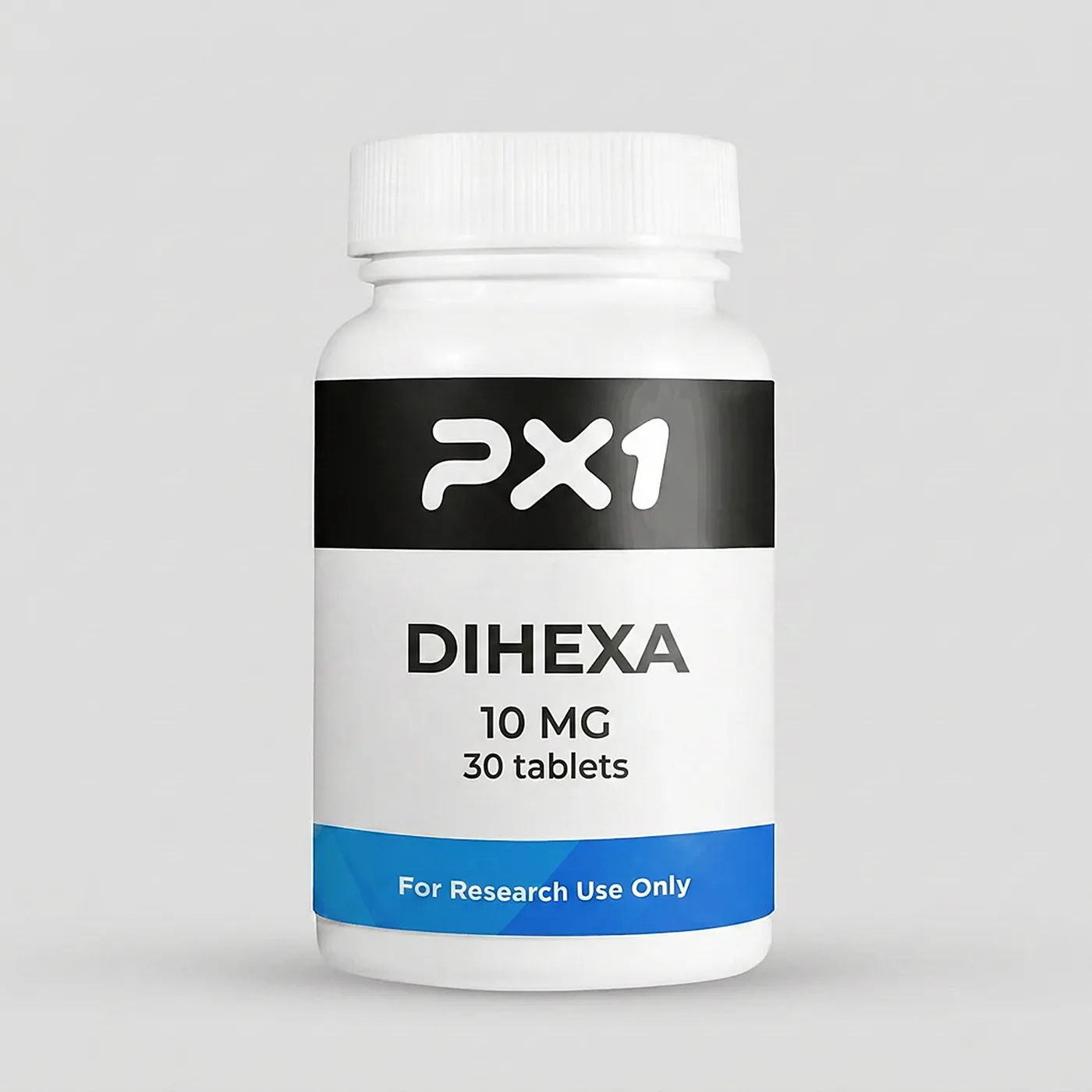
Disclaimer: All articles and product details provided on this website are intended for educational and informational purposes only. The products listed here are for in-vitro research only. In-vitro studies are conducted outside of living organisms. These products are not intended as medicines or drugs and have not been approved by the FDA to prevent, treat, or cure any medical condition, ailment, or disease. The direct or indirect administration of these substances to humans or animals is unequivocally prohibited under applicable law.
| Property | Detail |
|---|---|
| Also known as | N-hexanoic-Tyr-Ile-(6)-aminohexanoic amide; PNB-0408 |
| CAS Number | 1401708-83-5 |
| Molecular Formula | C25H33N3O4 |
| Molecular Weight | 439.55 g/mol |
| Purity | ≥99% by HPLC · COA available |
| Physical Form | Lyophilized powder |
What is DIHEXA?
DIHEXA is a small synthetic peptide analog belonging to the class of angiotensin IV (AngIV)-derived oligopeptides. It was engineered as a modified, metabolically stabilized derivative of the native AngIV fragment, with N- and C-terminal capping groups that distinguish it from the parent sequence and reduce susceptibility to aminopeptidase and carboxypeptidase cleavage. As a research chemical, it is handled and characterized as a defined small-molecule peptide rather than a formulated product.
Structurally, DIHEXA is categorized as a short capped oligopeptide (an amidated, N-acylated construct) built on an angiotensin IV-derived backbone. This capping architecture is the design feature that differentiates it from linear, unprotected peptides and is central to why it is studied as a distinct chemical entity. It is presented as a lyophilized (freeze-dried) solid, the standard physical form for peptides of this size intended for reconstitution in a laboratory setting.
In the scientific literature, DIHEXA is associated with in-vitro and preclinical neuroscience research, where angiotensin IV-derived compounds have been investigated in connection with the hepatocyte growth factor (HGF) / c-Met signaling system and related cell-biology models. PX1 Research supplies DIHEXA strictly as a reference material for such laboratory investigation. No physiological, therapeutic, or performance outcomes are claimed or implied, and the compound is not intended for human or veterinary use, diagnosis, or treatment.
Reconstitution & handling
DIHEXA is provided as a lyophilized solid and must be brought into solution before use in laboratory work. Because it is a relatively hydrophobic capped peptide, aqueous solubility can be limited; researchers commonly prepare a concentrated stock in a compatible organic co-solvent such as dimethyl sulfoxide (DMSO) and then dilute into the intended aqueous buffer or assay medium. Bacteriostatic or sterile water alone may not fully dissolve the material, so a small volume of DMSO is often used as the initial solvent to achieve a clear stock. Solvent selection should always be verified for compatibility with the downstream assay system.
For handling, allow the sealed vial to equilibrate to room temperature before opening to minimize condensation onto the hygroscopic solid. Introduce solvent gently down the vial wall and swirl rather than vortexing aggressively; avoid repeated foaming, which can promote aggregation. Prepared solutions should be clear and free of visible particulates. Because peptides are sensitive to freeze-thaw cycling, dividing reconstituted material into single-use aliquots is a standard practice to preserve integrity.
Storage & stability
In its lyophilized form, DIHEXA is best stored sealed, protected from light and moisture, at −20 °C, where capped peptides of this type maintain stability over extended periods. Once reconstituted, the material is far less stable: solutions should be kept refrigerated at 2–8 °C for short-term use or frozen at −20 °C (or colder) in single-use aliquots for longer storage, and repeated freeze-thaw cycles should be avoided. Minimizing exposure to warmth, light, and atmospheric moisture preserves purity and reduces the risk of hydrolysis or aggregation over time.
How it's tested
Each lot of DIHEXA is analytically characterized to confirm identity and purity, with a Certificate of Analysis (COA) available. Purity is determined by reversed-phase high-performance liquid chromatography (HPLC), establishing the ≥99% specification by quantifying the main peak relative to process-related impurities. Identity is typically corroborated by mass spectrometry (MS), which confirms the expected molecular mass of the peptide. Together, HPLC and MS provide orthogonal verification of composition, and the COA documents the analytical results for the specific lot supplied, supporting traceability in a research setting.
Frequently asked questions
What is DIHEXA?
DIHEXA is a synthetic oligopeptide analog derived structurally from angiotensin IV, supplied as a lyophilized research-grade solid at ≥99% purity by HPLC. It is intended strictly for laboratory research use only, not for human or veterinary use.
What purity is DIHEXA supplied at, and is a COA available?
It is supplied at ≥99% purity as measured by HPLC, and a Certificate of Analysis (COA) documenting the lot-specific analytical results is available.
How is DIHEXA reconstituted for laboratory use?
As a hydrophobic capped peptide, it is commonly first dissolved in a small volume of a compatible organic co-solvent such as DMSO to form a stock, then diluted into the aqueous buffer or assay medium. Solvent choice should be confirmed for compatibility with the downstream assay.
How should DIHEXA be stored?
Store the lyophilized powder sealed at −20 °C, protected from light and moisture. Reconstituted solutions should be refrigerated for short-term use or aliquoted and frozen for longer storage, avoiding repeated freeze-thaw cycles.
How is the identity and purity of DIHEXA verified?
Identity and purity are verified by reversed-phase HPLC for purity quantification and mass spectrometry (MS) for molecular-mass confirmation, with results reported on the lot COA.
What research area is DIHEXA associated with?
In the scientific literature, DIHEXA and related angiotensin IV-derived peptides are studied in in-vitro and preclinical neuroscience research, including work involving the HGF/c-Met signaling system. No physiological or therapeutic outcomes are claimed.