MELANOTAN-2
Melanotan-2 (MT-2) is a synthetic cyclic heptapeptide analog of alpha-melanocyte-stimulating hormone (α-MSH), supplied as a lyophilized research-grade solid for laboratory use only.
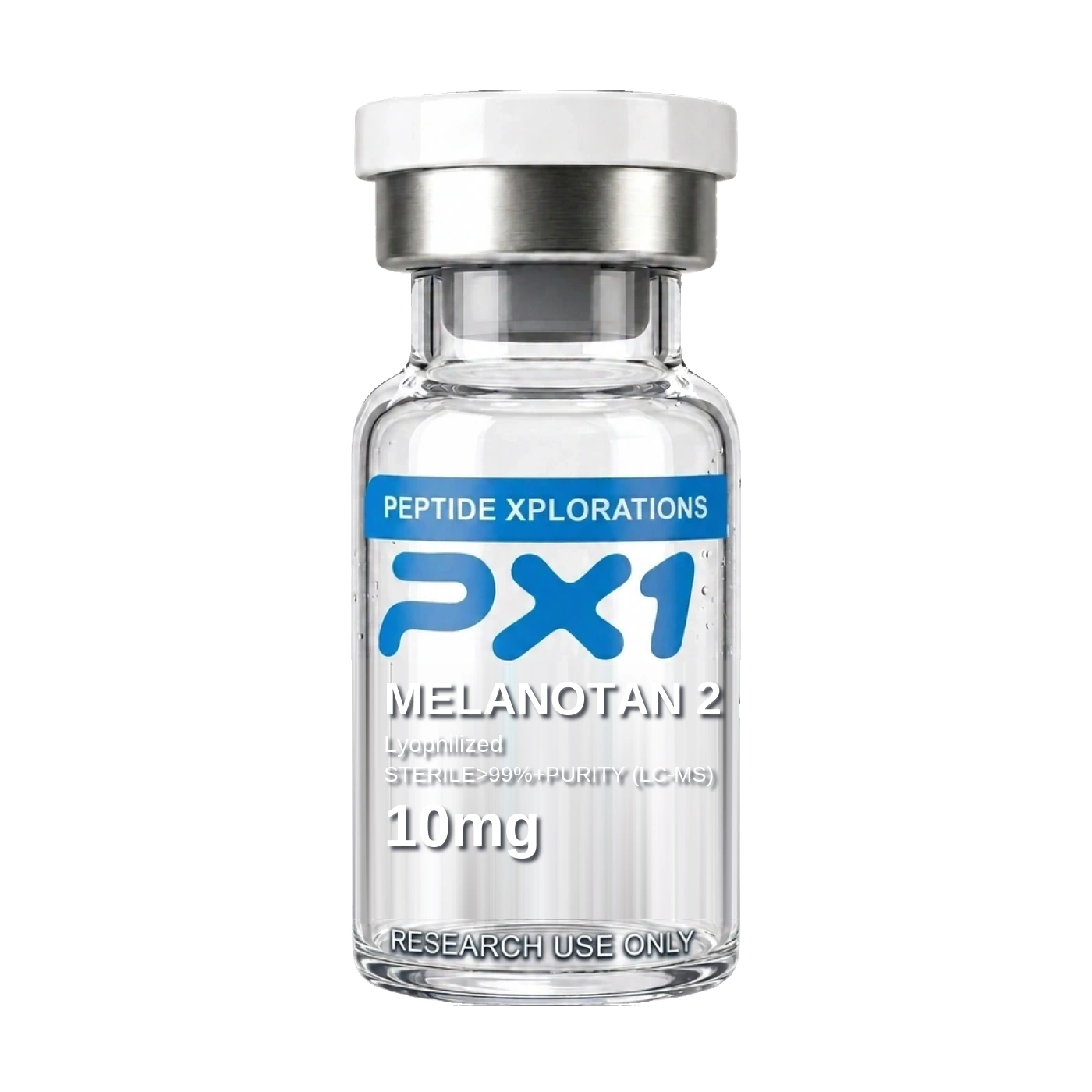
Disclaimer: All articles and product details provided on this website are intended for educational and informational purposes only. The products listed here are for in-vitro research only. In-vitro studies are conducted outside of living organisms. These products are not intended as medicines or drugs and have not been approved by the FDA to prevent, treat, or cure any medical condition, ailment, or disease. The direct or indirect administration of these substances to humans or animals is unequivocally prohibited under applicable law.
| Property | Detail |
|---|---|
| Also known as | MT-2; cyclic α-MSH analogue |
| CAS Number | 121062-08-6 |
| Molecular Formula | C50H69N15O9 |
| Molecular Weight | 1024.18 |
| Amino Acid Count | 7 |
| Sequence | Ac-Nle-cyclo[Asp-His-D-Phe-Arg-Trp-Lys]-NH2 |
| Purity | ≥99% by HPLC · COA available |
| Physical Form | Lyophilized powder |
What is MELANOTAN-2?
Melanotan-2 (MT-2) is a synthetic, cyclic seven-amino-acid peptide classified as a structural analog of alpha-melanocyte-stimulating hormone (α-MSH). It is catalogued under CAS number 121062-08-6 and carries the molecular formula C50H69N15O9 with a molecular weight of 1024.18 g/mol. The compound is defined by the sequence Ac-Nle-cyclo[Asp-His-D-Phe-Arg-Trp-Lys]-NH2, indicating an N-terminal acetyl cap, a C-terminal amide, and a lactam bridge that constrains the backbone into a cyclic conformation.
Structurally, the peptide incorporates several non-canonical features that distinguish it from a linear native sequence: a norleucine (Nle) residue at the N-terminus, a D-phenylalanine (D-Phe) substitution that inverts the stereochemistry at that position, and an intramolecular amide (lactam) cyclization between the aspartate and lysine side chains. These modifications increase the conformational rigidity and metabolic stability of the molecule relative to the parent hormone, which is a common design strategy in structure-activity research on melanocortin peptides.
Within the scientific literature, Melanotan-2 is studied as a non-selective melanocortin receptor ligand and is used as a reference tool compound in in-vitro melanocortin-system research and receptor-binding investigations. PX1 Research supplies this material strictly as a research chemical for laboratory and analytical applications. It is not a drug, dietary supplement, cosmetic, or food, and it is not intended for human or veterinary use, diagnosis, or any in-vivo administration.
Reconstitution & handling
Melanotan-2 is supplied as a lyophilized (freeze-dried) powder that must be brought into solution before analytical or in-vitro work. Bacteriostatic or sterile water is the most common reconstitution solvent for this class of cyclic peptide; the ionizable arginine, histidine, and lysine side chains generally confer good aqueous solubility. To dissolve the material, the chosen solvent is directed slowly down the inner wall of the vial rather than injected directly onto the powder pellet, and the vial is then left to stand and swirled gently until the solution is clear. Vigorous shaking or vortexing is avoided because mechanical shear and foaming can stress the peptide backbone.
For sparingly soluble handling scenarios, a small volume of a mild acid such as dilute acetic acid can be used to aid initial dissolution before dilution into the working aqueous buffer, and the resulting stock can be adjusted or diluted as the experimental protocol requires. Reconstituted solutions should be prepared fresh where possible, kept cold during handling, and protected from prolonged light exposure given the tryptophan and histidine residues in the sequence, which are sensitive to oxidation. All reconstitution should be performed by trained personnel using appropriate laboratory technique.
Storage & stability
In its lyophilized form, Melanotan-2 is stable for extended periods when stored sealed, desiccated, and protected from light; long-term storage at -20°C is standard practice, and the dry powder tolerates brief periods at ambient shipping temperatures without meaningful degradation. Once reconstituted, the peptide is markedly less stable and should be held refrigerated at 2-8°C for near-term use or aliquoted and frozen at -20°C or below for longer intervals. Repeated freeze-thaw cycles are minimized by dividing the stock into single-use aliquots, since successive thawing accelerates aggregation and hydrolytic breakdown of the cyclic structure. Keeping solutions cold, dark, and sealed preserves peptide integrity across the working period.
How it's tested
Each lot of Melanotan-2 is characterized analytically to confirm identity and purity before release. Reversed-phase high-performance liquid chromatography (RP-HPLC) is used to quantify chromatographic purity, with material specified at ≥99% by HPLC. Molecular identity is confirmed by mass spectrometry (MS), where the observed mass is checked against the theoretical monoisotopic and average mass derived from the C50H69N15O9 formula (MW 1024.18) to verify that the intact cyclic sequence and its acetyl/amide modifications are present. A Certificate of Analysis (COA) documenting these results is available for the supplied lot, providing traceable, lot-specific verification of identity, purity, and quality parameters.
Frequently asked questions
What is Melanotan-2?
Melanotan-2 (MT-2) is a synthetic cyclic heptapeptide analog of alpha-melanocyte-stimulating hormone (α-MSH), CAS 121062-08-6, supplied as a research-grade lyophilized powder for laboratory use only. It is not a drug or supplement and is not intended for human or veterinary use.
What is the molecular formula and weight of Melanotan-2?
Melanotan-2 has the molecular formula C50H69N15O9 and a molecular weight of 1024.18 g/mol. Its sequence is Ac-Nle-cyclo[Asp-His-D-Phe-Arg-Trp-Lys]-NH2, a cyclic 7-amino-acid peptide with an N-terminal acetyl group and C-terminal amide.
Why is the peptide described as cyclic?
The molecule contains an intramolecular lactam (amide) bridge between the aspartate and lysine side chains, which closes the backbone into a ring. Together with the norleucine and D-phenylalanine substitutions, this cyclization increases the conformational rigidity and stability of the peptide relative to a linear analog.
How is Melanotan-2 reconstituted for research?
The lyophilized powder is typically dissolved in bacteriostatic or sterile water, added slowly down the vial wall and swirled gently rather than shaken. A small amount of dilute acetic acid can assist initial dissolution before dilution into the working buffer. Reconstitution is a chemistry step performed by trained laboratory personnel.
How should Melanotan-2 be stored?
Store the lyophilized powder sealed, desiccated, and protected from light, ideally at -20°C for long-term stability. After reconstitution, keep solutions refrigerated at 2-8°C for short-term use or frozen at -20°C in single-use aliquots to minimize freeze-thaw cycles.
How is identity and purity verified?
Each lot is analyzed by reversed-phase HPLC for purity (specified ≥99%) and by mass spectrometry to confirm the molecular identity against the C50H69N15O9 formula and 1024.18 g/mol mass. A Certificate of Analysis (COA) documenting these results is available for the supplied lot.