SERMORELIN
Sermorelin is a synthetic 29-amino-acid peptide amide corresponding to the N-terminal 1-29 fragment of human growth-hormone-releasing hormone (GRF 1-29 NH2), supplied as a research-grade lyophilized powder for laboratory
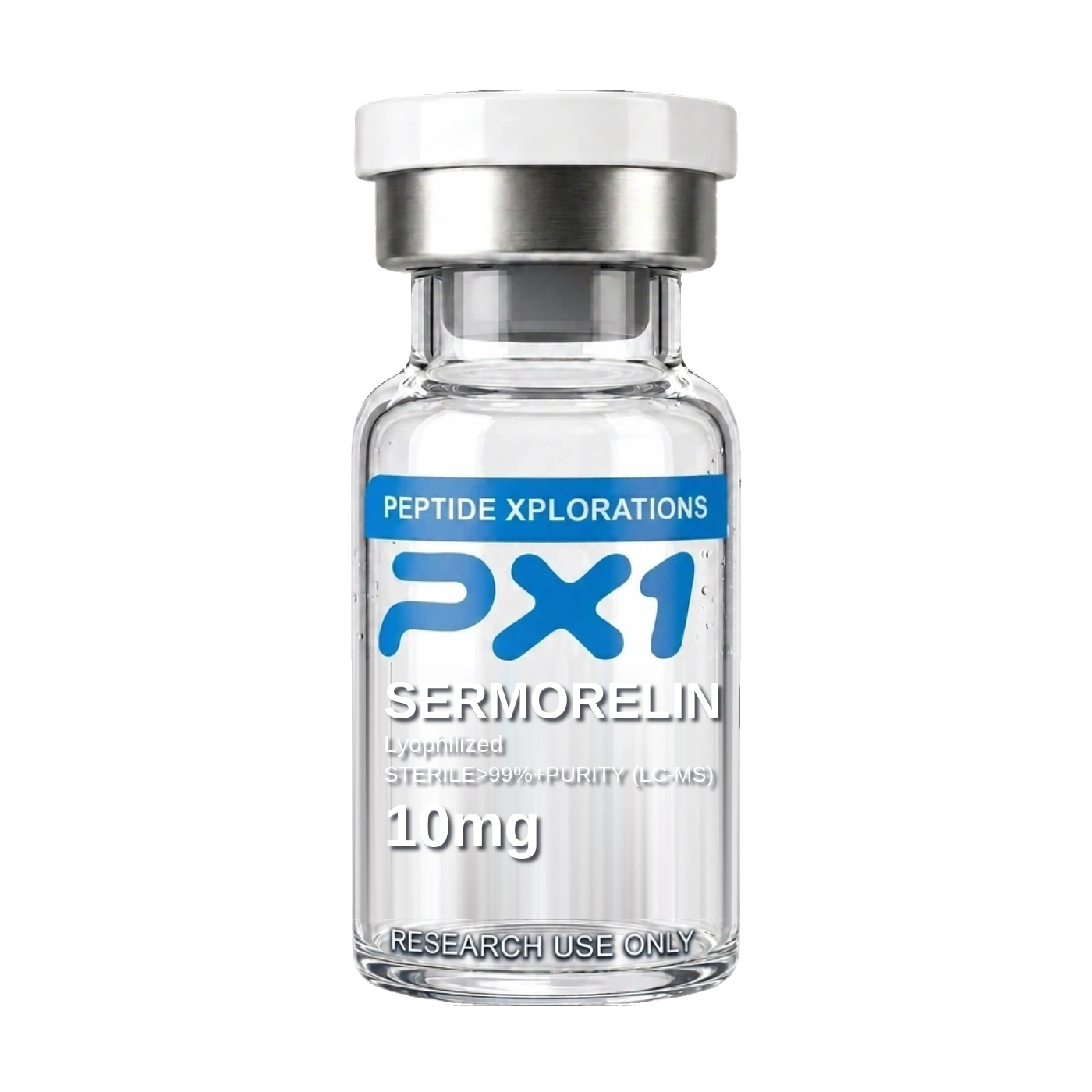
Disclaimer: All articles and product details provided on this website are intended for educational and informational purposes only. The products listed here are for in-vitro research only. In-vitro studies are conducted outside of living organisms. These products are not intended as medicines or drugs and have not been approved by the FDA to prevent, treat, or cure any medical condition, ailment, or disease. The direct or indirect administration of these substances to humans or animals is unequivocally prohibited under applicable law.
Sermorelin is a synthetic 29-amino-acid peptide amide corresponding to the N-terminal 1-29 fragment of human growth-hormone-releasing hormone (GRF 1-29 NH2), supplied as a research-grade lyophilized powder for laboratory use only.
| Property | Detail |
|---|---|
| Also known as | GRF(1-29); GHRH analogue |
| CAS Number | 86168-78-7 |
| Molecular Formula | C149H246N44O42S |
| Molecular Weight | 3357.93 |
| Amino Acid Count | 29 |
| Sequence | Tyr-Ala-Asp-Ala-Ile-Phe-Thr-Asn-Ser-Tyr-Arg-Lys-Val-Leu-Gly-Gln-Leu-Ser-Ala-Arg-Lys-Leu-Leu-Gln-Asp-Ile-Met-Ser-Arg-NH2 (GRF 1-29 NH2) |
| Purity | ≥99% by HPLC · COA available |
| Physical Form | Lyophilized powder |
What is SERMORELIN?
Sermorelin is a synthetic peptide classified as a growth-hormone-releasing hormone (GHRH) analog, corresponding to the first 29 residues of endogenous human GHRH — the N-terminal segment historically identified in reference literature as the shortest fragment that reproduces the sequence characteristics of the parent hormone. It is catalogued under CAS number 86168-78-7 and carries the molecular formula C149H246N44O42S with a molecular weight of 3357.93 g/mol. The compound is frequently referenced by its shorthand designation GRF 1-29 NH2.
Structurally, Sermorelin is a linear 29-residue polypeptide with a C-terminal amide (—NH2) modification, defined by the sequence Tyr-Ala-Asp-Ala-Ile-Phe-Thr-Asn-Ser-Tyr-Arg-Lys-Val-Leu-Gly-Gln-Leu-Ser-Ala-Arg-Lys-Leu-Leu-Gln-Asp-Ile-Met-Ser-Arg-NH2. The terminal amidation replaces the free carboxylate of the final arginine residue, a modification commonly introduced during solid-phase manufacturing that alters the molecule's terminal charge and can influence its conformational and handling characteristics. The single methionine residue and multiple basic arginine and lysine positions contribute to the peptide's overall physicochemical profile.
As a research material, Sermorelin is studied in the context of the GHRH receptor signaling axis and secretagogue biochemistry within in-vitro and preclinical laboratory models. It is used strictly as a reference and investigational compound for characterizing peptide-receptor interactions, structure-activity relationships, and analytical method development. This listing describes the material's chemistry and identity only; it is intended for laboratory research use and is not a drug, supplement, or article for human or veterinary use.
Reconstitution & handling
Sermorelin is supplied as a lyophilized (freeze-dried) powder and is typically reconstituted in the laboratory using sterile or bacteriostatic water as the primary solvent; the peptide's numerous ionizable arginine, lysine, and acidic residues generally support aqueous solubility. For peptides that are slow to dissolve, brief gentle swirling is preferred over vortexing or vigorous agitation, which can introduce shear stress and foaming. Solvent should be added slowly down the side of the vial and allowed to contact the powder without direct forceful streaming onto the pellet.
When fuller dissolution is required, a small proportion of a mild acidic aqueous solution (for example dilute acetic acid) is a common laboratory approach for peptides of this size, after which the solution may be brought up to working volume with water. Reconstituted material should be handled under clean conditions, kept cold during use, and inspected for clarity — a clear, particulate-free solution is expected. Reconstitution volumes and concentrations are determined solely by the researcher's analytical protocol.
Storage & stability
In its lyophilized form, Sermorelin is best stored desiccated and protected from light, with cold storage (refrigerated for short periods and frozen, typically at or below -20 C, for long-term archival) preserving peptide integrity over extended timeframes. Once reconstituted, aqueous peptide solutions are markedly less stable and should be kept refrigerated and used within a short working window; aliquoting into single-use fractions before freezing minimizes degradation from repeated freeze-thaw cycles. The methionine residue in the sequence makes the peptide potentially susceptible to oxidation, so limiting exposure to air, heat, and light supports stability. As with all research peptides, warming vials to room temperature before opening reduces condensation and moisture uptake.
How it's tested
Identity and purity of Sermorelin are verified analytically prior to release. Reversed-phase high-performance liquid chromatography (HPLC) is used to quantify chromatographic purity, with this material characterized at ≥99% by HPLC, resolving the target peptide from process-related impurities and truncated or deletion sequences. Mass spectrometry (MS) confirms molecular identity by matching the observed mass against the theoretical average mass derived from the C149H246N44O42S formula (3357.93 g/mol), verifying both the full 29-residue sequence and the C-terminal amide. A Certificate of Analysis (COA) documenting these results is available for the material, providing lot-specific verification of identity and purity.
Frequently asked questions
What is Sermorelin?
Sermorelin is a synthetic 29-amino-acid peptide amide corresponding to the N-terminal 1-29 fragment of human growth-hormone-releasing hormone, known as GRF 1-29 NH2. It carries CAS number 86168-78-7 and is supplied strictly as a research-use-only laboratory material.
What is the molecular formula and weight of Sermorelin?
Sermorelin has the molecular formula C149H246N44O42S and a molecular weight of 3357.93 g/mol. Its sequence is Tyr-Ala-Asp-Ala-Ile-Phe-Thr-Asn-Ser-Tyr-Arg-Lys-Val-Leu-Gly-Gln-Leu-Ser-Ala-Arg-Lys-Leu-Leu-Gln-Asp-Ile-Met-Ser-Arg-NH2, comprising 29 residues with a C-terminal amide.
Why is Sermorelin called GRF 1-29?
GRF 1-29 refers to the first 29 amino acids of growth-hormone-releasing factor (GHRH). Sermorelin reproduces this N-terminal segment, historically described as the shortest fragment that carries the defining sequence of the parent hormone, with a terminal amide denoted NH2.
How is Sermorelin reconstituted for laboratory work?
The lyophilized powder is typically dissolved in sterile or bacteriostatic water, added slowly and swirled gently rather than shaken. A small amount of dilute acetic acid can aid dissolution before diluting to working volume. Solutions should be clear and free of particulates. Concentrations are set by the researcher's protocol.
How should Sermorelin be stored?
Store the lyophilized powder desiccated, protected from light, and frozen (at or below -20 C) for long-term stability. After reconstitution, keep refrigerated, aliquot to avoid repeated freeze-thaw cycles, and use within a short window. Minimizing air and heat exposure helps protect the oxidation-sensitive methionine residue.
How is the purity of Sermorelin verified?
Purity is confirmed by reversed-phase HPLC at ≥99%, while mass spectrometry verifies molecular identity against the theoretical mass of 3357.93 g/mol. A lot-specific Certificate of Analysis (COA) documenting these results is available.