Understanding Certificates of Analysis (COA) for Research Peptides
How to read purity, identity, and quality data with confidence
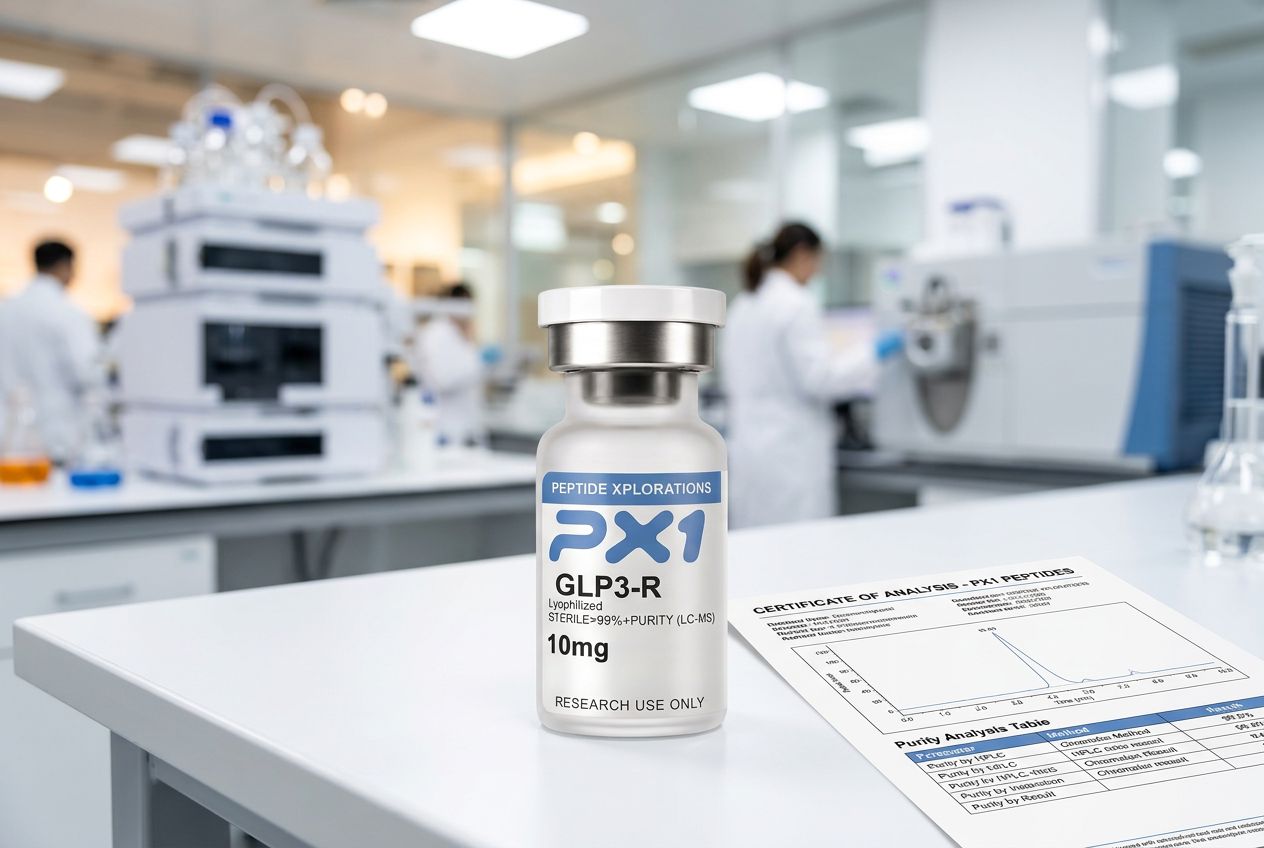
Disclaimer: All articles and product details provided on this website are intended for educational and informational purposes only. The products listed here are for in-vitro research only. In-vitro studies are conducted outside of living organisms. These products are not intended as medicines or drugs and have not been approved by the FDA to prevent, treat, or cure any medical condition, ailment, or disease. The direct or indirect administration of these substances to humans or animals is unequivocally prohibited under applicable law.
What a Certificate of Analysis Is
A Certificate of Analysis (COA) is a batch-specific document that reports the analytical testing performed on a research peptide. It is the single most important tool a researcher has for verifying that the material in a vial matches what was ordered — in identity, purity, and composition. A credible supplier publishes a COA tied to the exact lot number on the vial.
The Core Sections of a COA
- Product & lot identification — the peptide name, sequence or molecular formula, and a unique batch/lot number that should match the vial label.
- HPLC purity — High-Performance Liquid Chromatography separates the sample into its components. The chromatogram shows a dominant peak for the target peptide; the reported purity (e.g., ≥99%) is the area of that peak relative to all detected peaks.
- Mass Spectrometry (MS) — Confirms molecular identity by measuring the mass-to-charge ratio. The observed mass should match the theoretical mass of the intended sequence.
- Net peptide content / water content — Reports how much of the vial mass is actual peptide versus residual water, salts, or counter-ions.
- Appearance and additional tests — May include sterility, endotoxin, or heavy-metal screening depending on the product.
How to Read an HPLC Chromatogram
Look for one tall, sharp, well-resolved peak. Small satellite peaks represent impurities such as truncated or oxidized sequences. The narrower and cleaner the main peak — and the smaller the satellites — the higher the purity. Reputable COAs print the retention time and the integrated area percentages.
Red Flags
- A generic, undated COA not linked to a specific lot number
- Missing MS data (purity without identity confirmation is incomplete)
- Chromatograms with multiple large peaks reported as high purity
- No way to independently verify the document with the supplier
At PX1 Research, every batch is verified by HPLC and mass spectrometry, with a lot-linked COA available for the material you receive.