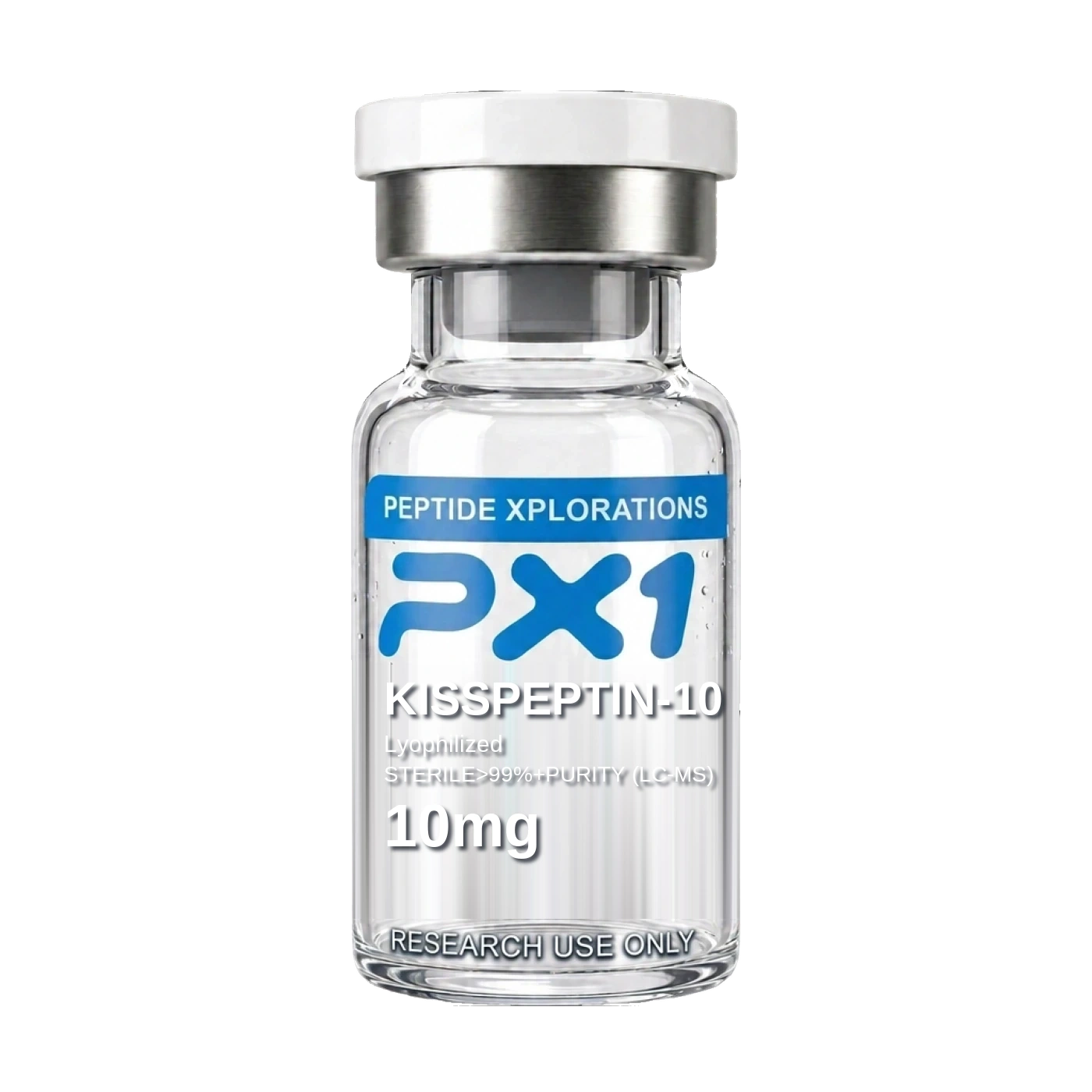
KISSPEPTIN-10
Kisspeptin-10 is a synthetic decapeptide corresponding to the conserved C-terminal fragment of the KISS1 gene-derived kisspeptin family, supplied as a lyophilized research-grade material at ≥99% HPLC purity for laborator
Disclaimer: All articles and product details provided on this website are intended for educational and informational purposes only. The products listed here are for in-vitro research only. In-vitro studies are conducted outside of living organisms. These products are not intended as medicines or drugs and have not been approved by the FDA to prevent, treat, or cure any medical condition, ailment, or disease. The direct or indirect administration of these substances to humans or animals is unequivocally prohibited under applicable law.
Kisspeptin-10 is a synthetic decapeptide corresponding to the conserved C-terminal fragment of the KISS1 gene-derived kisspeptin family, supplied as a lyophilized research-grade material at ≥99% HPLC purity for laboratory use only.
| Property | Detail |
|---|---|
| Also known as | Metastin(45-54); KP-10 |
| CAS Number | 374675-21-5 |
| Molecular Formula | C63H83N17O14 |
| Molecular Weight | 1302.47 g/mol |
| Amino Acid Count | 10 |
| Sequence | H-Tyr-Asn-Trp-Asn-Ser-Phe-Gly-Leu-Arg-Phe-NH2 |
| Purity | ≥99% by HPLC · COA available |
| Physical Form | Lyophilized powder |
What is KISSPEPTIN-10?
Kisspeptin-10 is a short synthetic peptide belonging to the kisspeptin family, a group of neuropeptides encoded by the KISS1 gene. As indicated by its name, it is a decapeptide (ten amino acid residues) representing the biologically conserved C-terminal fragment shared by the longer kisspeptin isoforms. Like other members of this family, it terminates in an amidated C-terminus, a structural feature characteristic of the RFamide peptide class to which kisspeptins belong.
Structurally, Kisspeptin-10 is produced by solid-phase peptide manufacturing and purified to a research-grade standard. It is an amphipathic peptide of modest molecular size, supplied as a lyophilized (freeze-dried) powder. Its compact ten-residue architecture makes it a well-defined, reproducible reference molecule for in-vitro and preclinical laboratory work, and its identity and purity are confirmed by chromatographic and spectrometric analysis prior to release.
In the scientific literature, kisspeptins and their C-terminal fragments are studied as endogenous ligands of the KISS1R (GPR54) receptor and are used as tool compounds in reproductive neuroendocrinology and receptor-signaling research. Kisspeptin-10 is offered here strictly as a reference material for such in-vitro and laboratory investigations. This listing makes no therapeutic, physiological, or performance claims of any kind; the peptide is intended for laboratory research use only and is not a drug, food, or cosmetic.
Reconstitution & handling
Kisspeptin-10 is supplied as a lyophilized solid and must be brought into solution before use in laboratory work. Bacteriostatic or sterile water is a common reconstitution solvent for peptides of this class; for peptides that resist dissolution, a small volume of dilute acetic acid or another appropriate co-solvent is sometimes used first to aid initial dissolution before dilution into the working buffer. Solvent should be directed against the wall of the vial and allowed to contact the powder gently rather than forcefully injected onto it, and the vial should be swirled or left to stand rather than vortexed, since aggressive agitation can promote aggregation, foaming, or shear-related degradation.
Solubility and stability of the reconstituted material depend on solvent choice, concentration, and pH, and researchers should confirm compatibility with their specific downstream assay. Once reconstituted, the peptide is generally less stable than the dry powder and is best prepared fresh or divided into single-use aliquots to avoid repeated handling. Any figures relating to concentration are experimental parameters determined by the end user's protocol; this page provides chemistry and handling context only and contains no administration or dosing guidance.
Storage & stability
In lyophilized form, Kisspeptin-10 is most stable when stored sealed, protected from light and moisture, and kept frozen; short periods at refrigerated or ambient temperature during shipping are typically tolerated, but long-term storage at -20 C or colder is preferred to preserve integrity. After reconstitution, the peptide should be held refrigerated for short-term use or frozen in single-use aliquots for longer storage, and repeated freeze-thaw cycles should be minimized because they can accelerate hydrolysis and aggregation. Labeling aliquots with preparation dates and avoiding unnecessary warming help maintain the material's analytical quality over the course of a research program.
How it's tested
Each lot of Kisspeptin-10 is characterized analytically before release. Purity is determined by reversed-phase high-performance liquid chromatography (HPLC), with this material meeting a specification of ≥99% by HPLC. Identity is confirmed by mass spectrometry (MS), which verifies that the measured mass corresponds to the expected peptide, while HPLC peak integration quantifies chromatographic purity and resolves related-substance impurities. These results are documented on a lot-specific Certificate of Analysis (COA), which is available for the product and serves as the primary record of identity, purity, and quality for laboratory reference and record-keeping.
Frequently asked questions
What is Kisspeptin-10?
It is a synthetic decapeptide from the kisspeptin (KISS1-derived) family, representing the conserved amidated C-terminal fragment of the longer kisspeptin isoforms. It is supplied as a lyophilized research-grade powder for laboratory use only.
What purity is this Kisspeptin-10 and is documentation available?
This material is tested to ≥99% purity by HPLC, and a lot-specific Certificate of Analysis (COA) is available documenting identity and purity.
How is the identity and purity of Kisspeptin-10 verified?
Purity is assessed by reversed-phase HPLC and identity is confirmed by mass spectrometry. Both are summarized on the COA supplied with the lot.
How should Kisspeptin-10 be reconstituted?
Sterile or bacteriostatic water is a common solvent for peptides of this class, added gently down the vial wall with swirling rather than vigorous agitation. Poorly soluble peptides may benefit from a small amount of a dilute co-solvent before dilution into the working buffer. Confirm compatibility with your assay.
How should Kisspeptin-10 be stored?
Store the lyophilized powder sealed, dry, and frozen (-20 C or colder) away from light for long-term stability. After reconstitution, refrigerate for short-term use or freeze in single-use aliquots and minimize freeze-thaw cycles.
What is Kisspeptin-10 used for?
It is intended strictly as a reference and tool compound for in-vitro and preclinical laboratory research, such as receptor-signaling and reproductive neuroendocrinology studies. It is for research use only and is not for human or animal use.