IPAMORELIN
Ipamorelin is a synthetic pentapeptide (Aib-His-D-2-Nal-D-Phe-Lys-NH2) supplied as a lyophilized research-grade material for in-vitro laboratory investigation only.
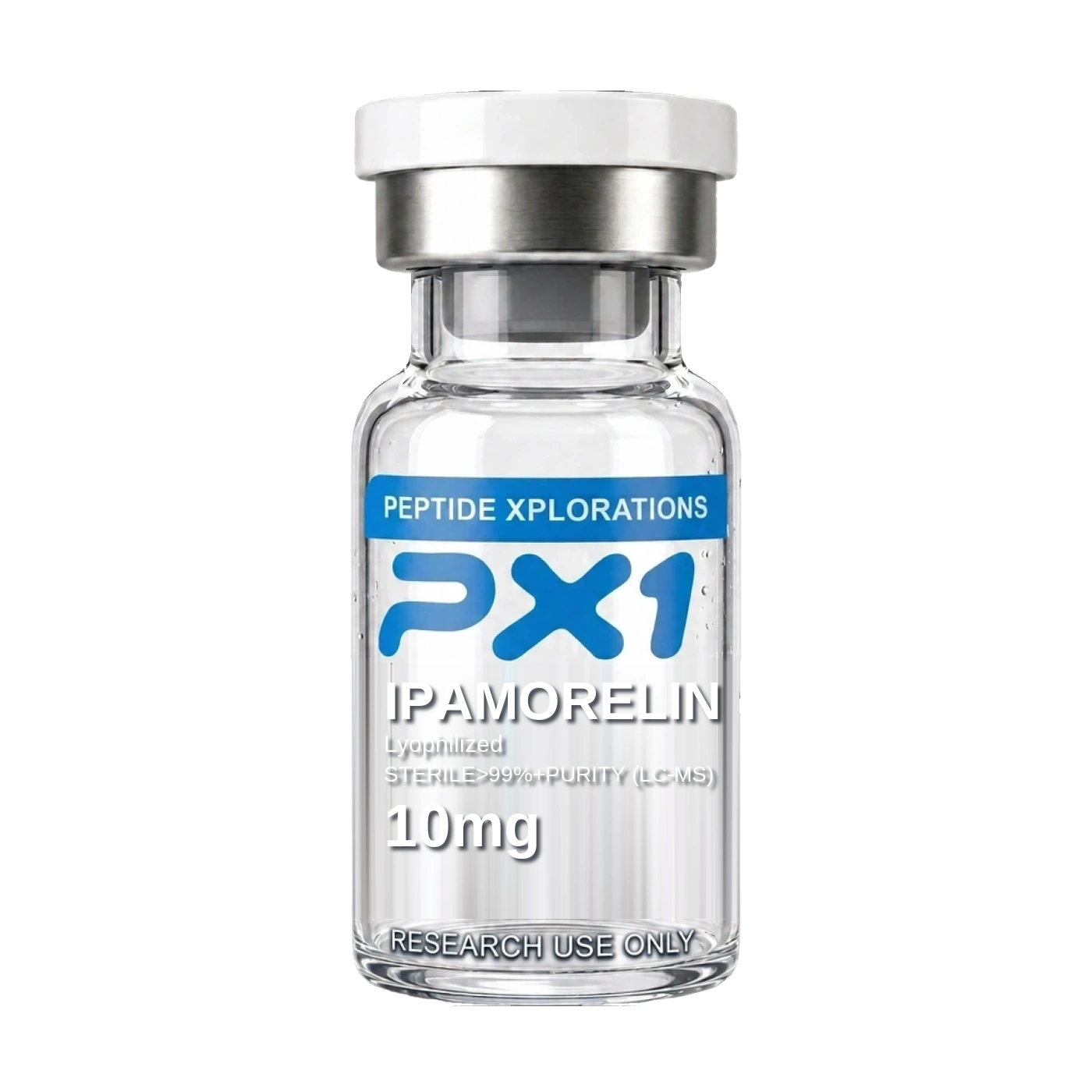
Disclaimer: All articles and product details provided on this website are intended for educational and informational purposes only. The products listed here are for in-vitro research only. In-vitro studies are conducted outside of living organisms. These products are not intended as medicines or drugs and have not been approved by the FDA to prevent, treat, or cure any medical condition, ailment, or disease. The direct or indirect administration of these substances to humans or animals is unequivocally prohibited under applicable law.
| Property | Detail |
|---|---|
| Also known as | Growth-hormone secretagogue |
| CAS Number | 170851-70-4 |
| Molecular Formula | C38H49N9O5 |
| Molecular Weight | 711.85 |
| Amino Acid Count | 5 |
| Sequence | Aib-His-D-2-Nal-D-Phe-Lys-NH2 |
| Purity | ≥99% by HPLC · COA available |
| Physical Form | Lyophilized powder |
What is IPAMORELIN?
Ipamorelin is a synthetic pentapeptide classified within the growth hormone secretagogue peptide family. It is catalogued under CAS number 170851-70-4 and carries the molecular formula C38H49N9O5 with a molecular weight of 711.85. As a short, fully synthetic sequence, it is manufactured by solid-phase peptide techniques and purified to research grade rather than isolated from biological sources.
Structurally, the molecule comprises five amino acid residues arranged in the sequence Aib-His-D-2-Nal-D-Phe-Lys-NH2. The design incorporates several non-canonical and D-configuration building blocks: aminoisobutyric acid (Aib) at the N-terminus, D-2-naphthylalanine (D-2-Nal), and D-phenylalanine (D-Phe), while the C-terminus is amidated (Lys-NH2). These modifications distinguish it from linear peptides built solely from natural L-amino acids and are characteristic of the growth hormone secretagogue receptor (GHS-R) ligand class studied in laboratory settings.
Within the scientific literature, ipamorelin is referenced as a research tool in the study of growth hormone secretagogue receptor signaling and related endocrine pathway models in vitro. PX1 Research supplies this compound strictly as a reference material for such laboratory research. It is not a drug, dietary supplement, cosmetic, or food, and it is not intended for diagnostic, therapeutic, or human or veterinary use.
Reconstitution & handling
Ipamorelin is supplied as a lyophilized (freeze-dried) powder and requires reconstitution into solution before it can be handled in laboratory work. The amidated C-terminus and predominantly hydrophilic residues make the peptide well suited to dissolution in aqueous media; bacteriostatic water or sterile water is the solvent most commonly selected for research handling, and a compatible buffer may be used where the experimental protocol calls for controlled pH. When adding solvent, direct the stream against the wall of the vial rather than onto the powder pellet, then allow the material to dissolve by gentle swirling. Vortexing, sonication, and rough agitation should be avoided, as mechanical shear and foaming can promote aggregation and degradation of a small peptide of this type.
If the peptide does not fully dissolve, brief resting at room temperature followed by additional gentle swirling generally clears residual haze. For sequences that resist aqueous dissolution, a minimal volume of a mild organic co-solvent (for example, dilute acetic acid) can be introduced first to wet the material before diluting with aqueous buffer, though ipamorelin's composition typically dissolves cleanly in aqueous media. All reconstitution should be performed under clean conditions, and the resulting solution should be visually clear and free of particulates.
Storage & stability
In its lyophilized form, ipamorelin is stable when stored sealed, protected from light and moisture, and kept desiccated; short-term storage at 2-8 degrees C is acceptable, while long-term storage at -20 degrees C or colder best preserves peptide integrity over extended periods. Once reconstituted, the peptide is far less stable and should be held refrigerated at 2-8 degrees C for near-term laboratory use and protected from repeated warming. To limit degradation from freeze-thaw cycling, reconstituted material intended for longer storage is best divided into single-use aliquots and frozen, with each aliquot thawed only once. Minimizing exposure to light, elevated temperature, and oxygen helps maintain the analytical purity of the material throughout its research lifetime.
How it's tested
Each lot of ipamorelin is characterized analytically to confirm identity and purity before release. Reversed-phase high-performance liquid chromatography (HPLC) is used to quantify chromatographic purity, which is verified at >=99% for this material, resolving the target peptide from process-related impurities. Molecular identity is confirmed by mass spectrometry (MS), which validates the observed mass against the expected molecular weight of 711.85 for the C38H49N9O5 sequence. A Certificate of Analysis (COA) documenting these results is available for the material, providing traceable, lot-specific verification of identity and purity for laboratory record-keeping and experimental reproducibility.
Frequently asked questions
What is ipamorelin?
Ipamorelin is a synthetic research-grade pentapeptide with the sequence Aib-His-D-2-Nal-D-Phe-Lys-NH2, CAS 170851-70-4, molecular formula C38H49N9O5, and molecular weight 711.85. It is classified within the growth hormone secretagogue peptide family and supplied strictly for laboratory research use only.
How many amino acids does ipamorelin contain?
Ipamorelin is a pentapeptide composed of five amino acid residues. Its sequence incorporates non-canonical and D-configuration building blocks - aminoisobutyric acid (Aib), D-2-naphthylalanine, and D-phenylalanine - with an amidated lysine at the C-terminus.
How is ipamorelin reconstituted for research?
The lyophilized powder is typically dissolved in bacteriostatic or sterile water, or a compatible buffer. Add solvent gently against the vial wall and swirl to dissolve; avoid vortexing or sonication, which can shear and aggregate the peptide. The final solution should appear clear and particulate-free.
How should ipamorelin be stored?
Store the lyophilized powder desiccated and protected from light, at 2-8 degrees C short term or -20 degrees C or colder for long-term storage. After reconstitution, keep it refrigerated at 2-8 degrees C for near-term use and aliquot before freezing to avoid repeated freeze-thaw cycles.
How is the purity and identity of ipamorelin verified?
Purity is measured by reversed-phase HPLC and confirmed at >=99%, while identity is validated by mass spectrometry against the expected molecular weight of 711.85. A lot-specific Certificate of Analysis (COA) is available documenting these analytical results.
Is ipamorelin intended for human or clinical use?
No. Ipamorelin is supplied exclusively as a reference material for in-vitro laboratory research. It is not a drug, supplement, or food and is not intended for diagnostic, therapeutic, or any human or veterinary application.