KPV
KPV is a synthetic tripeptide composed of the amino acids lysine, proline, and valine (Lys-Pro-Val), supplied as a lyophilized research-grade powder for laboratory use only.
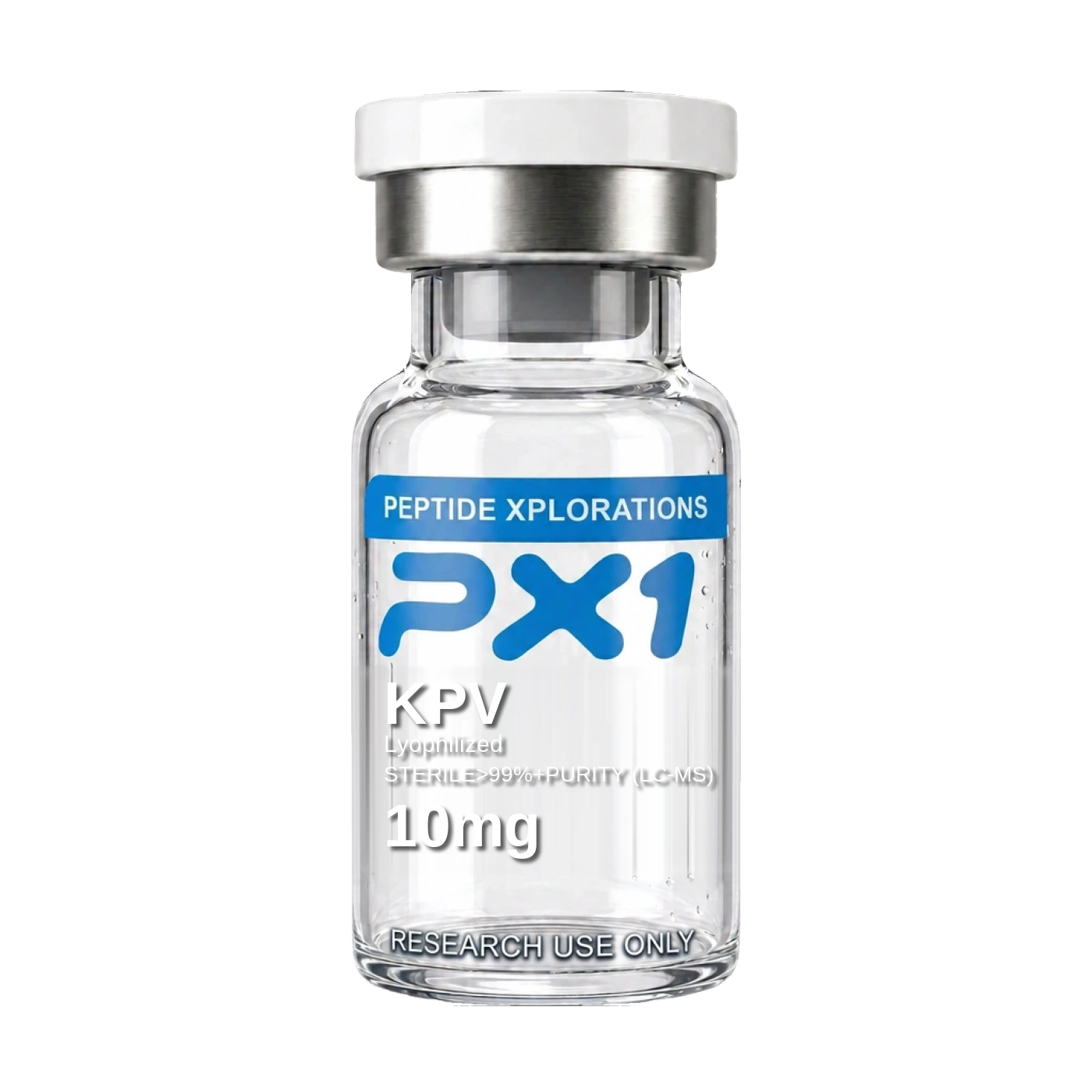
Disclaimer: All articles and product details provided on this website are intended for educational and informational purposes only. The products listed here are for in-vitro research only. In-vitro studies are conducted outside of living organisms. These products are not intended as medicines or drugs and have not been approved by the FDA to prevent, treat, or cure any medical condition, ailment, or disease. The direct or indirect administration of these substances to humans or animals is unequivocally prohibited under applicable law.
| Property | Detail |
|---|---|
| Also known as | α-MSH(11-13); Lys-Pro-Val |
| CAS Number | 67727-97-3 |
| Molecular Formula | C16H30N4O4 |
| Molecular Weight | 342.43 |
| Amino Acid Count | 3 |
| Sequence | Lys-Pro-Val |
| Purity | ≥99% by HPLC · COA available |
| Physical Form | Lyophilized powder |
What is KPV?
KPV is a short synthetic peptide belonging to the tripeptide class, formally designated by its amino acid sequence Lys-Pro-Val. It carries CAS registry number 67727-97-3, a molecular formula of C16H30N4O4, and a molecular weight of 342.43 g/mol. The molecule comprises three amino acid residues joined by peptide bonds, making it one of the smallest, most structurally defined peptides available for laboratory investigation.
Structurally, the sequence pairs a basic residue (lysine) at the N-terminus with a conformationally constrained proline in the central position and a hydrophobic valine at the C-terminus. This lysine-proline-valine arrangement corresponds to the C-terminal tripeptide fragment of the alpha-melanocyte-stimulating hormone (alpha-MSH) family of peptides, and KPV is commonly studied as a minimal peptide motif derived from that parent sequence.
In the research setting, KPV is used as a reference material in in-vitro and preclinical peptide chemistry and cell-signaling studies, where its well-characterized short sequence makes it a convenient model compound for structure-activity investigations. This listing and its molecular description are provided strictly for laboratory research use only. Nothing here characterizes physiological effects, outcomes, or suitability for use in humans or animals.
Reconstitution & handling
As a lyophilized (freeze-dried) solid, KPV is typically reconstituted immediately before use by adding a suitable sterile solvent to the vial. Bacteriostatic or sterile water is the most common vehicle for this tripeptide; the peptide's basic lysine residue generally supports aqueous solubility, though laboratories often introduce solvent slowly down the vial wall and allow the powder to dissolve by gentle swirling rather than vigorous vortexing or shaking, which can promote foaming and localized aggregation. For sequences that resist full dissolution, a small volume of dilute acetic acid or another mild co-solvent may be used before diluting to working concentration with aqueous buffer.
Reconstituted solutions should be prepared with analytical-grade solvents and handled aseptically to limit hydrolysis and microbial contamination. Because the molecular weight (342.43 g/mol) is fixed, molar concentrations of a prepared solution can be calculated directly from the mass of solid dissolved and the final solvent volume. This information addresses solution chemistry and handling only and is not guidance for administration.
Storage & stability
In its lyophilized form, KPV is most stable when stored sealed, protected from light and moisture, at or below -20 C, under which conditions the dry powder retains integrity over extended periods. Brief excursions to refrigerated (2-8 C) or ambient temperatures during weighing and shipping are generally tolerated by the dry solid, but repeated warming should be minimized. Once reconstituted, the peptide is less stable and is best kept refrigerated at 2-8 C for short-term use or aliquoted and frozen for longer storage; repeated freeze-thaw cycles should be avoided, as they promote aggregation and hydrolytic degradation of the peptide bonds.
How it's tested
Identity and purity of KPV are verified analytically before release. Reversed-phase high-performance liquid chromatography (HPLC) establishes chromatographic purity, with material specified at greater than or equal to 99% by HPLC. Mass spectrometry (MS) confirms identity by matching the observed mass to the expected molecular weight of 342.43 g/mol for the Lys-Pro-Val sequence. Each lot is accompanied by a Certificate of Analysis (COA) documenting the purity result and analytical findings, allowing researchers to confirm the specification of the specific batch received.
Frequently asked questions
What is KPV?
KPV is a synthetic tripeptide with the amino acid sequence Lys-Pro-Val (lysine-proline-valine). It has CAS number 67727-97-3, molecular formula C16H30N4O4, and a molecular weight of 342.43 g/mol. It is supplied as a lyophilized powder for laboratory research use only.
What is the amino acid sequence and size of KPV?
KPV consists of three amino acid residues in the sequence Lys-Pro-Val: a basic lysine at the N-terminus, a proline in the central position, and a hydrophobic valine at the C-terminus. It corresponds to the C-terminal tripeptide motif of the alpha-MSH peptide family.
How is KPV reconstituted?
The lyophilized powder is dissolved immediately before use in a sterile solvent, most commonly bacteriostatic or sterile water, added gently to the vial and allowed to dissolve by swirling rather than vigorous agitation. A mild co-solvent such as dilute acetic acid may assist dissolution when needed.
How should KPV be stored?
Store the lyophilized powder sealed at or below -20 C, protected from light and moisture. After reconstitution, keep refrigerated at 2-8 C for short-term use or aliquot and freeze for longer storage, avoiding repeated freeze-thaw cycles.
How is the purity of KPV verified?
Purity is determined by reversed-phase HPLC, with material specified at greater than or equal to 99%. Identity is confirmed by mass spectrometry against the expected 342.43 g/mol mass, and each lot ships with a Certificate of Analysis (COA).
Is KPV intended for research use?
Yes. KPV is offered strictly as a research-grade chemical for in-vitro and laboratory investigation only. It is not a drug, supplement, or product intended for human or veterinary use.